
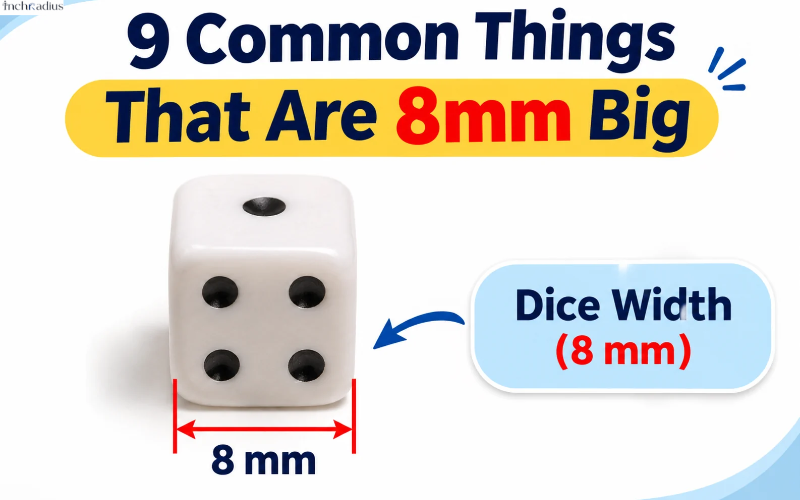
8 millimetres (8mm) is a small measurement, but it is easier to picture when compared with familiar objects. It is equal to 0.8 centimetres, approximately 0.315 inches, or 0.008 metres. That is slightly less than one-third of an inch. You might come across this size when looking at small nuts, drill bits, jewellery beads, buttons or other household items.
Although 8mm is too small to measure comfortably with your hand, several everyday objects can help you visualise it. Looking at their width, diameter or thickness gives you a useful reference without needing to carry a ruler everywhere.
How Long Is 8 Millimetres?
8 millimetres is a short distance, measuring less than one centimetre. To put it into perspective, you would need just 10 millimetres to make one centimetre, so 8mm covers most of that distance.
Here are the exact conversions:
- 8mm = 0.8 centimetres
- 8mm = 0.31496 inches
- 8mm = 0.02625 feet
- 8mm = 0.008 metres
On a standard metric ruler, 8mm is the eighth small marking after zero and sits just before the 1cm mark. This makes it fairly easy to identify when you have a ruler nearby.
In everyday life, this measurement often appears in the diameter of small craft beads, the width of certain metal fittings and the thickness of small components. It is also a useful size to recognise when choosing screws, drill bits and other hardware.
The important thing is to look at which part of an object measures 8mm. Its width might be 8mm even if its overall length is much greater.
Related Post: 11 Common Things That Are 7mm Big
How Big Is 8mm?
Imagine looking at a standard centimetre on a ruler. Now picture a distance that covers eight-tenths of that centimetre. That is exactly how big 8mm is.
It is smaller than the width of most adult fingernails and noticeably shorter than the length of a grain of rice. However, it is not so tiny that you cannot see it clearly.
A small bead measuring 8mm across is a particularly useful visual reference. You can hold it between your fingertips and see how much space it takes up. A small shirt button or a metal nut can also help you picture the measurement.
Another way to visualise 8mm is to look at the space between two nearby markings on a metric ruler. The distance from the 2mm mark to the 10mm mark is 8mm.
Remember that an object’s length, width and diameter are different measurements. An item can be 8mm wide without being 8mm long. This distinction matters when comparing real objects with a specific measurement.
9 Common Things That Are 8mm Big
Small objects can provide surprisingly useful references for understanding 8mm. Some are made to this measurement, while others have dimensions that come close.
The following nine examples come from different areas, including jewellery, DIY tools, clothing and household accessories. Some have an 8mm nominal measurement, while others are approximate comparisons.
| Everyday Item | Actual Size |
| Small Wooden Craft Bead | 8mm |
| M5 Hex Nut Width | 8mm |
| Small Pearl Jewellery Bead | 8mm |
| 8mm Drill Bit Diameter | 8mm |
| Small Shirt Button | 8mm |
| 8mm Socket Opening | 8mm |
| Metal Craft Eyelet Opening | 8mm |
| Small Watch Crown | 8mm |
| USB-C Connector Width | 8mm |
1. Small Wooden Craft Bead
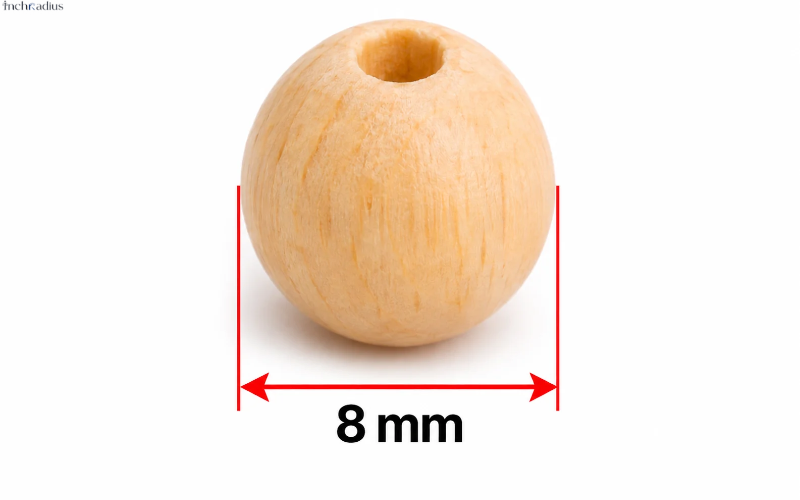
A small wooden craft bead measuring 8mm in diameter is one of the easiest objects to use as a reference. These beads are commonly used in jewellery making, children’s crafts, decorative projects and handmade accessories.
The bead is round, so its diameter from one side to the other measures 8mm. You can hold it between your thumb and index finger to get a better sense of its size. It is roughly the width of a small pea, although peas vary considerably in size.
Wooden beads are sold in different diameters, including 4mm, 6mm, 8mm and 10mm. An 8mm bead sits between the smaller and larger options.
If you have a packet of craft beads at home, check the packaging for the stated diameter. It can give you a convenient reference when trying to estimate how big 8mm looks without using a measuring tool.
Related Post: 10 Common Things That Are 6mm Big
2. M5 Hex Nut Width
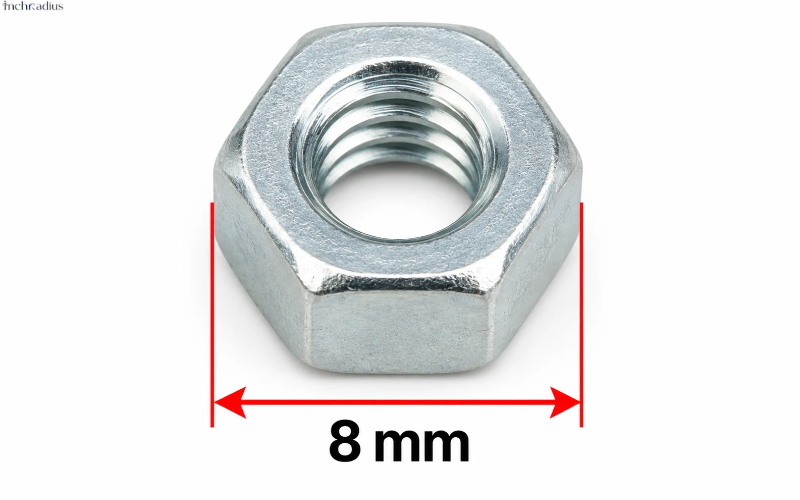
A standard M5 hex nut provides an interesting comparison because its width across the flat sides is approximately 8mm. This is a common hardware component used with matching bolts and threaded rods.
The letter M refers to the metric thread system, while the number 5 indicates the nominal thread diameter of 5mm. The 8mm measurement refers to the distance across opposite flat sides of the nut, not its overall diameter from corner to corner.
You can use an M5 nut to picture 8mm by looking directly at its flat-to-flat width. Its compact shape makes the measurement easy to identify.
These nuts are found in furniture fittings, small machinery, repair kits and DIY equipment. If you have a small hardware collection, an M5 nut can be a useful physical reference for understanding this measurement.
3. Small Pearl Jewellery Bead
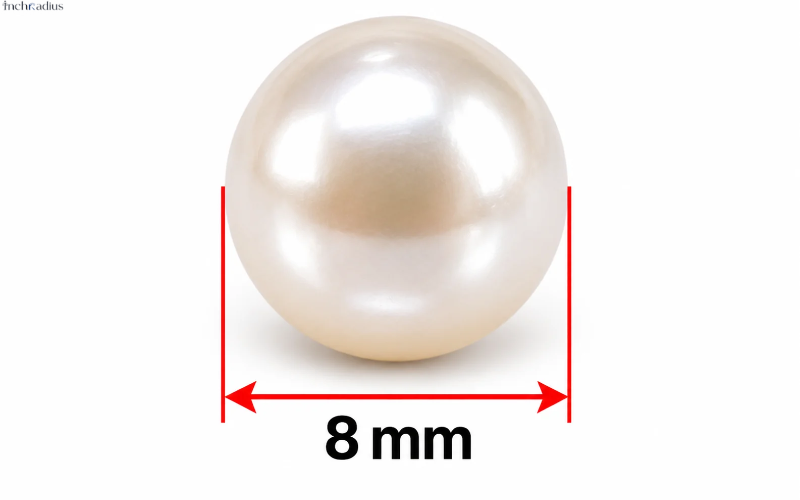
An 8mm pearl bead is another helpful way to picture this measurement. Pearl beads are commonly used in necklaces, bracelets, earrings and handmade jewellery. They are available in several sizes, with 8mm being a popular option for decorative designs.
The measurement refers to the diameter of the pearl, from one outer edge straight across to the opposite edge. This gives you a round object that is approximately 8mm wide.
A pearl bead of this size is small enough to sit comfortably between two fingertips, but it is still easy to see without magnification. It is also noticeably larger than tiny seed beads used in detailed jewellery work.
If you are shopping for pearl jewellery, you may see bead sizes listed in millimetres. Comparing an 8mm pearl with a smaller 6mm bead can help you recognise the difference between these two measurements.
4. Drill Bit Diameter
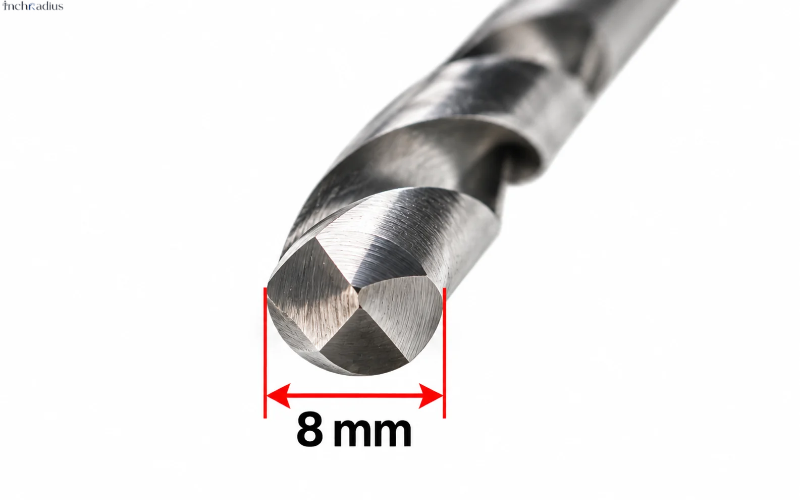
An 8mm drill bit is a practical example from the DIY world. Its cutting diameter measures 8mm, which means the hole it is designed to make is approximately 8mm wide when used correctly with suitable material and equipment.
The drill bit itself is much longer than 8mm. It is the thickness across its cutting tip that provides the measurement.
You might find this type of drill bit in a home tool kit, workshop or hardware shop. It is used for drilling holes in materials such as wood, metal or plastic, depending on the bit’s design.
To visualise the measurement, look directly at the cutting end of the drill bit. The width across its tip represents 8mm. This is especially useful because drill bits are often marked with their diameter, making them convenient references for metric measurements.
5. Small Shirt Button
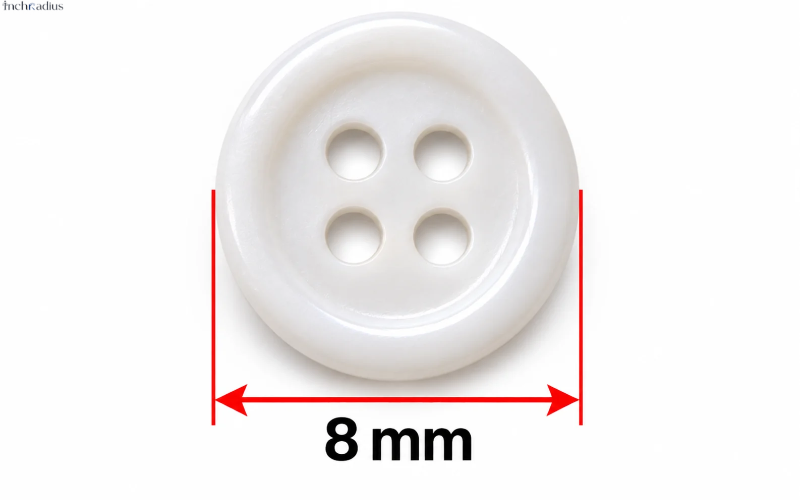
A small shirt button can also help you picture an 8mm measurement. Buttons are available in many different sizes, depending on the type of clothing and the design. Some small shirt buttons measure around 8mm across.
The measurement refers to the button’s diameter, not its thickness. If you place the button flat on a table and measure from one outer edge to the other, you can see how much space 8mm takes up.
These smaller buttons are often used on shirts, lightweight blouses, children’s clothing and decorative garments. Larger buttons are more common on coats and jackets because they are easier to grip.
Keep in mind that not every shirt button is 8mm. Some are smaller, while others are considerably wider. A button sold with an 8mm diameter specification is a useful reference, but an ordinary button should be treated as an approximate comparison.
Related Post: 9 Common Things That Are 5mm Big
6. Socket Opening
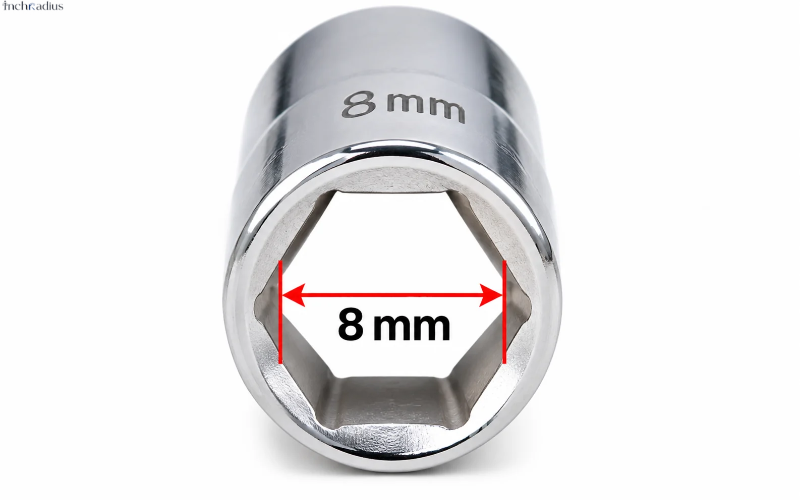
An 8mm socket is a small attachment used with a ratchet or socket wrench. It is designed to fit hexagonal fasteners with an 8mm width across their flat sides.
The 8mm measurement refers to the size of the socket opening, rather than the length of the entire tool. The socket itself is longer and has a hollow section that fits over the nut or bolt head.
You may find this tool in bicycle repair kits, car maintenance sets and general household toolboxes. It is particularly useful for working with small metric fasteners.
Looking into the opening gives you an idea of how much space 8mm covers. Although the socket has a different shape from a round bead, its internal width provides a practical comparison.
It is also worth remembering that an 8mm socket and an 8mm drill bit measure different parts of their respective tools.
7. Metal Craft Eyelet Opening
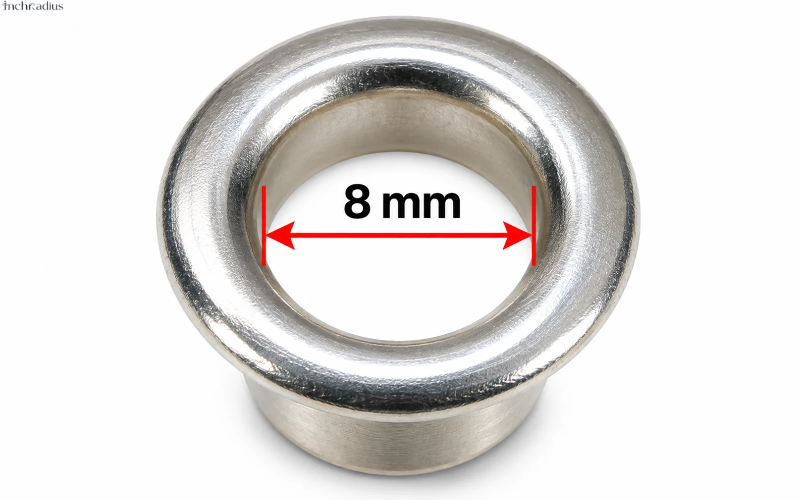
Metal eyelets are small rings fitted into materials to create reinforced openings. They are used in clothing, leather accessories, curtains, bags, banners and craft projects.
Some eyelets are made with an internal opening of approximately 8mm. This is the space in the centre of the ring, measured from one inside edge to the opposite inside edge.
The outside of the eyelet is wider because the metal ring itself adds material around the opening. For this reason, the internal diameter and external diameter should not be confused.
An eyelet with an 8mm opening provides a useful visual comparison because the circular gap makes the measurement easy to understand. You can look through the centre and imagine a distance of 8mm from one side to the other.
If you are buying eyelets for a project, check whether the listed size refers to the inner opening or the outside diameter. Manufacturers do not always describe these dimensions in the same way.
Related Post: 10 Common Things That Are 4mm Long
8. Small Watch Crown
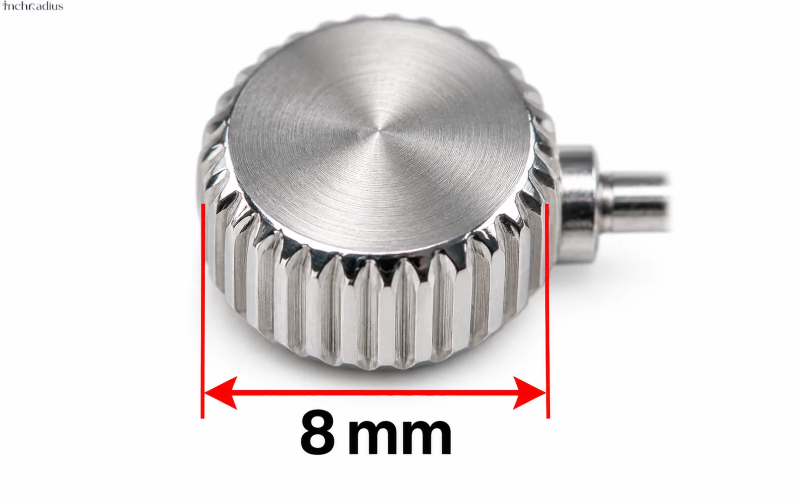
The small crown on a wristwatch is another object that can help you visualise an 8mm measurement. It is the little knob on the side of an analogue watch, usually used to adjust the time and date or wind the movement.
Some watch crowns measure close to 8mm in diameter, particularly on larger watches. Smaller watches often have narrower crowns, so the measurement varies between models.
The diameter is measured across the circular outer face of the crown. Its length, including the section that attaches to the watch case, is a separate dimension.
A crown around 8mm wide looks relatively small beside the watch case, but it is large enough to grip and turn with your fingertips. Its ridged or textured edges also make it easier to handle.
If you have an analogue wristwatch, look at the side knob. It offers a familiar household comparison, although you should not assume that every watch crown measures exactly 8mm.
9. USB-C Connector Width
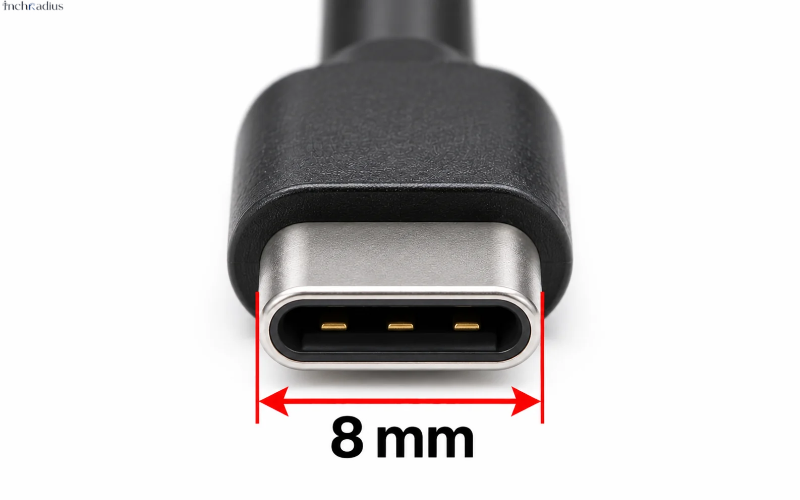
A USB-C connector is a familiar object found on modern phones, tablets, laptops and other electronic devices. Its small metal plug has a width of roughly 8.3mm, making it very close to the 8mm measurement.
The width refers to the metal connector itself, not the plastic housing or the full cable. This small difference is useful to remember because the connector is slightly wider than 8mm rather than an exact match.
You can examine a USB-C cable from the front to get a clear idea of its size. Its compact, rounded rectangular shape makes it easy to compare with a small bead or button.
USB-C connectors are designed to work in either orientation, so they can be inserted into compatible ports without checking which side faces upwards.
Although this connector is not precisely 8mm wide, it is a recognisable modern reference that helps put the measurement into perspective.
Related Post: 11 Common Things That Are 3mm Big
Measurement Without a Ruler
You do not always need a measuring tape or ruler to estimate 8mm. A few familiar objects and simple techniques can help you get close. These methods are useful for rough comparisons, although they should not replace accurate measuring when precision matters.
1. Use the 1cm Mark on a Metric Ruler
If you have a metric ruler, find the zero mark and look towards the 1cm mark. The distance between them is 10mm.
Now imagine stopping at the eighth small marking. That position represents 8mm.
You can also use the 1cm mark as a reference. An 8mm distance is just 2mm shorter than 1cm. This is probably the easiest way to estimate the measurement if a ruler is nearby.
2. Compare It With a Small Bead
An 8mm wooden craft bead or pearl bead provides a useful physical reference. Hold it between your thumb and index finger and look at its diameter.
Once you become familiar with its size, you can use it to make rough comparisons with other small objects.
For example, you could compare the width of a small button or the opening of a metal fitting with the bead.
Make sure you are comparing the same dimension. A bead’s diameter should be compared with an object’s width or diameter, not its overall length.
3. Use Your Fingertips for a Rough Estimate
Your fingertips can help you understand small measurements, although they are not accurate measuring tools.
Look at the width of your little fingernail or the space across the tip of your index finger. Both are generally wider than 8mm for many adults, but their actual sizes vary from person to person.
You can use this difference to recognise that 8mm is a relatively small distance.
Avoid treating a finger width as an exact reference. Hand proportions differ, and even two fingers on the same hand may have different widths.
Related Post: 10 Common Things That Are 1mm Big
FAQs
1. Is 8mm bigger than 1 centimetre?
No. 8mm is smaller than 1 centimetre. One centimetre contains exactly 10 millimetres, so 8mm is 2mm shorter. It represents 80% of a centimetre and can be found just before the 1cm mark on a metric ruler.
2. How many inches is 8mm?
8mm is approximately 0.315 inches. This is slightly less than one-third of an inch. For everyday comparisons, you can think of it as roughly 5/16 of an inch, which is 0.3125 inches.
3. Is 8mm the same as 0.8cm?
Yes. 8mm is exactly equal to 0.8cm. To convert millimetres into centimetres, divide the measurement by 10. Therefore, 8 divided by 10 gives 0.8 centimetres.
4. How do I measure 8mm accurately?
Use a metric ruler, digital calliper or suitable measuring tool. Place the starting edge at zero and identify the 8mm mark. For very small components, digital callipers can provide a more precise reading than an ordinary ruler.
5. Is 8mm considered a small measurement?
Yes. 8mm is less than one centimetre, making it a relatively small measurement. However, it is still visible and easy to handle in objects such as jewellery beads, small nuts and buttons.
6. What household object is close to 8mm?
A small shirt button or a USB-C connector can provide a rough comparison. Some buttons measure around 8mm in diameter, while a USB-C connector is approximately 8.3mm wide. Both help you picture the size, although neither should be treated as an exact measurement without checking.
7. How many 8mm sections make 1 metre?
There are 1,000 millimetres in one metre. Dividing 1,000 by 8 gives 125. Therefore, exactly 125 sections of 8mm fit into one metre, assuming they are placed end to end without gaps.
8. Is 8mm close to half an inch?
No. Half an inch is 12.7mm, which is considerably larger than 8mm. The difference is 4.7mm. A measurement of 8mm is closer to one-third of an inch than half an inch.
- Discover more everyday objects and their measurements in Feet
- 10 Common Things That Are 15 Feet Long
- 12 Common Things That Are 14 Feet Long
- 11 Common Things That Are 13 Feet Long
- 10 Common Things That Are 12 Feet Long
- 11 Common Things That Are 11 Feet Long
Conclusion
8mm is a small but easy-to-recognise measurement once you compare it with familiar objects. It equals 0.8cm or approximately 0.315 inches, placing it just below one-third of an inch. An 8mm wooden craft bead, an M5 hex nut and an 8mm drill bit are particularly useful references because their specified dimensions make the comparison clear.
A small shirt button and a USB-C connector can also help you picture a similar size, although their dimensions vary slightly. For the most reliable estimate, use the 8mm mark on a metric ruler and compare other objects against it. Remember that width, diameter and length describe different dimensions, even when they share the same measurement.
