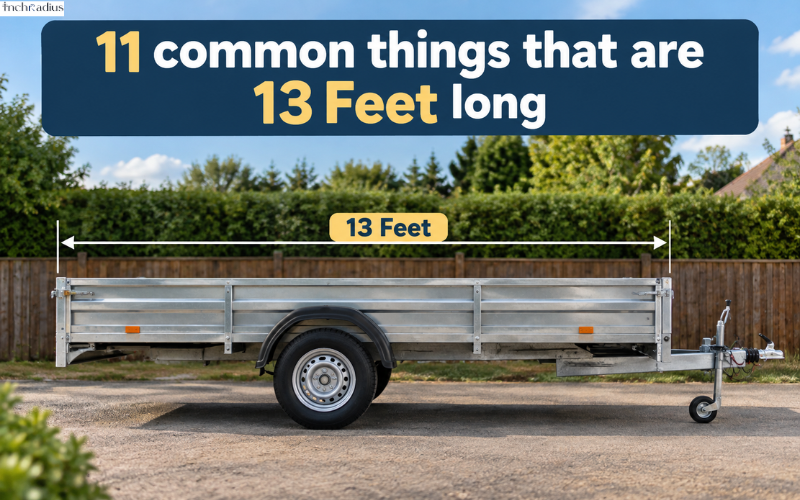
13 feet is exactly 156 inches, 396.24 centimetres, or 3,962.4 millimetres. It is a fairly long distance, roughly equal to the height of a tall room or the length of a large vehicle. Because 13 feet is longer than most everyday objects, it can be difficult to picture without a ruler or tape measure. Real-life comparisons make the size much easier to visualise.
A 13-foot length can be found in things such as a large dining table, a small boat, a long ladder, or part of a vehicle. The examples below are close to 13 feet and can help you judge the distance when you need a practical reference.
How Long Is 13 Feet?
Thirteen feet is a measurement of 156 inches. Converted into metric units, it is 396.24 centimetres, or 3.9624 metres. Rounded for everyday use, you can think of 13 feet as just under 4 metres long.
That is considerably longer than a standard doorway, which is usually around 6 to 7 feet high. It is also longer than many sofas, beds, and dining tables. A 13-foot measurement can therefore be useful when thinking about the size of a room, vehicle, boat, garden feature, or piece of equipment.
The easiest way to picture 13 feet is to imagine several familiar objects placed end to end. For example, three objects that are about 4 feet long would give you roughly 12 feet, with another foot added to reach 13 feet. This makes the measurement easier to visualise when you do not have a tape measure nearby.
How Big Is 13 Feet?
A length of 13 feet can be surprisingly large when compared with objects found inside a typical home. Imagine walking along a room from one end to the other and taking several normal-sized steps. Depending on your stride, you may need around five or six walking steps to cover 13 feet.
Another useful reference is a standard sheet of A4 paper. Its long side is about 11.7 inches, so placing roughly 13 A4 sheets end to end gives a length close to 13 feet. The comparison is not perfect, but it gives you a physical way to imagine the distance.
You can also compare 13 feet with a person’s height. Someone who is 6 feet tall would need to stand on top of another 6-foot length, with roughly 1 additional foot, to reach 13 feet. This shows why the measurement can be useful for visualising ladders, boats, vehicles, and long furniture.
11 Common Things That Are 13 Feet Long
The following objects provide practical examples of lengths around 13 feet. Some can be manufactured to exactly 13 feet, while others come in sizes that are close to this measurement. Always check the manufacturer’s specifications if an exact measurement matters.
| Everyday Item | Actual Size |
| Extension Ladder | 13 feet |
| Small Fishing Boat | 13 feet |
| Large Dining Table | 13 feet |
| Canoe | 13 feet |
| Utility Trailer | 13 feet |
| Garden Shed | 13 feet |
| Inflatable Paddle Board | 13 feet |
| Small Caravan | 13 feet |
| Curtain Rod | 13 feet |
| Timber Beam | 13 feet |
| Inflatable Water Slide | 13 feet |
Extension Ladder
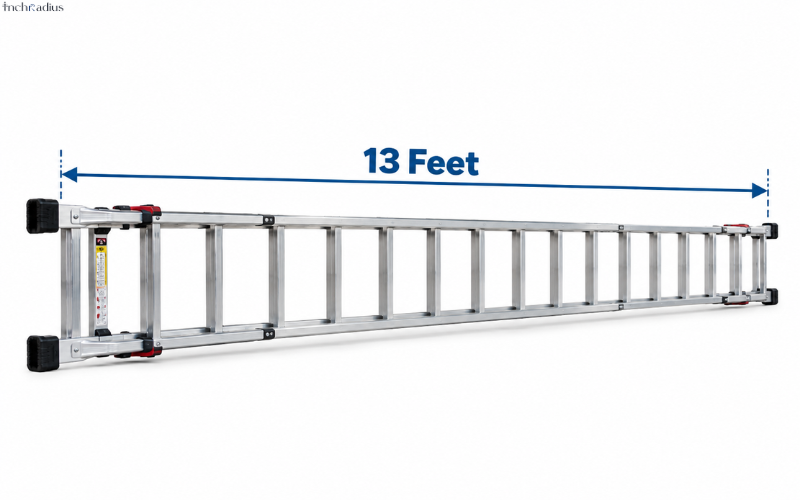
A long extension ladder is one of the easiest ways to picture 13 feet. Ladders are sold in many different lengths, and some models extend to around 13 feet or more. When fully extended, a ladder of this size is considerably taller than an average person.
If you imagine placing a 6-foot person beside a 13-foot ladder, the ladder would stand more than twice their height. That makes it a useful visual reference for the measurement.
There is an important distinction between an extension ladder’s stated length and the height it can safely reach when positioned against a wall. The ladder may be longer than the actual working height because it needs to be set at a safe angle. Even so, a 13-foot ladder gives you a clear physical sense of how long 13 feet really is.
Small Fishing Boat
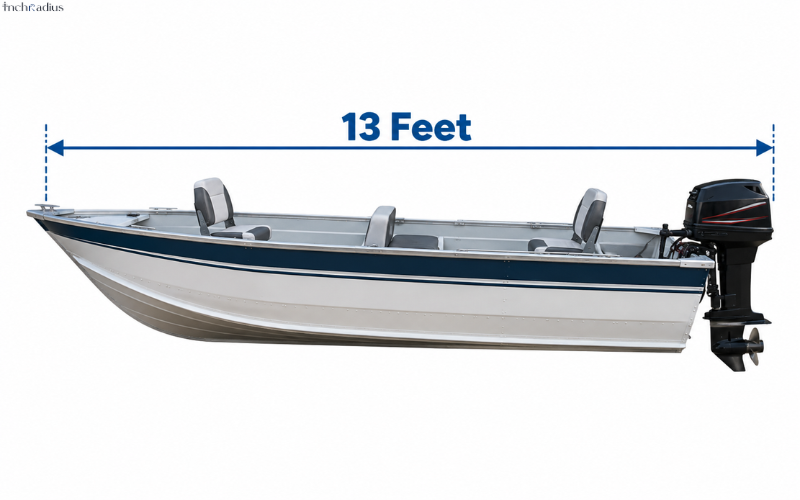
A small fishing boat can measure around 13 feet from bow to stern. Boats in this range are compact enough for lakes, rivers, and sheltered coastal waters, depending on their design and intended use.
Standing beside a 13-foot boat gives you a much better impression of the distance than simply seeing the number written down. The length is roughly equivalent to two adults lying head to toe, although individual heights vary.
Boat measurements can differ depending on the manufacturer and the style of the hull. Some 13-foot boats may have additional equipment extending beyond the main body. For visualising 13 feet, however, the hull length provides a helpful comparison. It shows that the measurement is long enough for a small recreational vessel but still modest compared with larger boats.
Large Dining Table
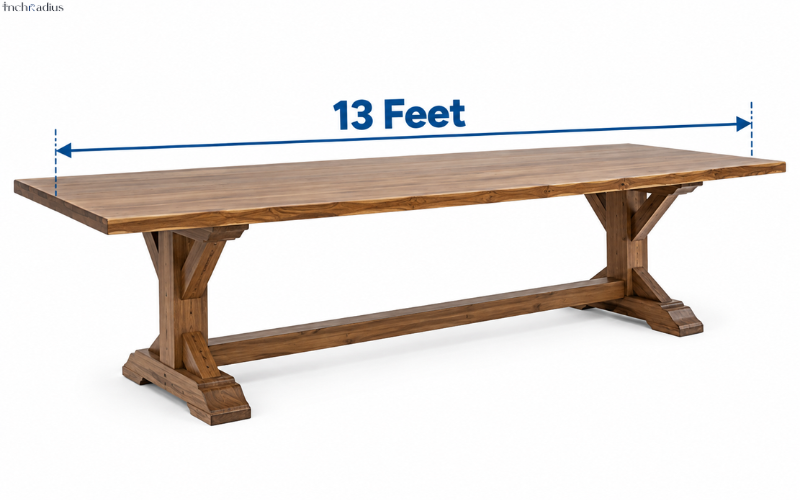
A large dining table can be close to 13 feet long, particularly one designed for a large dining room, banquet area, or event space. Most household dining tables are much shorter, so a 13-foot table would feel noticeably large in an ordinary room.
Picture a table extending across a substantial part of a dining area. A table measuring 13 feet would provide enough length for many people to sit along both sides, depending on the width and seating arrangement.
Tables are often available in custom sizes, making 13 feet a possible dimension for commercial or event furniture. For a visual comparison, imagine a typical 6-foot dining table and then add another 7 feet to it. That combined length gives you exactly 13 feet. This is a useful way to picture the measurement using familiar furniture.
Canoe
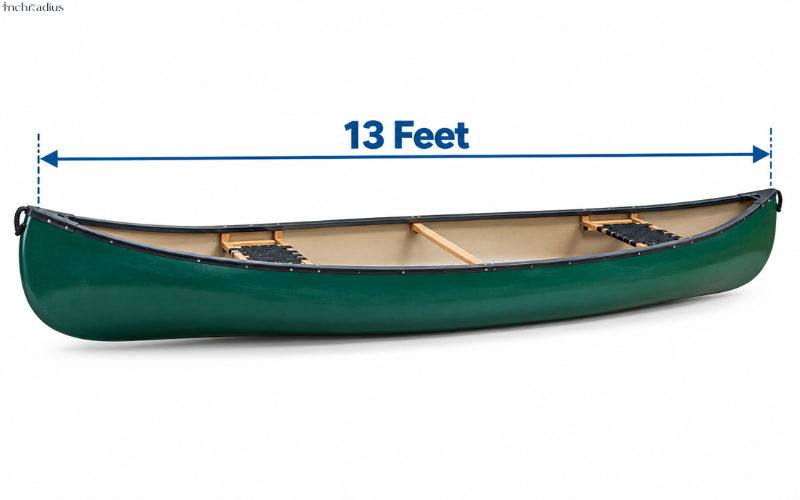
Long canoes can measure around 13 feet from one end to the other. Canoes come in many shapes and sizes, with some designed for one person and others built for several paddlers.
A 13-foot canoe is long enough to give you a strong sense of the measurement while remaining narrow compared with its length. If you stood beside one, you could see that its length is more than twice the height of a 6-foot adult.
Canoe measurements normally refer to the overall length from the bow to the stern. The exact dimensions vary between recreational, touring, and racing designs. This makes a canoe a useful 13-foot example, but it is important to check the particular model when an exact size is required.
Utility Trailer
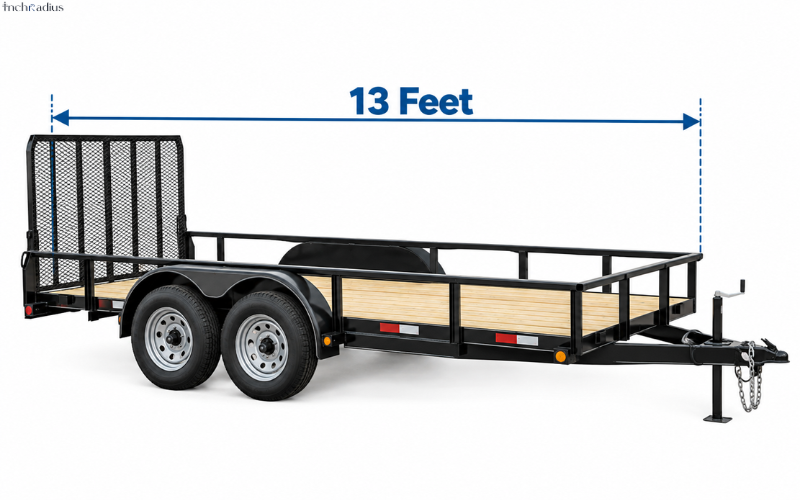
A utility trailer can have a body length close to 13 feet, although trailer sizes vary considerably. Longer trailers are commonly used to carry building materials, garden equipment, machinery, and other large loads.
A 13-foot trailer is useful for visualising the measurement because it has a long, straight floor. You can imagine measuring from the front of the trailer bed to the rear and seeing nearly 4 metres of length.
The overall trailer may be longer than 13 feet once the hitch and other components are included. For that reason, the bed length and total trailer length should not be treated as the same measurement. When using a trailer as a comparison, look at the exact specification. For general visualisation, though, a 13-foot utility trailer gives a clear idea of how much space the measurement covers.
Garden Shed
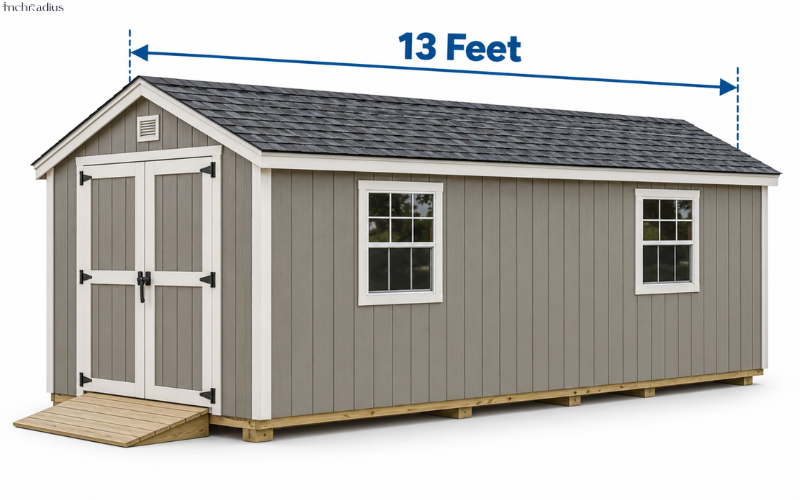
A large garden shed can have a side measuring approximately 13 feet. Sheds are available in many dimensions, from compact storage boxes to large structures used as workshops or garden rooms.
A 13-foot shed wall would stretch nearly 4 metres across your garden. That is enough length to accommodate shelving, gardening tools, bicycles, or a small work area, depending on the shed’s width and layout.
The important point is that shed dimensions are normally given as length by width, so a shed described as 13 feet long is not necessarily 13 feet wide. Some models are rectangular, while others have different shapes. As a comparison, however, standing along the long side of a 13-foot shed gives you a very practical sense of the distance.
Inflatable Paddle Board
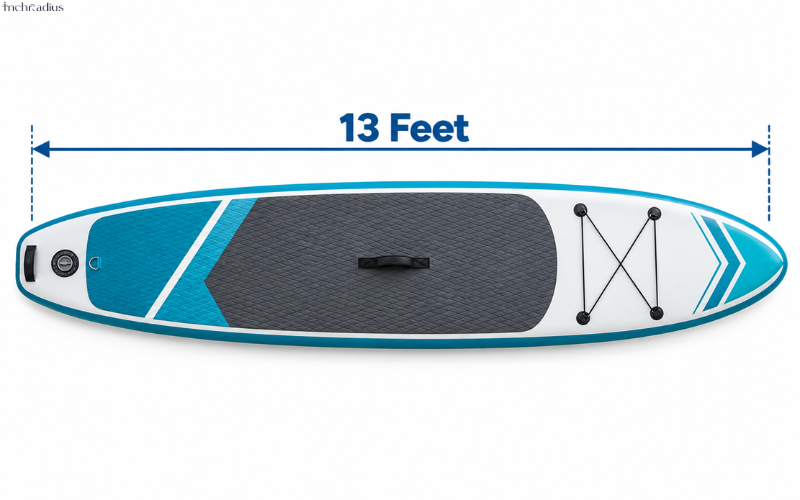
Some large inflatable paddle boards are around 13 feet long. These boards are designed to provide stability and glide for activities such as touring, recreational paddling, and longer trips on calm water.
A 13-foot paddle board is much longer than many ordinary all-round boards. Its narrow shape makes the length particularly noticeable. If you laid one flat on the ground, it would extend for almost 4 metres.
Paddle-board measurements are normally taken from nose to tail. Different designs can have slightly different dimensions, so a board advertised as 13 feet may be close to that figure rather than exactly 156 inches. It remains a useful comparison because the long, straight shape makes it easy to imagine how far 13 feet stretches.
Small Caravan
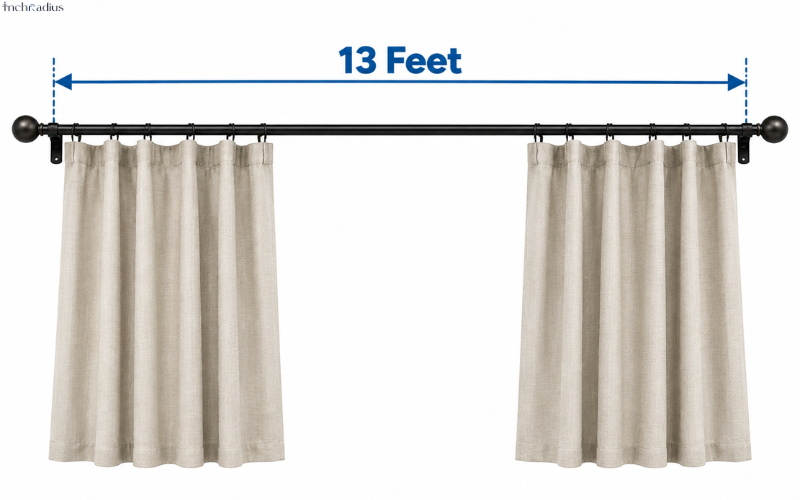
A small caravan can have an exterior length around 13 feet, although the exact size depends on the model and whether the manufacturer includes the hitch in its stated measurement.
A 13-foot caravan is roughly twice the length of a 6-foot person. It can therefore provide a strong real-world reference for the measurement. When parked, a caravan of this size takes up a noticeable amount of driveway or campsite space.
Caravan dimensions need careful interpretation because manufacturers may list body length, overall length, or living-space length separately. The tow hitch can add extra distance beyond the main body. For a simple visual comparison, imagine a compact caravan stretching almost 4 metres from front to back. That gives a much clearer picture of 13 feet than the number alone.
Curtain Rod
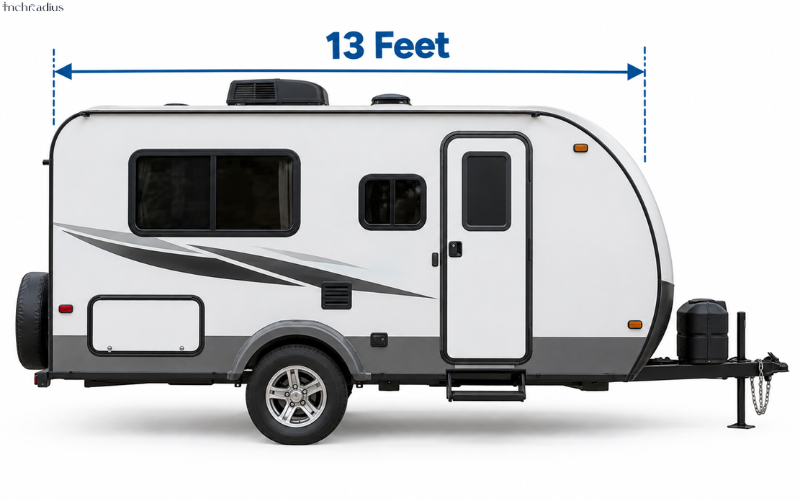
A curtain rod can be made to measure 13 feet when covering a particularly wide window, stage opening, shopfront, or large room divider. Standard household curtain rods are usually much shorter, but commercial and custom installations can require much longer lengths.
A 13-foot rod would stretch nearly 4 metres in a straight line. That makes it a useful comparison for rooms and architectural openings.
Long curtain rods may require additional supports to prevent bending or sagging. The material also affects how much weight the rod can safely carry. For visualising the measurement, the important part is its straight length. Imagine a rod extending across the width of a large opening, and 13 feet becomes much easier to picture.
Timber Beam
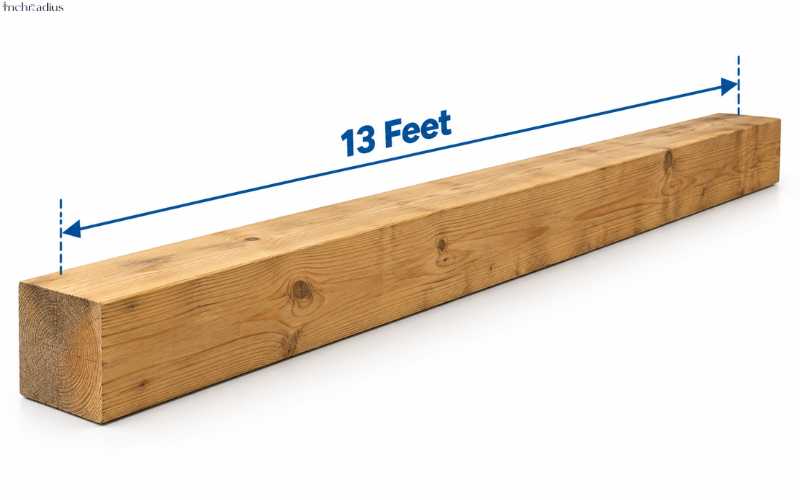
A timber beam can be supplied at 13 feet long for construction, framing, landscaping, or other building work. Timber is commonly sold in standard lengths, but exact availability depends on the type, supplier, and intended application.
A 13-foot beam is easy to visualise because it is generally long and straight. If you placed it on the ground, it would cover almost 4 metres. It would also extend well beyond the length of many standard household furniture pieces.
The beam’s length does not tell you its thickness or strength. A structural beam needs to be selected according to its dimensions, material, load requirements, and building specifications. As a simple comparison, however, a 13-foot timber beam provides a physical reference that closely matches the target distance.
Inflatable Water Slide
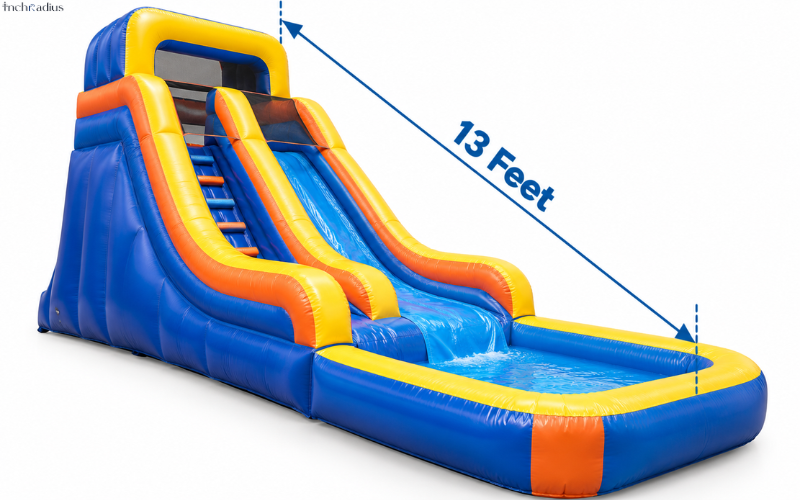
A large inflatable water slide can reach around 13 feet in length, although many products are considerably longer or shorter. Smaller home-use slides may have dimensions near this range, depending on their design.
Unlike a straight object such as a beam or rod, an inflatable slide may curve, rise, or include several sections. Its advertised length therefore needs to be checked carefully to understand what dimension the manufacturer is measuring.
If the slide is 13 feet long when laid out according to its stated dimensions, that is nearly 4 metres of space. Imagine stretching a 13-foot tape measure along the ground and then placing the slide over that distance. This gives a practical sense of its footprint without relying on its height or width.
Measurement Without a Ruler
You can estimate 13 feet without carrying a ruler, although these methods will only give you an approximation.
Use walking steps: An average adult walking stride is often somewhere around 2 to 3 feet, depending on height and pace. Taking about five or six ordinary steps can therefore bring you close to 13 feet. For better accuracy, first measure your own normal stride when you have access to a tape measure.
Use a 4-foot reference: A common object or piece of equipment that is close to 4 feet long can be used as a rough unit. Three 4-foot lengths give 12 feet, and adding another foot gets you to 13 feet. This is useful for estimating the length of a room, garden area, or large object.
Use your hand span repeatedly: An adult hand span can be roughly 8 inches from the tip of the thumb to the tip of the little finger when fully stretched, although this varies significantly. Since 13 feet equals 156 inches, around 19–20 hand spans could give a rough estimate. This method is much less precise than using a tape measure, so it should only be used when accuracy is not critical.
Related Post: 10 Common Things That Are 12 Feet Long
FAQs
Is 13 feet the same as 4 metres?
Not exactly. Thirteen feet equals 3.9624 metres, which is about 3.96 metres when rounded to two decimal places. It is therefore just under 4 metres. For rough everyday estimates, you can think of 13 feet as approximately 4 metres, but the exact conversion is 3.9624 metres.
How many inches are in 13 feet?
There are 156 inches in 13 feet. This is calculated by multiplying 13 by 12 because every foot contains 12 inches. So, 13 × 12 = 156. If you are measuring a long object in inches, 156 inches represents exactly the same length as 13 feet.
How many centimetres is 13 feet?
Thirteen feet equals 396.24 centimetres. The conversion comes from multiplying 13 feet by 30.48 centimetres, which is the exact number of centimetres in one foot. For everyday measuring, you can round 396.24 centimetres to about 396 centimetres.
Is 13 feet long for a room?
It depends on the room’s purpose and layout. A room that is 13 feet long would be a moderate dimension for many residential spaces. For example, a bedroom, dining room, or small living room could have a 13-foot wall. The perceived size would depend heavily on the room’s width, ceiling height, furniture, and arrangement.
How can I picture 13 feet?
Think of 13 feet as just under 4 metres. You could imagine a 13-foot extension ladder, a small boat, or a long timber beam. Another simple mental picture is a 6-foot person followed by another 6 feet, plus 1 additional foot. These comparisons help turn the numerical measurement into a physical distance.
Is a 13-foot boat considered small?
A 13-foot boat is generally on the smaller side compared with many recreational boats, although the classification depends on the type of boat. Small fishing boats, canoes, and other recreational craft can be around this length. Capacity, hull design, motor size, and intended use matter as much as length when describing a boat.
Can I measure 13 feet using footsteps?
Yes, but footsteps provide only a rough estimate. The number of steps needed depends on your stride length. A person’s normal walking stride can vary with height and walking style. For a closer estimate, determine your average stride first and then use it repeatedly over the distance. A tape measure is preferable when precision is important.
What is 13 feet in millimetres?
Thirteen feet equals 3,962.4 millimetres. One foot contains 304.8 millimetres, so multiplying 304.8 by 13 gives 3,962.4 millimetres. This is the exact metric conversion. For practical work, the required level of precision will depend on what you are measuring and how accurately the final dimension needs to be recorded.
Conclusion
13 feet is 156 inches, 396.24 centimetres, or 3,962.4 millimetres. In everyday terms, it is just under 4 metres long. A long extension ladder, small fishing boat, large dining table, or timber beam can provide a useful mental picture of the distance. If you need to estimate 13 feet without measuring equipment, several walking strides or a combination of familiar 4-foot lengths can help.
Remember that real objects vary in size, so these comparisons are visual aids rather than proof of an exact dimension. When precision matters, use a tape measure or another suitable measuring tool.