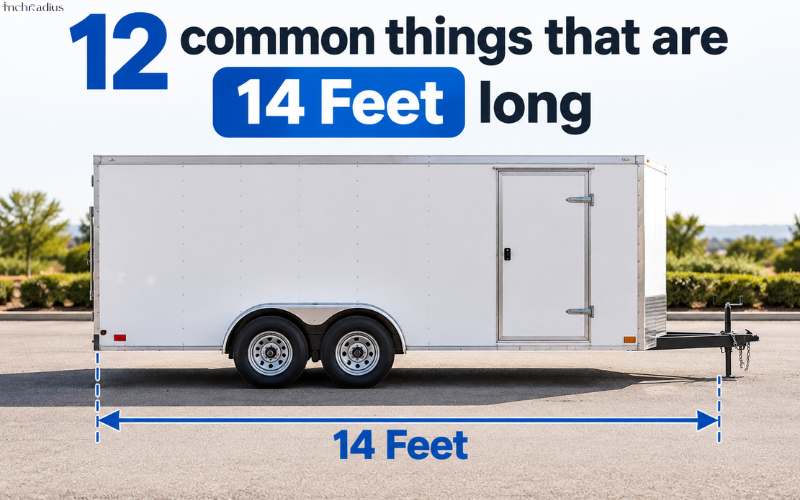
14 feet is equal to 168 inches, 426.72 centimetres, or 4,267.2 millimetres. It is a fairly long distance, roughly the length of a large family room, a medium-sized boat, or a long recreational vehicle. Seeing 14 feet as a number can be difficult, especially when you do not have a tape measure nearby.
Real-life comparisons make the distance much easier to picture. A 14-foot object would stretch across a sizeable part of a room and would be far longer than an ordinary sofa or dining table. The examples below use familiar objects and spaces that can help you develop a better sense of what 14 feet looks like.
How Long Is 14 Feet?
Fourteen feet is exactly 168 inches. Converted to metric units, it measures 426.72 centimetres, or about 4.27 metres. In millimetres, that is 4,267.2 mm.
At this size, 14 feet is long enough to span a substantial indoor space. For example, a room measuring 14 feet from one wall to another would feel noticeably larger than a compact bedroom. It is also a useful length for recreational equipment. Canoes, kayaks, ladders, trampolines and small boats can all be found around the 14-foot mark.
The important point is that a 14-foot comparison does not always mean an object is exactly 14 feet long. Many manufactured products are available in several sizes, so their dimensions can vary by model. A 14-foot canoe, for example, can be very close to the measurement, while a room may be exactly 14 feet long by design.
How Big Is 14 Feet?
A 14-foot length is about 4.27 metres, so it is considerably longer than most everyday household objects. Picture a line running from one end of a medium-sized room to the other. That gives a useful sense of scale.
You can also visualise 14 feet by placing several familiar objects end to end. A standard sheet of A4 paper is only 29.7 cm long, so more than 14 sheets would be needed to cover 14 feet. A typical adult’s hand span is much shorter, meaning many hand spans would be needed to estimate the full distance.
The measurement becomes easier to imagine with large recreational objects. A 14-foot canoe or kayak has almost the same length as the target measurement. A 14-foot trampoline also gives a useful visual reference, although its stated measurement normally refers to its diameter rather than its length.
12 Common Things That Are 14 Feet Long
The following examples are useful ways to picture 14 feet. Some are manufactured products available in a 14-foot size, while others are spaces or objects that can commonly be found around this length.
| Everyday Item | Actual Size |
| 14-foot canoe | 14 feet |
| 14-foot kayak | 14 feet |
| 14-foot fishing boat | 14 feet |
| 14-foot trampoline | 14 feet |
| 14-foot extension ladder | 14 feet |
| 14-foot utility trailer | 14 feet |
| Small room length | 14 feet |
| Long living-room wall | 14 feet |
| 14-foot paddleboard | 14 feet |
| 14-foot swimming pool | 14 feet |
| 14-foot garden fence run | 14 feet |
| 14-foot banquet table | 14 feet |
14-Foot Canoe
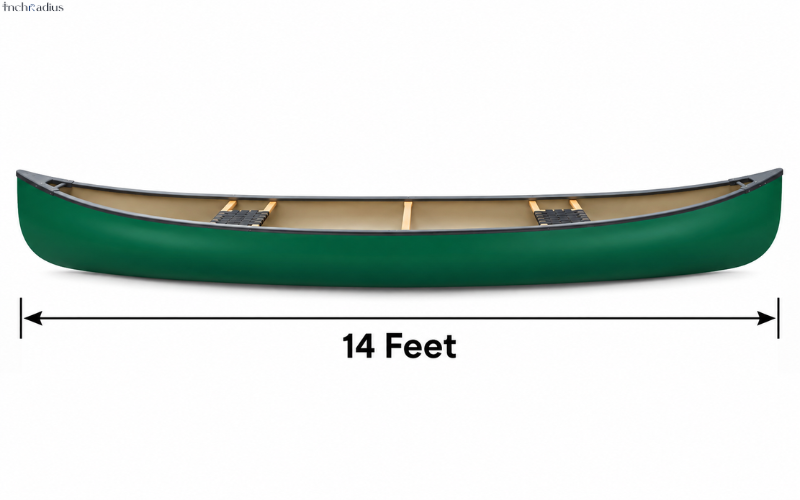
A 14-foot canoe is one of the clearest real-world examples of this measurement because canoe manufacturers commonly produce boats around this length. A canoe measuring 14 feet stretches roughly 168 inches from bow to stern.
Fourteen-foot canoes are large enough to provide useful space for paddlers and equipment while remaining manageable for recreational use. Depending on the design, they may be intended for one, two or more people.
The canoe is especially useful for visualising 14 feet because its length is easy to see as a single continuous measurement. Imagine standing at the bow and looking towards the stern. The distance between the two ends is more than four metres.
Canoe dimensions vary by model, so always check the manufacturer’s specification if you need an exact measurement. For visualising the general size, however, a 14-foot canoe is an excellent reference.
14-Foot Kayak
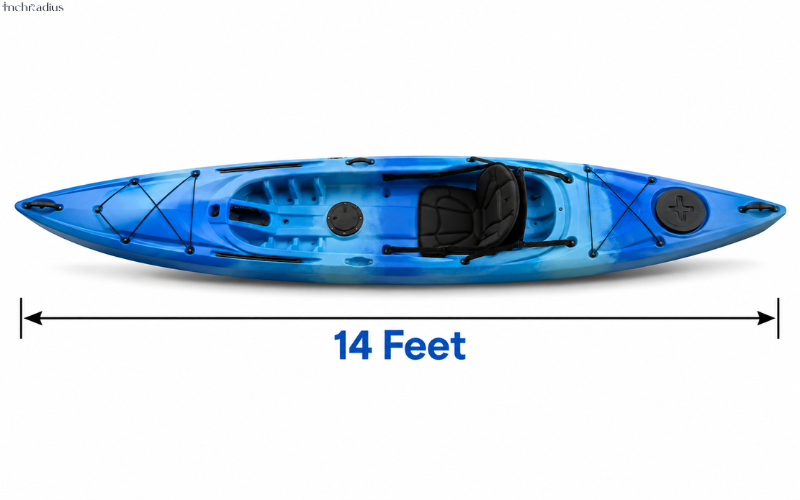
A 14-foot kayak provides another practical comparison. Touring and recreational kayaks are available in lengths around 14 feet, giving paddlers a relatively long, narrow craft for travelling across the water.
At 14 feet, the kayak is 168 inches long. Because kayaks are narrow, their length looks particularly pronounced when viewed from the side. This makes one useful for developing a sense of distance rather than simply thinking about the number 14.
A 14-foot kayak is also substantially longer than many shorter recreational kayaks. The extra length can provide room for storage and can influence how the boat behaves on the water.
Different kayak designs have different dimensions, so a kayak advertised as being in the 14-foot class may not measure exactly 14 feet. For an exact comparison, use the manufacturer’s listed overall length.
14-Foot Fishing Boat
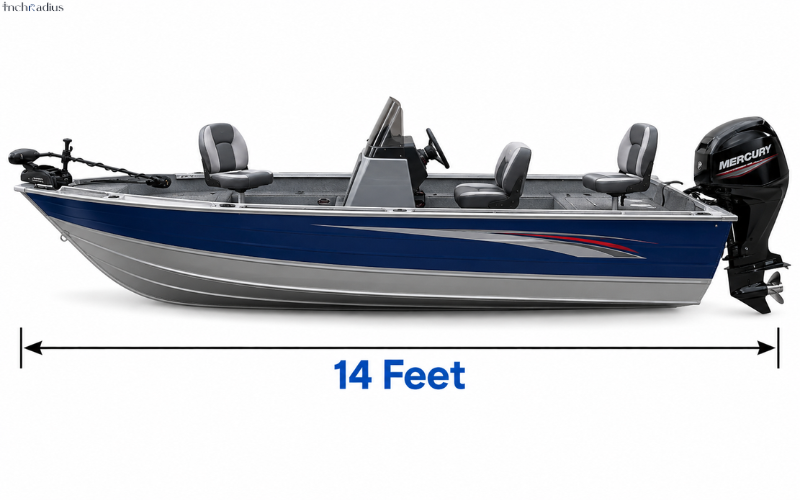
Small fishing boats can also be found at around 14 feet in length. These boats are designed to provide enough space for anglers, equipment and seating while remaining relatively compact compared with larger recreational boats.
A 14-foot fishing boat measures 168 inches from one end to the other. Standing beside one gives a much better impression of the measurement than simply reading “14 feet”.
The beam, or width, of the boat can vary considerably, so its overall appearance depends on the design. Some models are slim and lightweight, while others have a wider hull that provides more stability.
For someone trying to picture 14 feet, the important dimension is the boat’s overall length. If the manufacturer’s specification states 14 feet, the boat gives a close physical representation of the target measurement.
14-Foot Trampoline
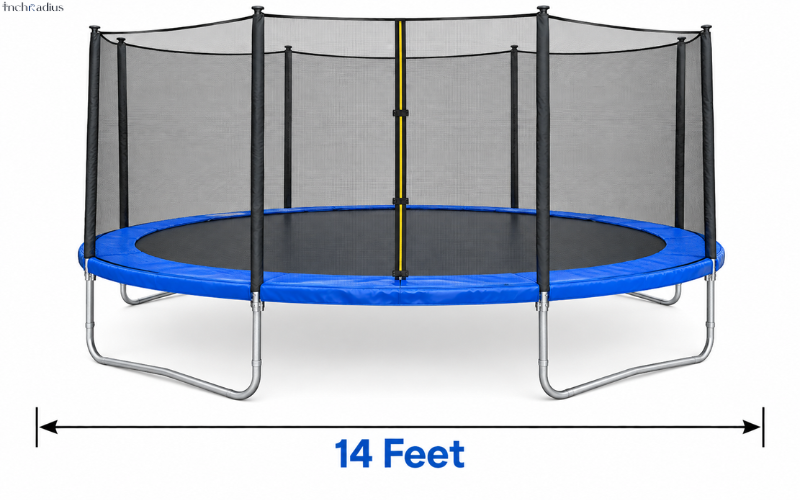
A 14-foot trampoline is a useful example, although its measurement needs a little explanation. For a round trampoline, the advertised size normally refers to its diameter, rather than the length of one side.
A 14-foot trampoline therefore measures 14 feet across its widest point. That is equivalent to 168 inches or 4.27 metres. If you stood at one edge and walked directly across the centre to the opposite edge, you would cover approximately 14 feet.
This makes a trampoline particularly helpful for visualising the size of an open area. It takes up considerably more ground space than a small children’s trampoline.
The exact outside dimensions can vary slightly depending on the frame and model. The advertised 14-foot measurement is the useful reference when estimating how much space the trampoline occupies.
14-Foot Extension Ladder
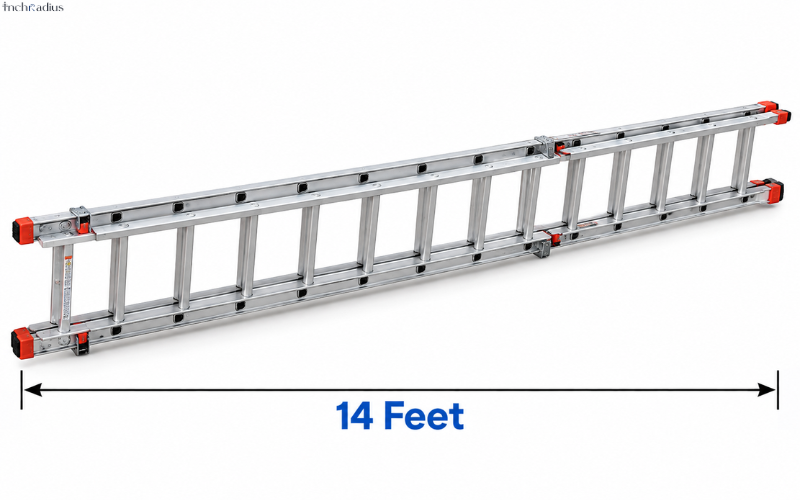
An extension ladder measuring 14 feet is another straightforward way to imagine the distance. When fully extended to its stated length, it can reach about 168 inches from one end to the other.
A ladder also makes the measurement easy to visualise because it is a long, straight object. If it were laid flat on the ground, the full ladder would occupy a little over four metres of space.
Extension ladders are sold in different sizes, and their advertised length may describe the maximum extended length rather than the length when collapsed. This distinction matters when storing or transporting one.
For comparison purposes, picture a 14-foot ladder laid along a driveway. It would stretch much farther than a typical household stepladder and would cover a substantial section of the ground.
14-Foot Utility Trailer
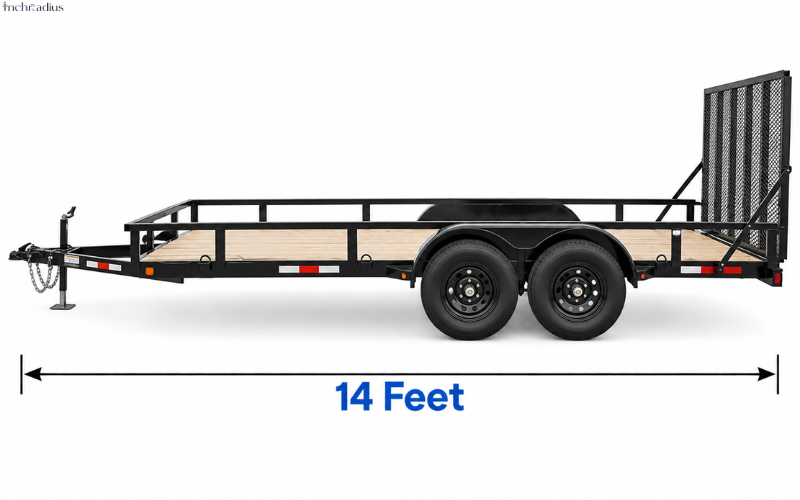
A 14-foot utility trailer can give you a useful idea of the measurement in a driveway or garage. Trailer sizes vary, but models with a 14-foot deck length are available for transporting equipment, landscaping materials and other large loads.
Fourteen feet equals 168 inches, so a 14-foot trailer bed would stretch more than four metres. The trailer’s overall length can be greater once the tongue is included.
This is an important distinction. If a trailer is described as having a 14-foot bed, that does not necessarily mean the entire trailer is exactly 14 feet long. The useful comparison is the specified deck or cargo length.
Even so, a 14-foot trailer provides a strong visual reference. Imagine the cargo floor extending from one end to another across a driveway. That distance is about the same as 14 feet.
Small Room Length
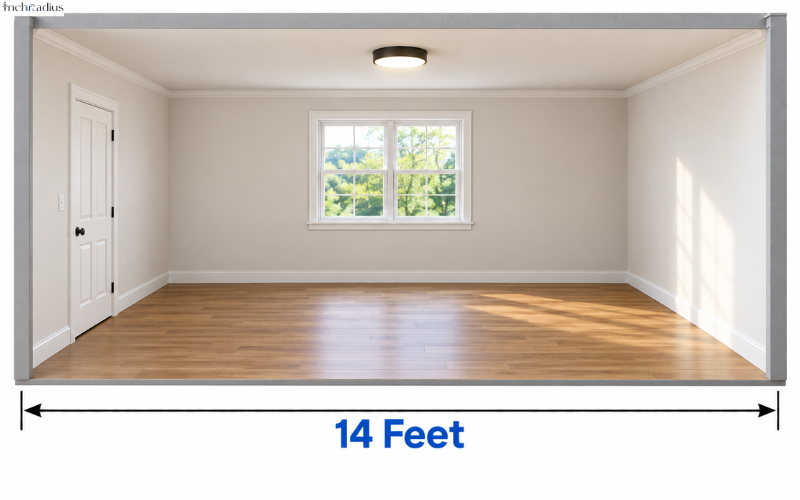
A room can easily have a wall or floor dimension of 14 feet. For example, a rectangular room may measure 14 feet from one wall to the opposite wall.
This is a helpful comparison because you can often visualise room dimensions more easily than the length of an isolated object. A 14-foot room dimension is about 4.27 metres, giving enough space for several pieces of furniture with room for movement between them.
The room does not have to be exactly 14 feet long, of course. Homes are built with many different layouts and dimensions. If you are measuring a particular room, use a tape measure rather than assuming its size from appearance.
As a mental reference, imagine walking across a room and covering just over four metres. That gives you a practical sense of how far 14 feet is.
Long Living-Room Wall
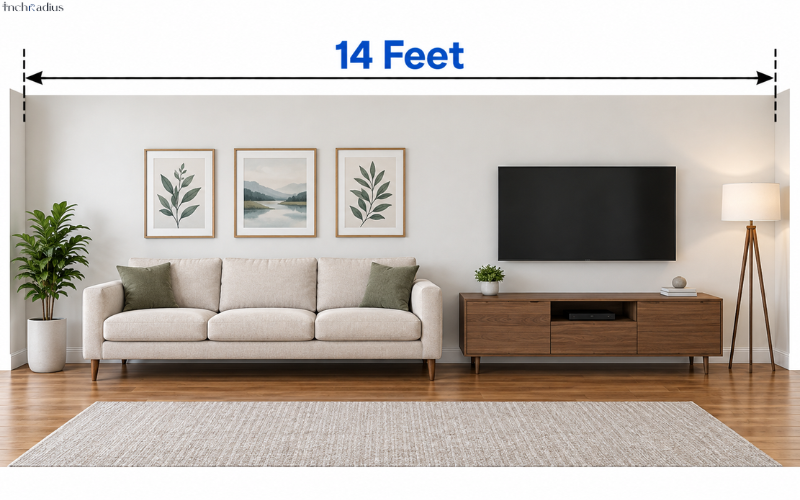
A 14-foot living-room wall can provide another familiar reference. Fourteen feet is a substantial wall length and could accommodate a sofa, television unit, shelving or other furniture, depending on the layout.
The benefit of using a wall as a comparison is that the distance is horizontal and easy to imagine. You can picture standing at one corner and looking towards the opposite end.
Furniture placed along the wall also helps break the measurement into smaller sections. Several pieces positioned next to each other could collectively occupy much of the 14-foot span.
Not every long living-room wall will measure exactly 14 feet. This example represents a room dimension that can reasonably occur in a home rather than a standard fixed product size.
14-Foot Paddleboard
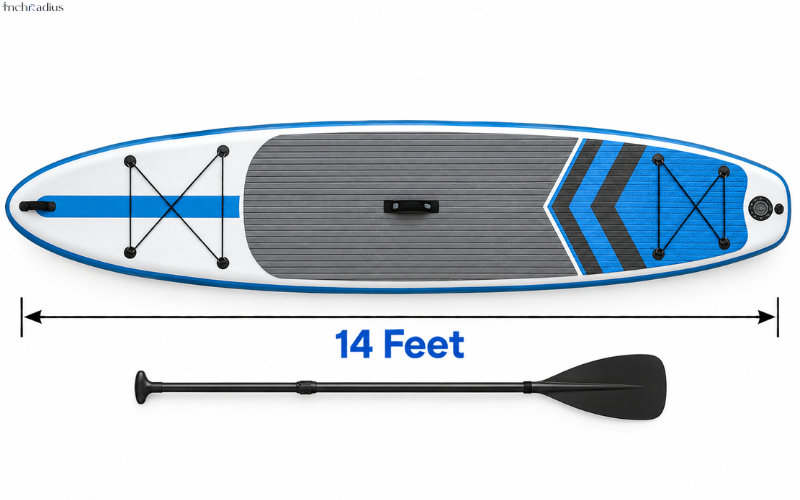
Long inflatable and touring paddleboards are available in lengths around 14 feet. These boards are designed for longer-distance paddling and are noticeably longer than many recreational boards.
A 14-foot paddleboard is 168 inches long, making it an easy object to compare directly with the target measurement. Because the board is long and narrow, its full length is immediately visible when it is placed on the ground.
Some paddleboards may be advertised as 14 feet but have small variations in their actual dimensions. Product specifications should be checked when exact measurements matter.
For a simple mental picture, imagine a long board stretching across a large section of a garden or sports hall. Its length would cover roughly 4.27 metres, giving you a strong visual impression of 14 feet.
14-Foot Swimming Pool
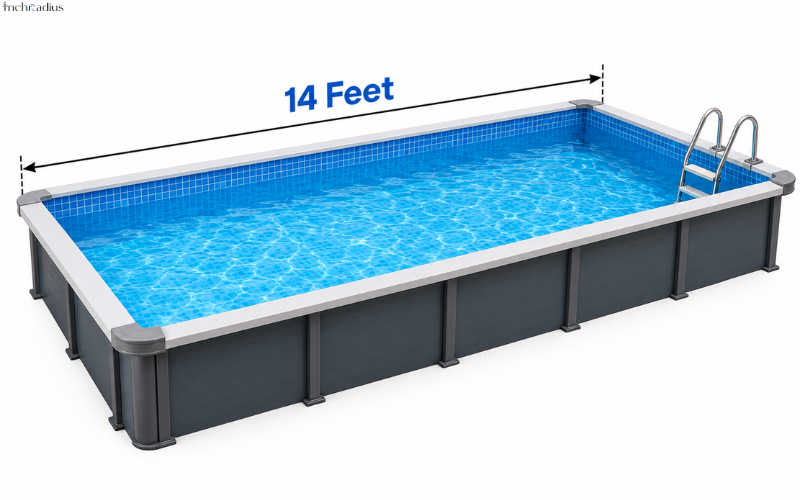
A 14-foot swimming pool is another way to visualise the measurement, particularly when considering a round above-ground pool. In this case, 14 feet usually describes the diameter across the pool.
Standing at one side of a 14-foot round pool and looking directly towards the opposite side gives you a span of 14 feet. That is 168 inches or about 4.27 metres.
The pool’s depth is a separate measurement and does not affect its diameter. Likewise, rectangular pools may be described using length and width rather than a single diameter.
Pool dimensions can differ between manufacturers, so the product specification is the best source for exact measurements. As a visual comparison, however, a 14-foot pool demonstrates just how much horizontal space 14 feet can cover.
14-Foot Garden Fence Run
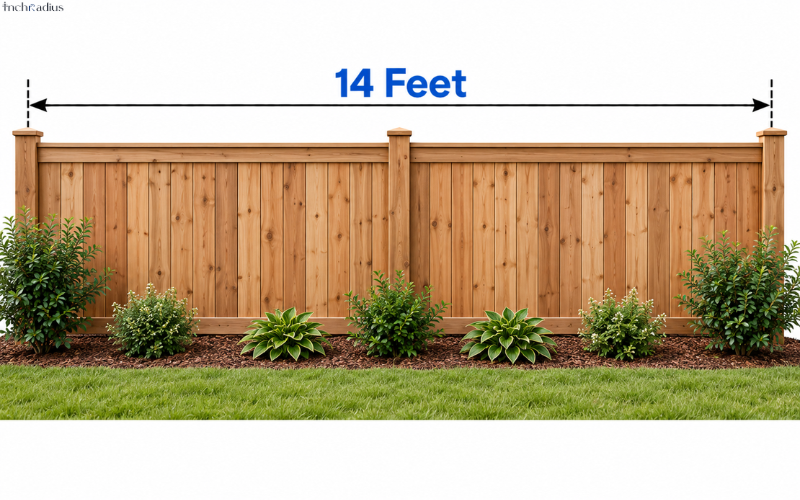
A garden fence can easily extend 14 feet along a boundary. Unlike a manufactured object with one fixed dimension, a fence run can be created to whatever length a garden requires.
Fourteen feet of fencing would cover 168 inches of horizontal distance. It is enough for several standard fence panels, depending on the width of each panel and the spacing between posts.
This comparison is useful because fences are familiar outdoor structures. If you have a garden, imagine measuring along one boundary for a little more than four metres. That distance would give you approximately 14 feet.
The actual number of fence panels needed depends on their individual width. For that reason, 14 feet should be treated as the total length of the fence run, not as the size of a standard fence panel.
14-Foot Banquet Table
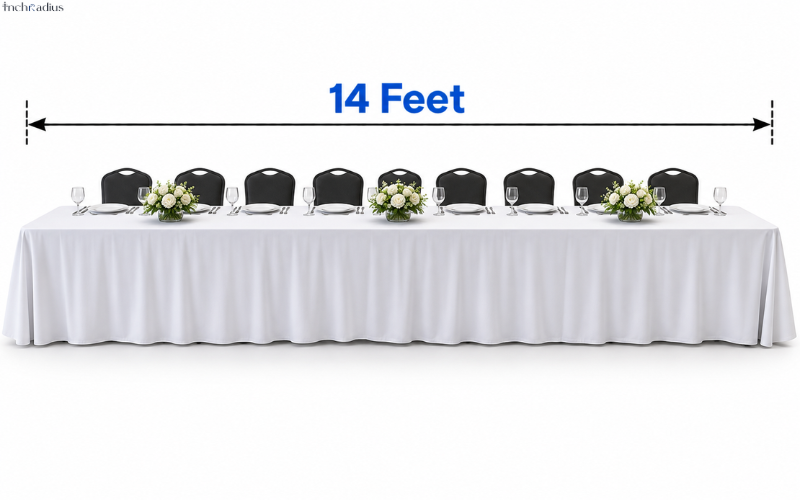
A 14-foot banquet table is a long table designed for events, meetings, dining or temporary functions. Tables of this length are less common in ordinary homes, but long event tables can be arranged or supplied in extended sizes.
Fourteen feet gives a table length of 168 inches. Viewed from one end, it would take a noticeable amount of time to walk to the other end compared with a normal dining table.
The exact construction can vary. Some banquet tables are made as a single long unit, while others are created by joining shorter tables together. If several tables are connected, the total arrangement can reach 14 feet without any individual table being that long.
This example is most useful for understanding the scale of a long, continuous surface rather than identifying a universally standard table size.
Measurement Without a Ruler
You can estimate 14 feet without a ruler, although these methods are only approximate.
Use hand spans. Measure your own hand span from the tip of your thumb to the tip of your little finger when your hand is stretched open. Many adults have a span of roughly 8 to 9 inches, but this varies considerably. You would need around 19–21 such spans to cover 14 feet. Because hand sizes differ, this method is better for estimation than exact measurement.
Use sheets of A4 paper. An A4 sheet is 29.7 cm long, or about 11.7 inches. Placing sheets end to end would require roughly 14½ sheets to cover 14 feet. This works best on a flat floor and gives a surprisingly useful visual check.
Use a familiar 14-foot object. If you have access to a 14-foot canoe, kayak, ladder or similar item, its stated length can provide a direct reference. Place it beside the area you want to estimate and compare the two distances.
Related Post: 11 Common Things That Are 13 Feet Long
FAQs
Is 14 feet the same as 4 metres?
No. Fourteen feet is approximately 4.27 metres, so it is 27 centimetres longer than 4 metres. The difference is noticeable when measuring a room, vehicle or large object. For rough mental estimates, you can think of 14 feet as a little more than four metres.
How many inches are in 14 feet?
There are 168 inches in 14 feet. The calculation is straightforward because one foot contains 12 inches. Multiplying 14 by 12 gives 168. This conversion is useful when comparing the measurement with objects whose dimensions are normally given in inches.
How many centimetres is 14 feet?
Fourteen feet equals 426.72 centimetres. For a simpler everyday figure, you can round this to about 427 cm. The exact conversion comes from multiplying 14 feet by 30.48 centimetres per foot.
How many millimetres is 14 feet?
Fourteen feet is exactly 4,267.2 millimetres. Since one centimetre contains 10 millimetres, the conversion from 426.72 cm gives 4,267.2 mm. This unit is generally more useful for technical measurements than everyday conversations about long distances.
Is a 14-foot room considered large?
A 14-foot room dimension is fairly substantial, but whether the room is large depends on its other dimensions. A room measuring 14 feet by 10 feet has a very different floor area from one measuring 14 feet by 14 feet. The 14-foot figure describes only one dimension.
What does 14 feet look like compared with a car?
A typical passenger car is considerably shorter than 14 feet, although vehicle lengths vary. A 14-foot span would be longer than many ordinary cars. A large vehicle could approach this length, but using a specific vehicle model is better if you need an exact comparison.
Can I measure 14 feet using my feet?
You can make a rough estimate by walking heel-to-toe and counting your steps, but your foot length and stride will affect the result. A person’s walking step is not the same as one foot of measurement. For an accurate 14-foot measurement, use a tape measure or another known-length reference.
What is the easiest object to use to visualise 14 feet?
A 14-foot canoe, kayak or ladder is particularly easy to visualise because it is a long, straight object with a stated length. A 14-foot trampoline or pool can also help, but their 14-foot measurement usually refers to a diameter rather than a straight length.
Conclusion
Fourteen feet is a little over 4.27 metres, or exactly 168 inches. A long canoe, touring kayak, extension ladder or paddleboard can give you a strong sense of the distance because these objects can be made close to 14 feet long. A 14-foot room dimension is another useful reference if you are thinking about indoor space.
For a quick mental picture, imagine a straight line stretching across a sizeable room for just over four metres. If you have no measuring tool, several sheets of A4 paper placed end to end can provide a rough estimate, while a known 14-foot object gives a much more direct comparison. For anything that needs precision, use a tape measure rather than relying on visual estimation.