
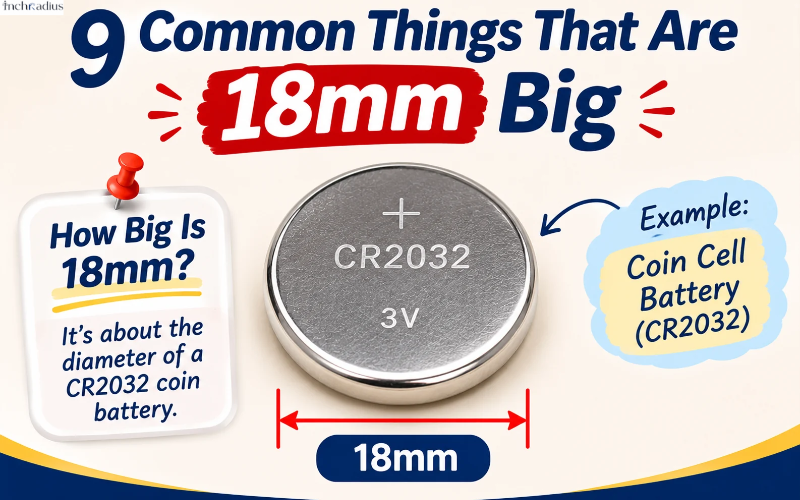
18 millimetres (mm) is a small measurement, equal to 0.71 inches or 1.8 centimetres. It is slightly less than three-quarters of an inch, so it takes up very little space on a ruler. Although 18mm may seem difficult to picture on its own, several everyday objects have a similar width, diameter or length.
A British 5p coin, for example, has a diameter of exactly 18mm. Small hardware parts, watch straps and craft supplies also provide useful comparisons. These familiar items can help you estimate 18mm when checking a small gap, choosing a replacement part, working on a craft project or measuring something without a ruler.
How Long Is 18 Millimetres?
18 millimetres is a short distance that is easy to overlook when looking at larger measurements. It is equal to 1.8 centimetres, 0.018 metres and approximately 0.7087 inches. On a standard ruler, it sits just before the 2cm mark.
There are 10 millimetres in every centimetre, so 18mm is eight small millimetre divisions beyond the 1cm line. This makes it fairly easy to locate on a metric ruler.
For a practical comparison, imagine a British 5p coin lying flat on a table. Its diameter measures exactly 18mm. This gives you a familiar reference that is close to the target measurement.
You might encounter 18mm when buying small fittings, checking the width of a watch strap, measuring craft materials or working with nuts and bolts. In these situations, even a difference of a few millimetres can affect whether two parts fit together properly.
Related Post: 11 Common Things That Are 19 Feet Long
How Big Is 18mm?
The easiest way to picture 18mm is to think of something that fits comfortably between your thumb and index finger. It is less than 2cm, which means it is much shorter than the width of most adult fingers.
Imagine a line drawn across a ruler from the 0 mark to the 18mm mark. That small distance is the size you are trying to visualise.
A British 5p coin offers an especially useful comparison because its diameter is exactly 18mm. Place one on a table and look across its widest point. You will have a clear idea of how much space 18mm covers.
It is also helpful to compare the measurement with a standard 20mm object. The difference is only 2mm, so 18mm is just slightly smaller. This is useful when estimating small household fittings, jewellery components and other objects that have similar dimensions.
9 Common Things That Are 18mm Big
Several familiar objects can help you recognise 18mm without needing to look at a ruler. Some have an exact 18mm dimension, while others are manufactured in this size or come close to it.
The following table includes objects from different categories, including money, watch accessories, tools, craft materials and household fittings.
| Everyday Item | Actual Size |
| British 5p coin (diameter) | 18mm |
| 18mm watch strap | 18mm |
| 18mm deep socket | 18mm |
| 18mm hexagonal nut | 18mm |
| 18mm wooden dowel | 18mm |
| 18mm masking tape | 18mm |
| 18mm craft bead | 18mm |
| 18mm glass cabochon | 18mm |
| 18mm tile spacer | 18mm |
Some measurements refer to a particular dimension, such as diameter or width, rather than the object’s overall length. Manufactured products can also have small variations.
1. British 5p Coin
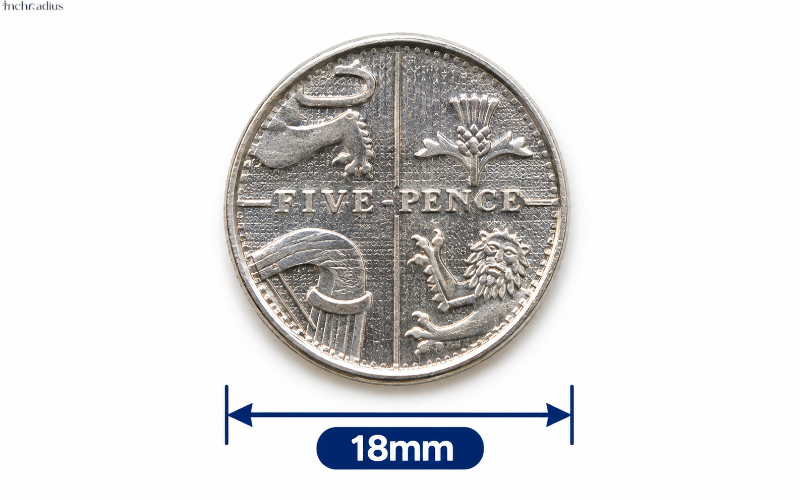
A British 5p coin is one of the easiest ways to picture 18mm. Its diameter is exactly 18mm, making it an excellent real-life reference for this measurement. The coin is small enough to sit comfortably between your fingers, yet large enough to see its circular shape clearly.
Place the coin on a flat surface and measure straight across its centre, from one outer edge to the other. That distance is 18mm. Be careful not to measure around the curved edge, as that would give you the circumference instead.
The coin is particularly useful because it is a familiar object that many people recognise. You can keep one nearby when checking small spaces or comparing the size of tiny household components.
Related Post: 10 Common Things That Are 20 Feet Long
2. Watch Strap
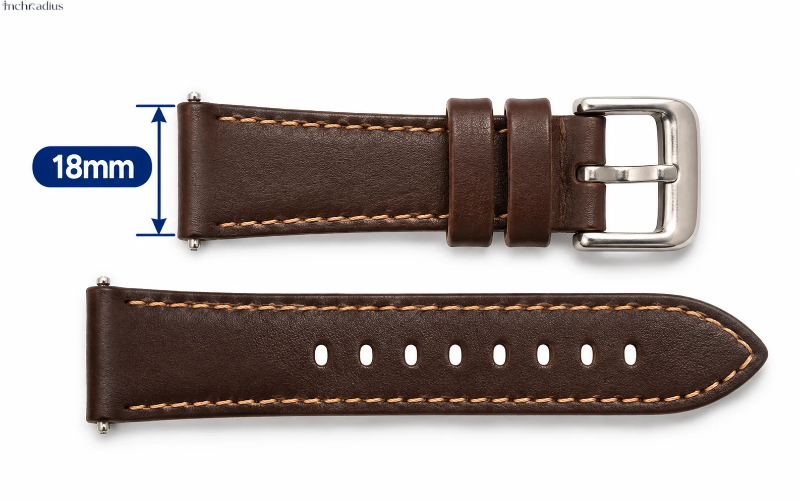
Watch straps are available in several widths, and 18mm is a common size for smaller and medium-sized watches. The measurement refers to the width of the strap, usually taken where it attaches to the watch case.
Imagine a leather or silicone strap laid flat on a table. The distance from one side to the other is 18mm. This gives you a narrow strip that is slightly less than 2cm wide.
Watch straps are useful comparisons because their widths are normally given in millimetres. You will often see sizes such as 16mm, 18mm, 20mm and 22mm when shopping for replacement straps.
If you already own an 18mm watch strap, you can use it to estimate the measurement on other small objects. Just remember that the strap’s width is 18mm, not its overall length. Its total length is usually many times greater.
3. Deep Socket
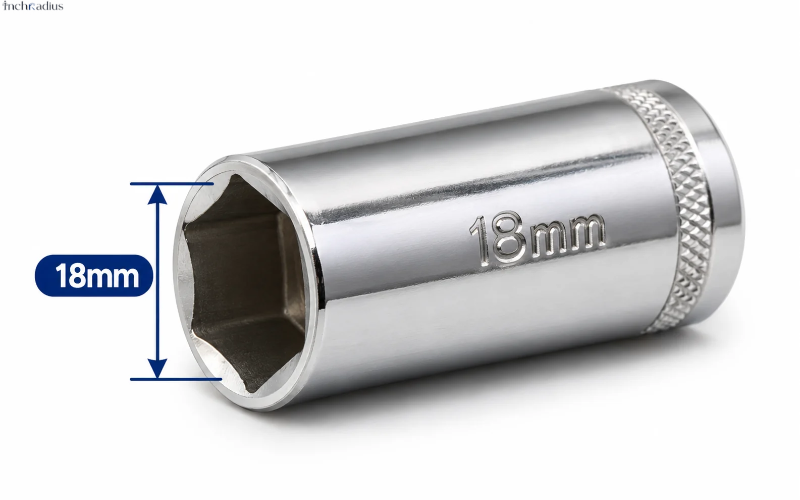
A socket wrench set is another useful place to find an 18mm measurement. An 18mm socket is designed to fit a fastener with an 18mm size across its flats.
The number printed on the socket refers to the size of the opening, rather than the total length of the tool. A deep socket may be considerably longer than 18mm because it needs enough depth to reach certain nuts and bolts.
Look directly into the opening to see the six-sided shape. The distance between two opposite flat sides is the important measurement.
This is a practical comparison for anyone who works with bicycles, cars, machinery or household repairs. Socket sizes are clearly labelled, making it easier to identify the correct measurement without guessing.
An 18mm socket is also useful for understanding why small differences matter. A socket that is too large may slip, while one that is too small will not fit over the fastener.
Related Post: 11 Common Things That Are 21 Feet Long
4. Hexagonal Nut
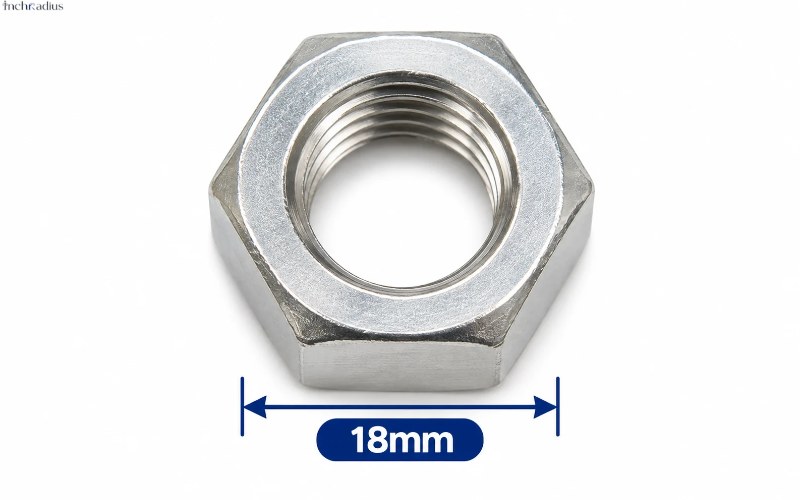
Hexagonal nuts are used in furniture, construction, machinery and general repair work. Some metric nuts have an 18mm measurement across their flat sides, giving you another way to picture this small distance.
A hexagonal nut has six sides, so it does not look like a simple square or circle. To understand its 18mm dimension, imagine drawing a straight line from one flat side to the opposite flat side through the centre.
The 18mm measurement describes the distance across those flats. It does not describe the height of the nut or the diameter of the threaded hole.
This distinction is useful when buying replacement hardware. Nuts are sold according to their thread size and other specifications, so an 18mm measurement across the flats does not automatically mean every nut with that dimension will fit the same bolt.
Related Post: 10 Common Things That Are 30 Feet Long
5. Wooden Dowel
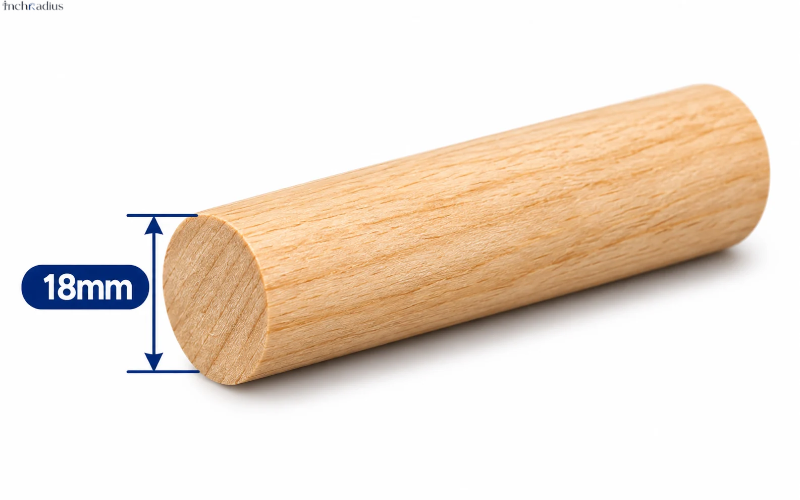
A wooden dowel is a round piece of wood commonly used in furniture making, DIY projects and woodworking. Dowels are manufactured in different diameters, including 18mm.
Picture a round wooden rod resting on a workbench. If you measure straight across its circular end, you will get 18mm. The rod itself may be much longer, but its diameter provides a useful comparison.
This is particularly helpful when working with furniture joints. Wooden dowels are often inserted into matching holes to connect two pieces of wood. The diameter must be suitable for the hole so that the joint remains secure.
An 18mm dowel is also easy to compare with a British 5p coin. Their measurements are the same across their widest points, although one is circular wood and the other is a flat metal coin.
Related Post: 11 Common Things That Are 40 Feet Long
6. Roll of Masking Tape
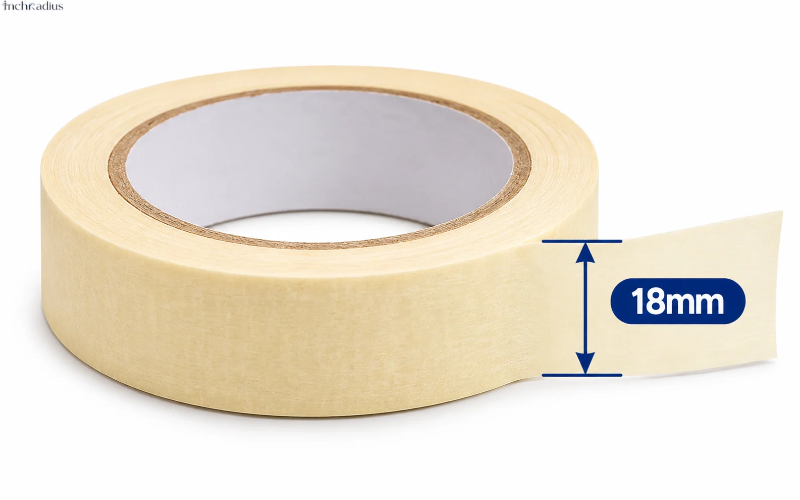
Masking tape is used for painting, decorating, craft work and protecting surfaces. Narrow rolls are available in widths of 18mm, making them a convenient example of this measurement.
The width is measured across the flat strip of tape, not around the circular roll. If you pull out a short section and lay it flat, you can see how much space 18mm covers.
This type of tape is particularly useful when working on small painting projects. It can protect narrow edges, create clean borders and help separate different sections of a surface.
A roll of 18mm masking tape also makes a practical reference because the measurement is normally printed on its packaging. You do not have to estimate its width by looking at the roll.
If you compare it with a 20mm strip, the masking tape will be slightly narrower. That small difference can be noticeable when applying tape to a detailed surface.
7. Craft Bead
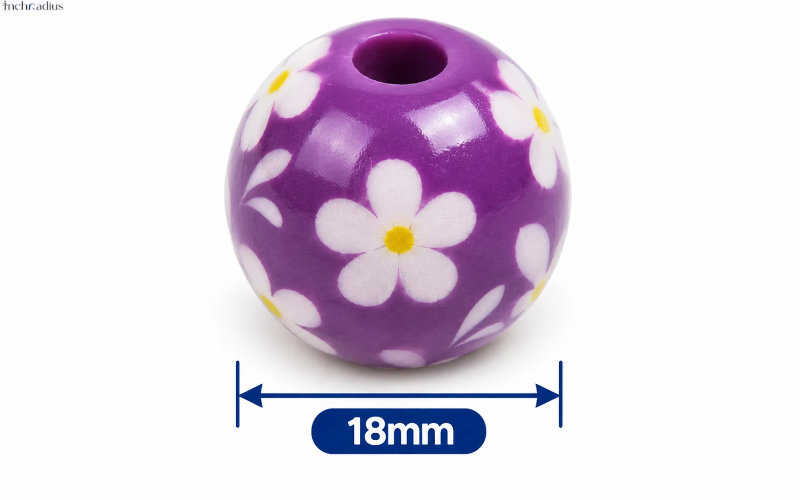
Craft beads come in a wide range of sizes, from tiny seed beads to larger decorative pieces. An 18mm bead has a diameter of 1.8cm, making it noticeably larger than the small beads used for delicate jewellery.
A round wooden or plastic bead is a useful comparison because its widest point is easy to identify. Imagine placing it between your thumb and index finger. It should occupy a little less than 2cm of space across.
These beads are often used in jewellery making, decorative garlands, keyrings and handmade accessories. They can also be used in school craft activities where children need larger pieces that are easier to handle.
When purchasing beads, check whether the advertised measurement refers to the diameter. Some products include a hole running through the centre, but that hole does not change the outside diameter.
Related Post: 12 Common Things That Are 50 Feet Long
8. Glass Cabochon
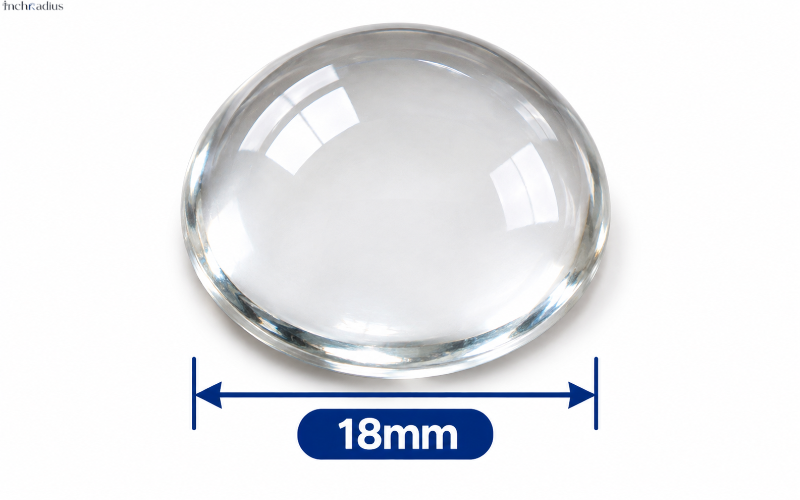
A glass cabochon is a smooth decorative piece commonly used in jewellery and craft projects. It usually has a rounded top and a flat underside. Round cabochons are sold in different diameters, including 18mm.
The measurement is taken across the widest part of the circular glass piece. If you place an 18mm cabochon on a table, its diameter will cover the same distance as the width of an 18mm watch strap.
These small glass pieces are used in pendants, rings, earrings and decorative settings. They can have clear, coloured or patterned surfaces, depending on the design.
A cabochon is particularly helpful when visualising 18mm because its smooth circular outline makes the size easy to recognise. You can compare it with a British 5p coin to see how similar their diameters are.
If you are buying one for a jewellery setting, check the stated diameter carefully. A small difference can prevent it from fitting correctly.
9. Tile Spacer
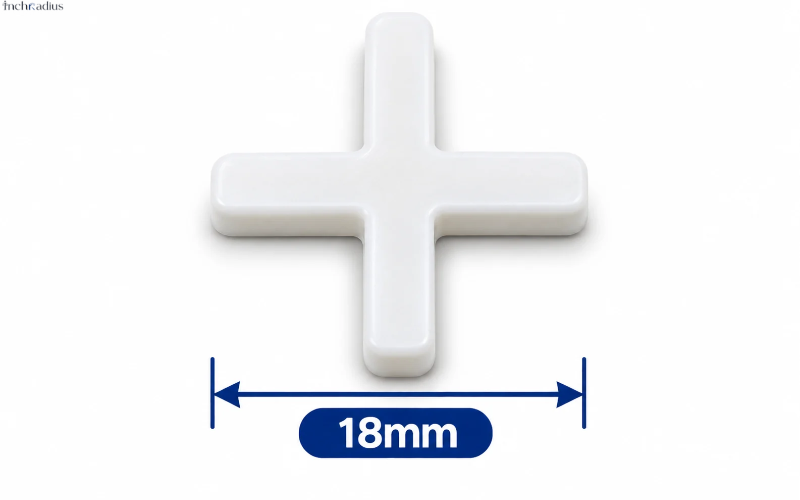
Tile spacers are small accessories used during tiling work to help maintain consistent gaps between tiles. They come in several thicknesses and sizes, depending on the type of installation.
An 18mm tile spacer can be used as a reference for the target measurement if its specified dimension is 18mm. It is worth checking the product’s dimensions, as ordinary tile spacers are often much smaller, and not every spacer sold for tiling measures 18mm.
For a visual comparison, place the spacer beside a ruler and identify the side or dimension marked as 18mm. Its shape may be cross-shaped, T-shaped or another design, so the relevant measurement depends on the product.
This example is useful because it shows how millimetres are used in practical building work. Small measurements can affect the fit and appearance of finished surfaces.
When choosing spacers, always check the manufacturer’s stated dimensions rather than relying on their appearance alone.
Related Post: How Long Is 60 Feet? 11 Common Things That Are 60 Feet Long
How to Measure 18mm Without a Ruler
You do not always need a ruler or tape measure to estimate 18mm. A few familiar objects can help you get reasonably close. These methods are suitable for rough comparisons, although a proper measuring tool is better when accuracy matters.
1. Use a British 5p Coin
If you have a British 5p coin, you already have a reference that measures exactly 18mm across its diameter.
Place the coin on a flat surface and look at its widest point. Imagine drawing a straight line from one edge to the opposite edge through the centre.
You can use this distance to compare other small objects. For example, if a button looks almost as wide as the coin, its diameter may be close to 18mm.
This method works particularly well for circular objects, although it can also help with estimating the width of flat items.
2. Use Your Index Finger
Your index finger can provide a rough visual reference. Look at the width of the finger near its tip or middle section.
For many adults, this part of the finger is wider than 18mm, but finger sizes vary considerably. Some people have narrower fingers, while others have wider ones.
Instead of assuming your finger is exactly 18mm, compare the target measurement with a small section of its width.
This is useful when you need a quick estimate, such as checking whether a small object is closer to 1.5cm or 2cm.
3. Compare It With a 2cm Ruler Mark
If you have access to a ruler but cannot measure the object directly, use the 2cm mark as a reference.
Since 2cm equals 20mm, 18mm is just 2mm shorter. Find the 2cm mark and imagine moving backwards by two small divisions.
The resulting distance is 18mm.
This method is more reliable than using your hand because the ruler has clearly marked millimetre divisions. It is especially useful when comparing small components, craft materials or household fittings.
Related Post: How Long Is 70 Feet? 10 Common Things That Are 70 Feet Long
FAQs
1. Is 18mm bigger than 1 inch?
No. One inch is equal to 25.4mm, while 18mm is approximately 0.71 inches. This means 18mm is noticeably shorter than 1 inch. The difference between the two measurements is 7.4mm.
2. Is 18mm the same as 1.8cm?
Yes. 18mm is exactly equal to 1.8cm because every centimetre contains 10 millimetres. To convert millimetres into centimetres, simply divide the measurement by 10.
3. How many inches are there in 18mm?
18mm is approximately 0.7087 inches. For everyday use, you can round this to 0.71 inches. It is slightly less than three-quarters of an inch, which measures 0.75 inches.
4. What coin is 18mm wide?
The British 5p coin has a diameter of exactly 18mm. It is a useful everyday reference for this measurement. Measure across the centre of the coin to see the full diameter.
5. Is 18mm close to 2cm?
Yes. Two centimetres equal 20mm, so 18mm is only 2mm shorter. The difference is small enough that the two measurements can look very similar when viewed without a ruler.
6. How can I measure 18mm with my fingers?
You can use your index finger as a rough comparison, but finger widths vary between people. For a better estimate, compare an 18mm distance with a small section of your finger rather than assuming the entire finger has this width.
7. What does 18mm look like on a ruler?
On a metric ruler, 18mm is the eighth small division after the 1cm mark. It sits two millimetres before the 2cm line. Look for the longer centimetre markings and count the smaller divisions between them.
8. Is 18mm suitable for measuring small objects?
Yes. Millimetres are particularly useful for small objects because they allow more precise measurements than centimetres. An 18mm measurement can be helpful when checking watch straps, hardware, craft supplies, wooden dowels and other small components.
- Discover more everyday objects and their measurements in inches
- 8 Common Things That Are 29 Inches Long
- 9 Common Things That Are 28 Inches Long
- 9 Common Things That Are 27 Inches Long
- 9 Common Things That Are 26 Inches Long
- 9 Common Things That Are 25 Inches Long
- 9 Common Things That Are 24 Inches Long
Conclusion
18mm is a small measurement, but it becomes much easier to picture when you compare it with familiar objects. A British 5p coin is particularly useful because its diameter is exactly 18mm. You can also use an 18mm watch strap, a wooden dowel or a craft bead as visual references. Remember that 18mm equals 1.8cm and approximately 0.71 inches. It is just 2mm shorter than 2cm, making that mark on a metric ruler another helpful reference.
For quick estimates, these comparisons work well, but always use a proper ruler or calliper when an accurate measurement is needed.
