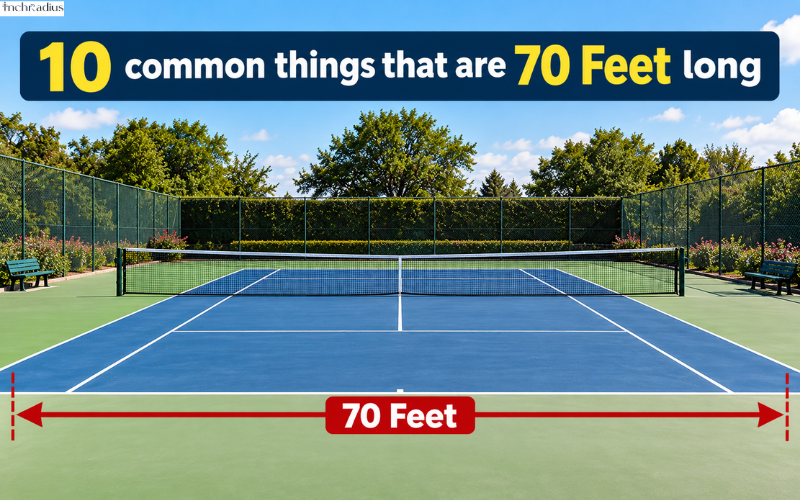
70 feet is exactly 840 inches, 21.336 metres, or 2,133.6 centimetres (21,336 millimetres). That is a considerable distance, roughly the length of a railway carriage or a long section of an industrial conveyor system. It can be difficult to picture such a measurement without a familiar object for comparison. Looking at things found in transport, sports, construction, and industry makes the distance easier to imagine. Some objects are close to 70 feet long, while others can be designed to match this measurement.
These comparisons are useful when estimating distances around large buildings, planning outdoor projects, or simply satisfying your curiosity about measurements. The important thing is to distinguish between objects that are approximately 70 feet long and those that can be measured to exactly 70 feet.
How Long Is 70 Feet?
Seventy feet is a fixed measurement equal to 840 inches, 23.33 yards, or approximately 21.34 metres. In centimetres, it measures 2,133.6 cm, and in millimetres, it measures 21,336 mm. These conversions are useful when reading construction plans, comparing product dimensions, or working with measurements written in metric units.
One way to picture this length is to imagine a railway carriage standing on a straight section of track. Some passenger carriages measure around this length, although their dimensions vary by railway system and design. A similar distance can be found in large industrial installations, where conveyor belts move materials between different stages of a production process.
The measurement can describe a horizontal distance, such as the length of a carriage, or a vertical dimension, such as the height of a structure. These are different ways of using the same measurement. A 70-foot object does not have to look particularly tall or wide; its overall length is what matters when making a direct comparison.
Related Post: How Long Is 60 Feet? 11 Common Things That Are 60 Feet Long
How Big Is 70 Feet?
A distance of 70 feet is much longer than most objects found inside a home. To picture it, imagine a straight line running from one end of a large room to the other and continuing well beyond the opposite wall. The measurement is also about 21.34 metres, which is long enough to span a substantial part of a sports facility or industrial building.
You could use a familiar object to build the comparison. For instance, a standard tennis court is 78 feet long, so 70 feet is only 8 feet shorter than the full court. If you have watched a tennis match in person, you can use the court as a useful visual reference.
Another comparison is a row of seven sections, each measuring 10 feet. Put those sections together end to end and the total is exactly 70 feet. This is a simple way to understand the distance without imagining one enormous object.
Remember that these comparisons are intended to help you visualise the scale. The actual length of a railway carriage, sports facility, or industrial machine depends on its design. For an accurate measurement, use a suitable tape measure or other measuring equipment.
10 Common Things That Are 70 Feet Long
The following examples use different settings, including rail transport, aviation, sports, construction, and industrial equipment. Some can be built to a length of 70 feet, while others are approximate comparisons. Checking the specifications of a particular object is essential before treating its dimensions as exact.
| Everyday Item | Actual Size |
| Railway Carriage | 70 feet |
| Small Aircraft Wingspan | 70 feet |
| Tennis Court Length | 70 feet |
| Industrial Conveyor System | 70 feet |
| Warehouse Roof Truss | 70 feet |
| Pedestrian Bridge Span | 70 feet |
| Concert Stage Truss | 70 feet |
| Wind Turbine Blade | 70 feet |
| Airport Passenger Boarding Bridge | 70 feet |
| Zip-Line Cable Section | 70 feet |
1. Railway Carriage

A railway carriage is a useful comparison for a distance of 70 feet because passenger trains contain long, recognisable vehicles arranged in a straight line. Some passenger carriages are around 70 feet long, although others are shorter or longer depending on the railway system and the type of train.
The measurement may refer to the body of the carriage or its overall length, including the ends and coupling equipment. These details matter because railway manufacturers use specific dimensions when describing their vehicles.
Imagine standing on a station platform and looking along a single carriage from one end to the other. A carriage measuring 70 feet would cover a substantial section of the platform. It is also a helpful comparison for anyone who regularly travels by train because the shape is familiar.
If you want to estimate this distance at a station, avoid relying entirely on appearance. Perspective can make a carriage seem shorter when viewed from one end. Manufacturer specifications provide a more reliable measurement.
2. Small Aircraft Wingspan
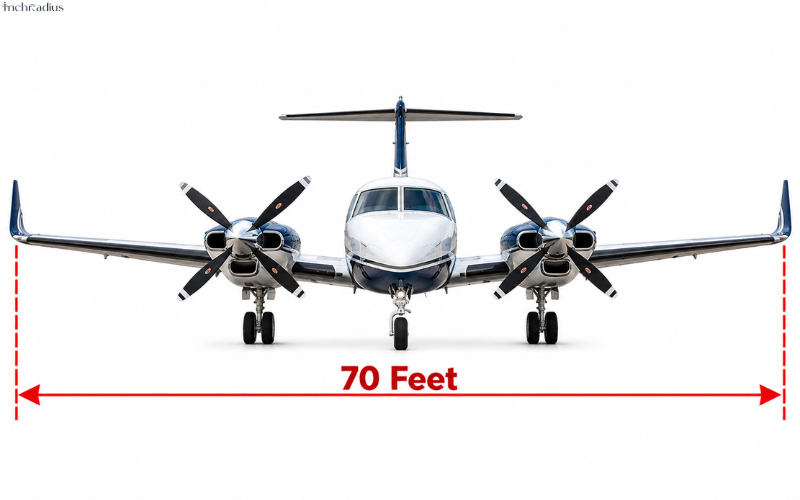
An aircraft’s wingspan is the distance from the tip of one wing to the tip of the other. Some smaller aircraft can have wingspans close to 70 feet, although the measurement varies considerably between aircraft types. A compact commuter aircraft, for example, may have a very different wingspan from a large commercial passenger jet.
A wingspan of 70 feet equals approximately 21.34 metres. This is a useful way to picture the distance because the wings extend across the aircraft rather than along its fuselage. The wingspan is therefore a width measurement, not the overall length of the plane.
Imagine looking down at an aircraft from above while it is parked on an apron. A 70-foot wingspan would stretch a considerable distance across the parking area. This comparison can help explain why aircraft need enough space between neighbouring stands and other equipment.
Actual wingspans should always be checked against the aircraft’s published specifications. Winglets and other design features may also affect how the overall span is defined.
3. Tennis Court Length
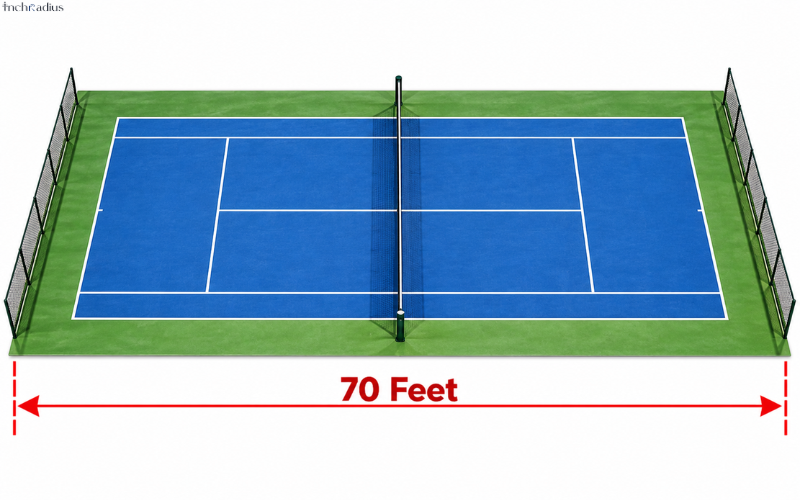
A tennis court provides an especially helpful reference for visualising 70 feet. A standard court measures 78 feet from one baseline to the other, making it 8 feet longer than the target measurement. This is a close comparison that many people can picture, even if they do not play tennis regularly.
The playing area is marked with clear white lines, so its length is easy to recognise. A 70-foot line would cover most of the distance from one baseline to the other but would stop 8 feet short.
This example also demonstrates why it is important to distinguish between a standard measurement and an approximate comparison. A tennis court is not exactly 70 feet long. Its official playing length is 78 feet, so it should be used as a visual reference rather than a precise match.
If you are standing beside a court, imagine measuring from one baseline towards the opposite end. The distance would reach close to the far baseline, making it easier to picture a length of 70 feet without a tape measure.
4. Industrial Conveyor System

Industrial conveyor systems move products, packages, raw materials, and manufactured parts between different work areas. They are used in warehouses, factories, food-processing plants, and distribution centres. A conveyor can be designed with a straight section measuring exactly 70 feet, depending on the space and the work it needs to perform.
The length of a conveyor system is not fixed across the industry. Some are only a few feet long, while large installations extend across substantial buildings. For this comparison, imagine a straight conveyor running for 70 feet between two workstations.
The measurement becomes easier to picture when you consider the belt’s starting and ending points. A worker standing at one end would need to walk more than 21 metres to reach the other.
Conveyor systems may also include rollers, support frames, motors, and transfer points. These components can affect the total footprint, so the length of the belt itself may differ from the overall installation length. Always check the equipment drawing if a precise dimension is needed.
5. Warehouse Roof Truss
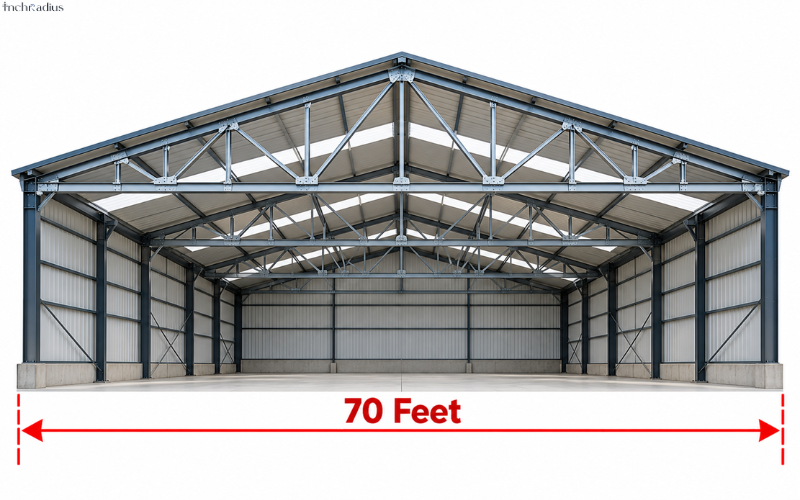
A roof truss is a structural framework that supports a roof and transfers its loads to the building’s supporting walls or columns. Large warehouses often use steel or timber trusses to create broad spaces with fewer internal supports. A truss designed with a 70-foot span can cover a substantial area inside an industrial building.
In this example, 70 feet refers to the span across the structure rather than the length of an entire roof. The span is commonly measured horizontally between the supporting points. This distinction is important because a truss may have a much greater diagonal length along its individual members.
Picture a large warehouse with a wide, open interior. A truss spanning 70 feet would stretch across much of the building, supporting the roof above the working floor.
The exact dimensions depend on the structural design, material, load requirements, and building layout. A truss is not a standard 70-foot object, but it can be engineered to this span. Structural engineers determine the appropriate dimensions and supports for each project.
6. Pedestrian Bridge Span
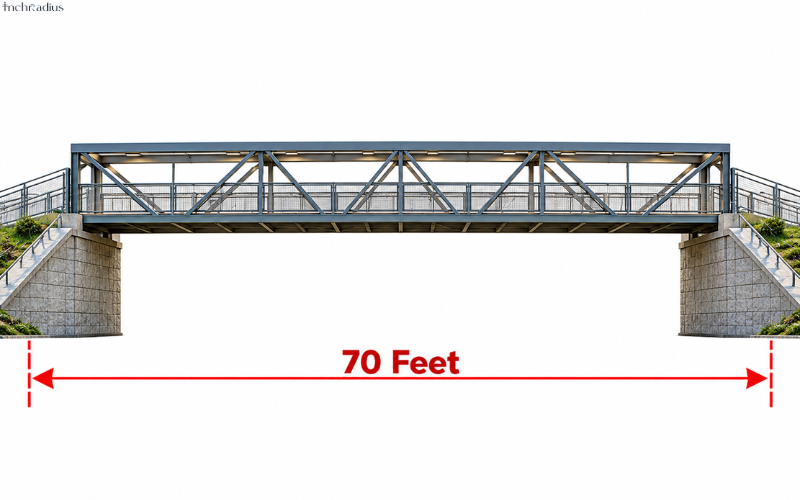
Pedestrian bridges allow people to cross roads, railway lines, waterways, and other obstacles safely. Their designs range from simple footbridges to larger structures with steel beams, railings, ramps, and support columns. A bridge with a 70-foot span provides a practical example of the distance.
The span is generally the distance between the bridge’s supports. It does not necessarily equal the full length of the structure, particularly if the bridge extends beyond its supports or has additional sections.
Imagine looking across a small river or road at a footbridge that spans 70 feet between its supporting points. The crossing would measure approximately 21.34 metres across. This is long enough to create a clear visual reference when viewed from the bank or pavement.
Bridge dimensions vary according to the terrain, expected loads, materials, and engineering requirements. Some footbridges are much shorter, while others extend for hundreds of feet. The 70-foot example illustrates a possible span rather than a universal bridge size.
7. Concert Stage Truss
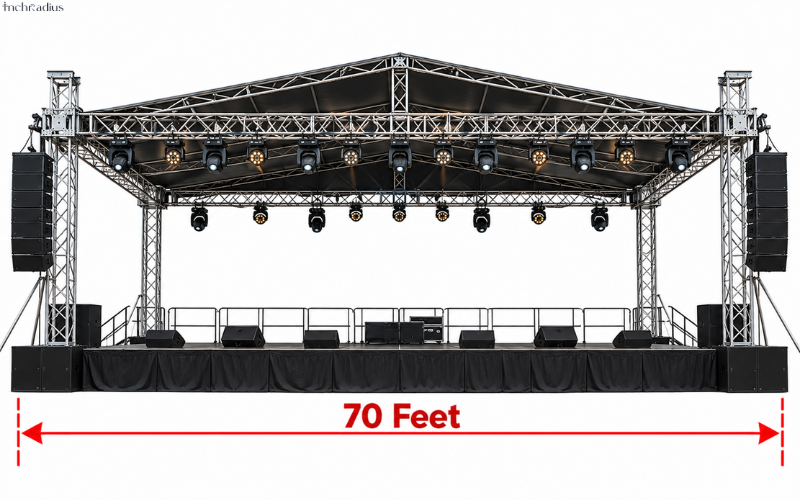
Concert stage trusses are strong frameworks used to support lighting, speakers, screens, and other production equipment. They are common at music festivals, indoor concerts, theatre productions, and large public events.
A stage truss can be assembled to create a horizontal span of 70 feet, depending on the venue and the production design. This might run across the front of a stage or above a performance area. The total length is determined by the number of connected sections and the layout chosen by the event production team.
Imagine standing in front of a concert stage and looking at the metal framework above the performers. A truss spanning 70 feet would stretch across a broad section of the stage, providing a useful way to visualise the measurement.
Individual truss sections are much shorter than the complete span. They are joined together to create the required structure. The finished installation must be designed and assembled according to its load capacity, connection requirements, and safety rules. Its dimensions should never be estimated for rigging or equipment installation.
8. Wind Turbine Blade

Wind turbine blades are long aerodynamic structures designed to capture energy from moving air. Their lengths depend on the turbine’s size, intended power output, and operating conditions. Some smaller or older turbine designs use blades that are around 70 feet long, while modern utility-scale turbines often have much longer blades.
A blade measuring 70 feet would be approximately 21.34 metres from its root to its tip. This distance provides a useful comparison because turbine blades are long, narrow objects that can be difficult to appreciate when viewed from the ground.
The blade length is not the same as the full rotor diameter. A turbine’s rotor diameter measures the distance across the circular area swept by the blades as they rotate. It is therefore much greater than the length of a single blade.
Imagine a blade laid horizontally on the ground, with its root at one end and tip at the other. A 70-foot blade would stretch across a substantial open area. The actual size of a turbine blade should be confirmed from its technical specifications.
9. Airport Passenger Boarding Bridge
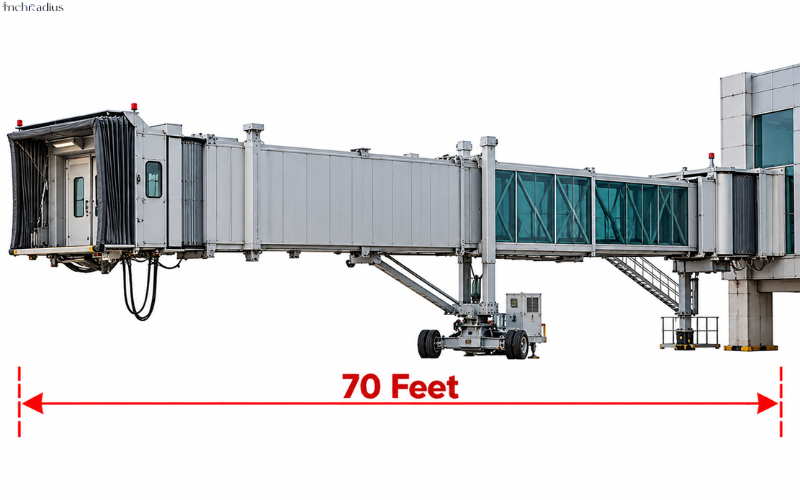
An airport passenger boarding bridge connects an airport terminal to an aircraft, allowing passengers to board and leave without walking across the apron. These enclosed bridges are adjustable, so they can move into position for different aircraft and door heights.
A boarding bridge may include a section or extended configuration measuring around 70 feet, depending on the terminal design and the distance between the building and the aircraft. However, there is no single standard length for every boarding bridge. Some are shorter, while others use several connected sections.
Imagine looking through the airport windows at a boarding bridge stretching from the terminal towards a parked aeroplane. A 70-foot section would cover approximately 21.34 metres, making it a useful comparison for a long enclosed passage.
The bridge’s total reach may change as its sections extend or retract. Its usable length can also differ from its overall structural length. Airport designers must account for aircraft positions, terminal layout, passenger flow, and operational safety when selecting the equipment.
10. Zip-Line Cable Section

Zip-lines use suspended cables to carry a rider between two points, usually with a pulley and safety harness. They are found at adventure parks, outdoor activity centres, and some recreation facilities. A cable section measuring 70 feet offers a straightforward way to visualise the distance.
Unlike the length of a winding water slide, a straight cable section can be measured directly from one endpoint to the other. However, some zip-lines follow a slope, and their cable length may differ from the horizontal distance between the launch and landing platforms.
Imagine a short recreational zip-line extending between two sturdy platforms. A 70-foot cable would cover approximately 21.34 metres along its route. This is a useful comparison for understanding the scale of a cable installation, although many commercial zip-lines are considerably longer.
The cable must be selected and installed according to the intended load, tension, slope, and safety requirements. A visual estimate is not suitable for deciding whether a cable or supporting structure is safe. Always rely on the installation specifications and qualified professionals for those decisions.
Measurement Without a Ruler
You can estimate 70 feet without carrying a long tape measure, although the result will not be exact. The best method depends on the space available and whether you have a familiar reference nearby.
1. Use Your Walking Steps
An adult’s walking step may cover roughly 2 to 2.5 feet, depending on height and walking style. At this pace, covering 70 feet could take around 28 to 35 steps.
To improve the estimate, measure a known distance first and count your steps while walking normally. Divide the distance by the number of steps to calculate your average step length. You can then use that personal figure to estimate longer distances.
Keep in mind that stride length changes with uneven ground, slopes, footwear, and walking speed. Use this method for a rough idea rather than a precise measurement.
2. Divide the Distance into 10-Foot Sections
If you have enough space, mark a straight route into seven sections, each measuring 10 feet. Seven sections of 10 feet add up to exactly 70 feet.
You can use a tape measure to mark the first section and then repeat the same distance along the route. Temporary markers, such as small cones or pieces of chalk, make the boundaries easier to see.
This method is useful for garden planning, event layouts, and estimating space around a building. Keep each section straight and measure from the end of one section to the start of the next without leaving gaps or overlapping the marks.
3. Compare It with a Tennis Court
A standard tennis court is 78 feet long, so 70 feet is 8 feet shorter. If you have access to a tennis court, imagine a line beginning at one baseline and stopping 8 feet before the opposite baseline.
This comparison gives you a reasonably close visual estimate without requiring you to mark out the full distance. It is particularly helpful for people who are familiar with sports courts.
Remember that the court’s official length is 78 feet, not 70 feet. Use the comparison to picture the scale, and measure directly if your project needs an accurate result.
Related Post: How Long Is 40 Feet? 11 Common Things That Are 40 Feet Long
FAQs
1. How many inches are in 70 feet?
There are exactly 840 inches in 70 feet. One foot contains 12 inches, so multiplying 70 by 12 gives 840. This conversion is useful when working with building plans, technical drawings, or other specifications that use inches instead of feet.
2. How many metres is 70 feet?
Seventy feet equals 21.336 metres, which is approximately 21.34 metres when rounded to two decimal places. This conversion is useful when comparing measurements in countries that use the metric system or reading the specifications of equipment manufactured overseas.
3. How many centimetres and millimetres are in 70 feet?
Seventy feet equals 2,133.6 centimetres and 21,336 millimetres. To convert feet into centimetres, multiply the measurement by 30.48. To convert feet into millimetres, multiply it by 304.8. These are exact conversions, not estimates.
4. Is 70 feet longer than a tennis court?
No. A standard tennis court is 78 feet long, making it 8 feet longer than 70 feet. However, 70 feet still covers most of the court’s length. This makes a tennis court a useful visual comparison when you want to picture a distance of around 21 metres.
5. Can an aircraft have a 70-foot wingspan?
Yes. Some smaller aircraft can have wingspans close to 70 feet, depending on their design. A wingspan measures the distance between the tips of the two wings, not the length of the aircraft’s fuselage. Always check the manufacturer’s specifications for the exact dimension.
6. Is a railway carriage usually 70 feet long?
Some railway carriages are around 70 feet long, but there is no single standard length for all passenger trains. Dimensions vary by country, railway operator, carriage type, and design. The manufacturer’s published measurements are the best source for an exact figure.
7. How can I measure 70 feet without a tape measure?
You can estimate the distance by counting your walking steps, using repeated 10-foot sections, or comparing the route with a familiar sports court. These methods are suitable for visual estimates and preliminary planning. For construction, property boundaries, or other tasks requiring precision, use proper measuring equipment.
8. What is the easiest way to remember 70 feet?
Think of a tennis court that is 78 feet long. A distance of 70 feet is only 8 feet shorter, so it covers most of the playing area from baseline to baseline. This familiar comparison makes it easier to picture the measurement without memorising several conversions.
Conclusion
Seventy feet measures exactly 840 inches, 21.336 metres, or 2,133.6 centimetres. You can picture this distance by comparing it with a railway carriage, a tennis court, an industrial conveyor, or a long structural span. Some of these objects may be close to 70 feet, while others can be designed to match the measurement precisely.
For a quick mental reference, remember that a standard tennis court is 78 feet long. Seventy feet covers nearly all of that distance, stopping 8 feet short of the opposite baseline. If you need to measure a real space for construction, equipment, or planning, use a tape measure or suitable measuring tool to confirm the exact length.