
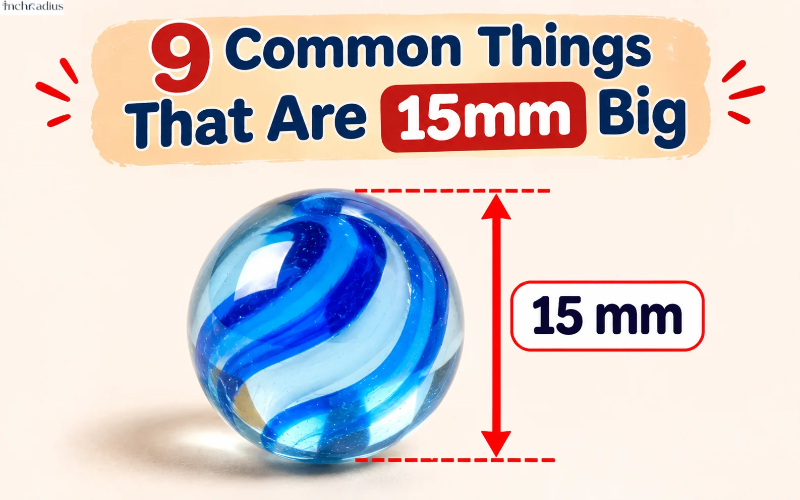
15mm is a small measurement, equal to 1.5 centimetres, 0.59 inches or 15 millimetres. It is slightly more than half an inch, making it easy to underestimate when you cannot see it beside a familiar object. You might come across this measurement when checking the size of a craft item, a small household fitting, a button or a piece of hardware.
A ruler can show you the exact distance, but everyday objects can also help you picture it. Several familiar items have dimensions close to 15mm, giving you a practical reference for estimating this small length.
How Long Is 15 Millimetres?
15 millimetres is a short distance that measures exactly 1.5 centimetres. In imperial measurements, it is approximately 0.59 inches, which is just under five-eighths of an inch.
To picture this distance, imagine a small button, a craft bead or the width of a compact building block. These objects can give you a better sense of the measurement than simply looking at numbers on a ruler.
Millimetres are particularly useful for measuring small items because even a slight difference can affect whether something fits properly. For example, a 15mm fitting may not work in an opening designed for 12mm. The difference is only 3mm, but it can matter when assembling furniture, working with tools or choosing replacement parts.
Here are the main conversions for this measurement:
- Millimetres: 15mm
- Centimetres: 1.5cm
- Inches: 0.59 inches
- Metres: 0.015 metres
- Feet: Approximately 0.049 feet
Related Post: 11 Common Things That Are 21 Feet Long
How Big Is 15mm?
The easiest way to picture 15mm is to think of something that is a little over half an inch across. It is not particularly large, but it is big enough to see clearly without needing a magnifying glass.
Imagine holding a small craft bead between your thumb and index finger. Its width might be close to 15mm, depending on the bead. You can also picture a small square building block, which may measure around 16mm across.
A standard ruler is another helpful reference. The distance from the 1cm mark to the 2.5cm mark is exactly 15mm. This gives you a simple visual reference whenever you need to estimate the size.
A 15mm object can easily fit between the tips of two fingers. However, the exact appearance depends on the shape and thickness of the object. A round item with a 15mm diameter will look different from a flat strip measuring 15mm in length.
Related Post: 10 Common Things That Are 20 Feet Long
9 Common Things That Are 15mm Big
Several small objects can help you visualise 15mm without having to carry a measuring tool everywhere. Some are made specifically in this size, while others have standard dimensions that come very close.
The following examples cover craft supplies, household fittings, toys and everyday accessories. Remember that the exact size can vary between manufacturers, so check the product specifications when precision matters.
| Everyday Item | Actual Size |
| Small wooden craft dowel | 15mm |
| Round craft bead | 15mm |
| Clothing button | 15mm |
| Square mosaic tile | 15mm |
| Metal snap fastener | 15mm |
| Round acrylic cabochon | 15mm |
| Rubber grommet opening | 15mm |
| LEGO-style building brick width | Approximately 15mm |
| Standard gaming die | Approximately 15mm |
1. Small Wooden Craft Dowel
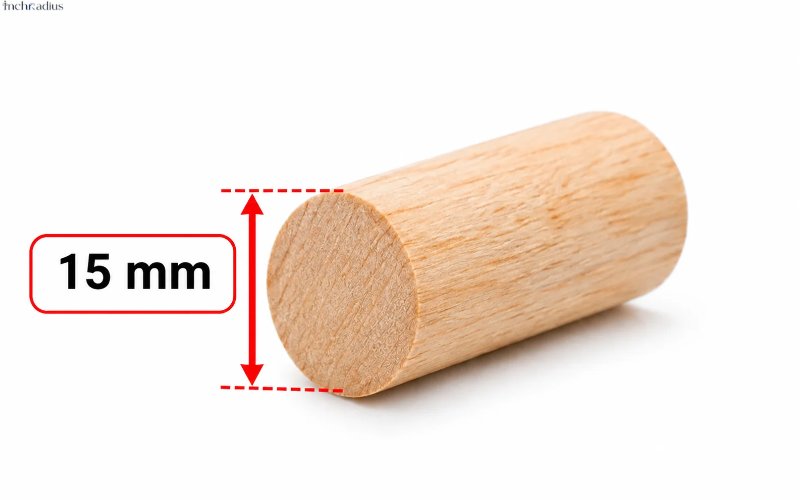
A small wooden craft dowel with a 15mm diameter is a useful way to picture this measurement. These cylindrical wooden pieces are used in furniture projects, model-making, craft work and simple home repairs.
A 15mm dowel is 1.5cm thick, which makes it noticeably wider than a pencil. If you hold one between your fingers, you can see how much space this small measurement occupies.
The important thing to remember is that 15mm describes the diameter of the dowel, not necessarily its length. Wooden dowels are sold in different lengths, so you should look at both dimensions when purchasing one.
For visualising 15mm, focus on the distance across the circular end. That width provides a clear reference for the measurement.
Related Post: 11 Common Things That Are 19 Feet Long
2. Round Craft Bead
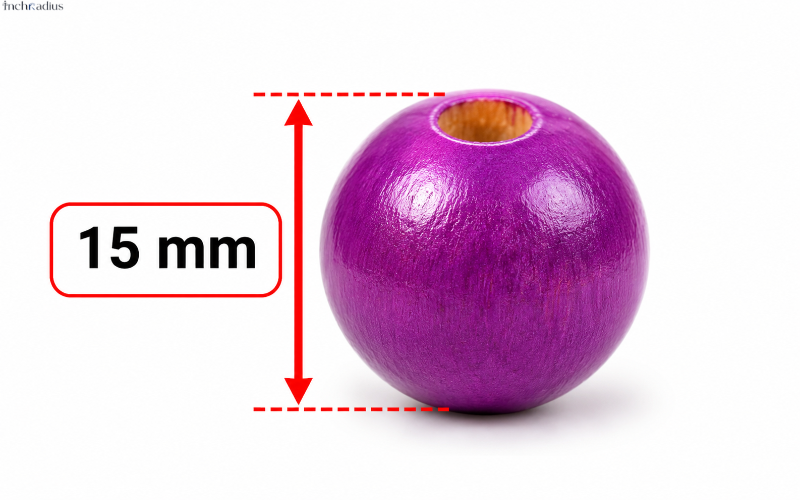
Round craft beads are available in many sizes, including 15mm. They are commonly used for making bracelets, necklaces, decorative accessories and handmade gifts.
A 15mm bead measures 1.5cm across its widest point. It is large enough to hold comfortably between your fingertips, yet small enough to fit into many types of jewellery designs.
You can use a bead of this size as a practical reference by placing it beside a ruler. The distance across its centre will show you what 15mm looks like.
Keep in mind that some beads have holes running through their centres. These holes do not change the outside diameter, which is the measurement you should use when comparing the bead with 15mm.
3. Clothing Button
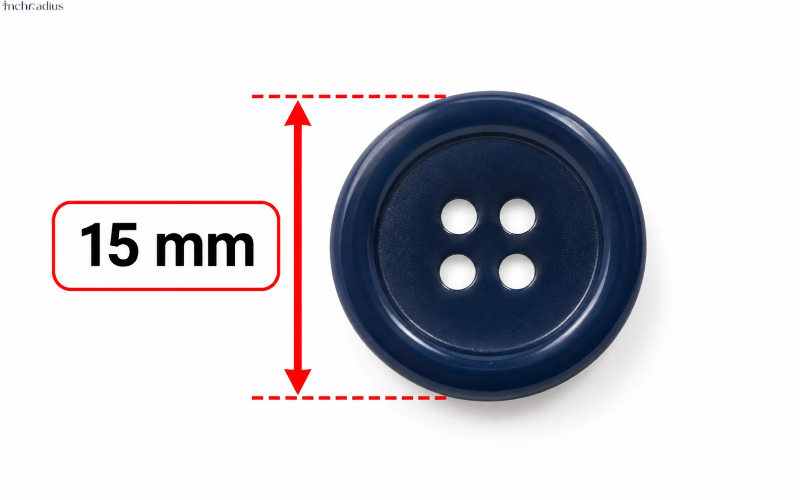
A small clothing button can be another helpful comparison for 15mm. Buttons are made in a range of diameters, and 15mm is a common size for shirts, children’s clothing, cardigans and lightweight jackets.
Place a button measuring 15mm on a flat surface and look at its width from one edge to the other. It will measure exactly 1.5cm across.
Buttons are particularly useful because their circular shape makes the measurement easy to picture. You can also compare one with a ruler to see how closely it matches the 15mm mark.
Not every small button measures 15mm. Some are considerably smaller, while coat and jacket buttons can be much larger. Check the button diameter rather than relying on its appearance alone.
Related Post: 10 Common Things That Are 18 Feet Long
4. Square Mosaic Tile
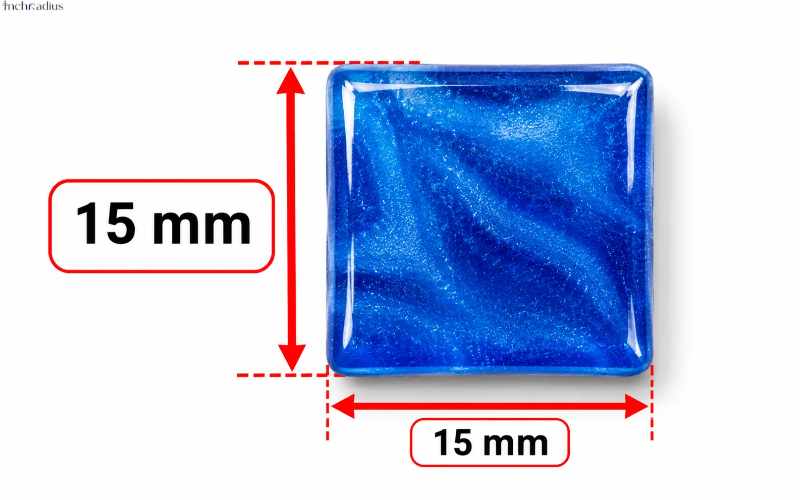
Small square mosaic tiles are often used in decorative crafts, bathroom designs, kitchen splashbacks and miniature artwork. Some mosaic tile ranges include individual pieces measuring 15mm on each side.
A square tile with these dimensions gives you a clear example because its width and height are both 15mm. Place it on a table and compare one edge with a ruler to see the exact distance.
This is also a useful household comparison because tiles have straight edges. Unlike a round bead, you can easily see where the measurement begins and ends.
Mosaic tiles are sold in many different sizes, so not every small tile will measure 15mm. Some products use 10mm, 20mm or larger pieces. Always check the listed dimensions before using one as an exact reference.
5. Metal Snap Fastener
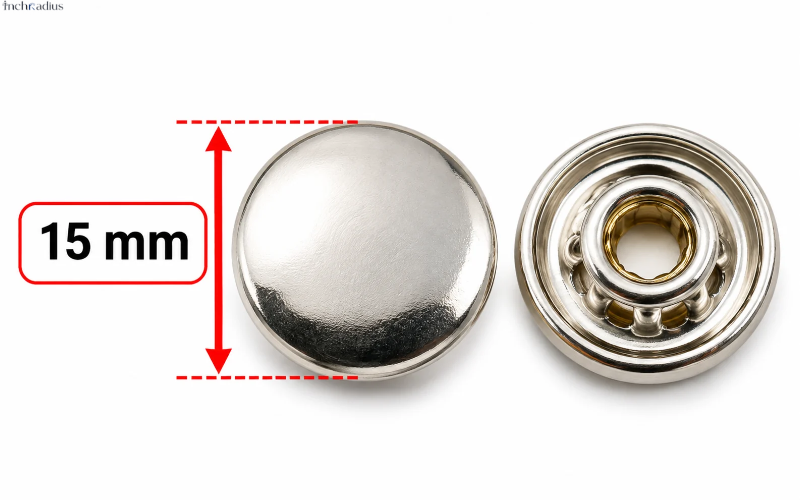
Metal snap fasteners are small fittings used to join two pieces of fabric. You will find them on jackets, bags, baby clothing, purses and other accessories.
Some snap fastener sets have a diameter of 15mm. This means the circular fitting measures 1.5cm from one side to the other.
The measurement is easy to visualise because the fastener has a compact, round shape. If you have a spare 15mm snap fastener, place it beside a ruler and compare its outside edge with the 1.5cm mark.
One detail to remember is that snap fasteners come in several sizes. The diameter of the visible cap may also differ from the dimensions of the fitting underneath. Use the manufacturer’s measurement when an accurate size is needed.
Related Post: 11 Common Things That Are 17 Feet Long
6. Round Acrylic Cabochon
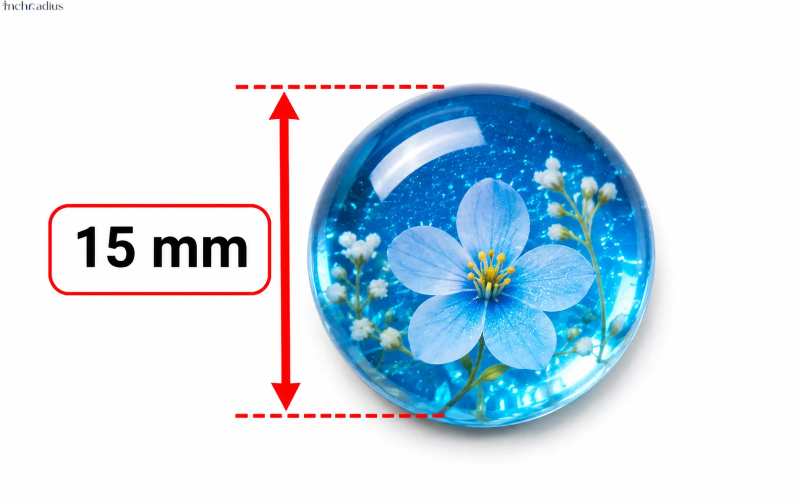
Acrylic cabochons are decorative pieces used in jewellery-making, craft projects and handmade accessories. They often have a smooth, rounded top and a flat underside.
A 15mm round cabochon measures 1.5cm across its widest point. Its smooth surface makes it easy to compare with other small objects.
You might see these pieces used on decorative rings, hair clips, brooches, pendants and handmade embellishments. Their size makes them useful for projects that need a noticeable decorative detail without taking up too much space.
For a quick visual comparison, place a 15mm cabochon on a ruler. Its outside edges should line up with the 0cm and 1.5cm marks.
Cabochons are available in different shapes and sizes, so choose one specifically labelled 15mm if you need an accurate example.
7. Rubber Grommet Opening
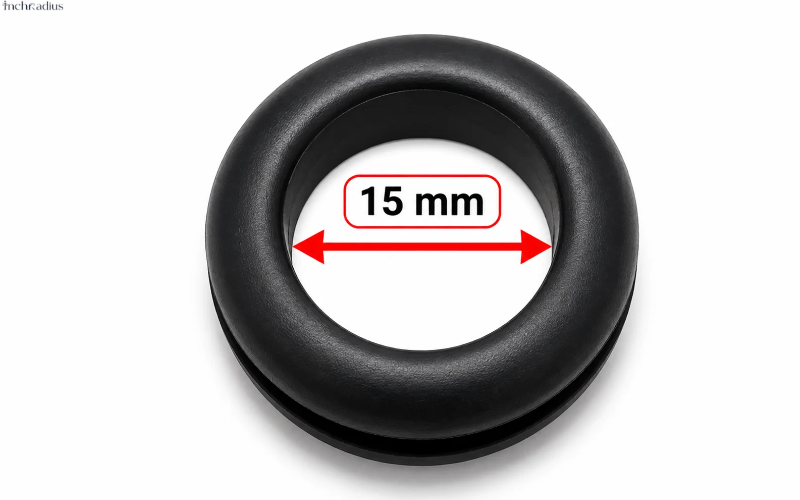
Rubber grommets are small protective fittings used around holes in metal, plastic and wooden surfaces. They help prevent cables, wires and other materials from rubbing against sharp edges.
Some grommets are designed with a 15mm inner opening. This means the hole through the centre measures 1.5cm across.
It is a useful example because you can directly see the circular space created by the measurement. Looking through the opening gives you a practical idea of how wide 15mm is.
However, be careful when comparing grommets. Their outer diameter can be much larger than their inner opening. A grommet advertised as having a 15mm hole may have an outside measurement of 20mm or more.
For this comparison, focus only on the inside diameter.
8. LEGO-Style Building Brick Width
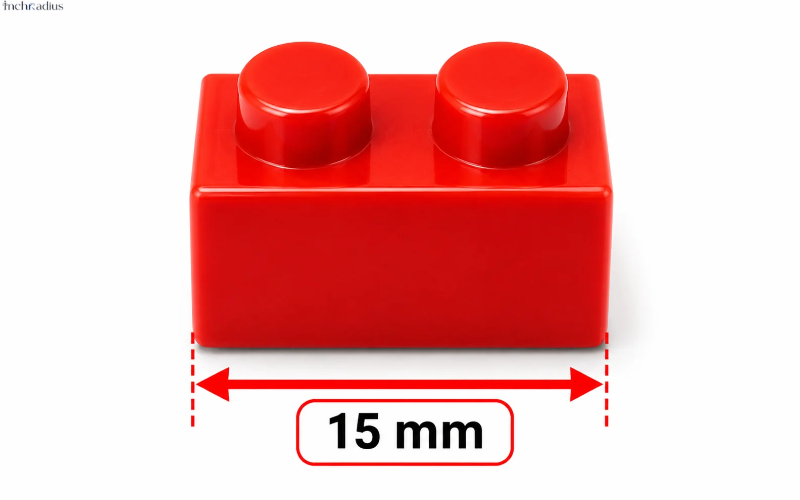
Small interlocking building bricks are familiar to children and adults. They are used for creating houses, vehicles, buildings and countless other models.
A standard LEGO-style brick has a stud-to-stud layout based on a spacing of 8mm. A brick measuring two stud spaces across is approximately 16mm wide.
That makes it a close visual comparison for 15mm. The difference is only 1mm, which is difficult to judge by eye without a ruler.
This is especially helpful if you already have building bricks at home. You can use the width of a small two-stud brick to picture a distance slightly smaller than 16mm.
Remember that the comparison is approximate. Different building systems and brick designs can have different dimensions, so it should not replace an actual measurement when accuracy matters.
Related Post: 11 Common Things That Are 16 Feet Long
9. Standard Gaming Die
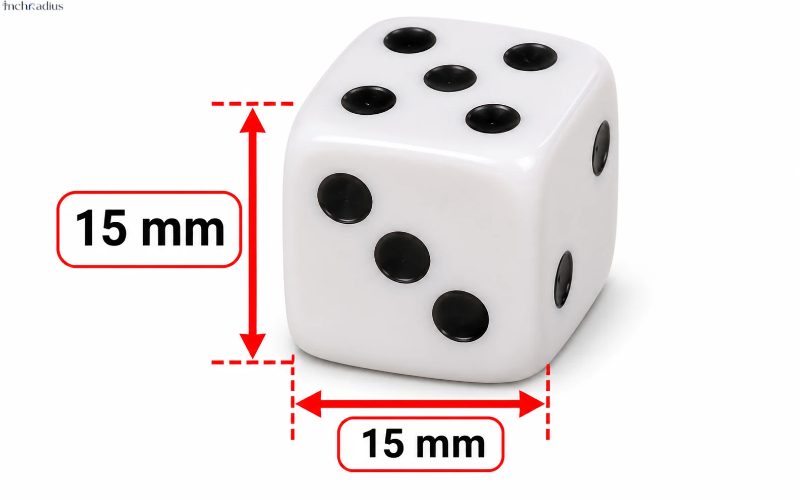
A small six-sided gaming die is another recognisable object that can help you estimate 15mm. Many standard gaming dice are sold in sizes around 16mm, although smaller and larger versions are also available.
A 16mm die is just 1mm larger than 15mm. This makes it a close comparison for visualising the target measurement.
The benefit of using a die is its square shape. You can look at any one of its faces and compare the width with a ruler. Its flat sides also make the difference easier to understand than comparing two rounded objects.
Gaming dice are used in board games, tabletop games and role-playing games. If you have a small die at home, it can provide a convenient reference for a measurement just over half an inch.
Do not assume every gaming die measures 16mm. Check its dimensions before treating it as an accurate comparison.
Related Post: 10 Common Things That Are 15 Feet Long
Measurement Without a Ruler
You do not always need a ruler or tape measure to estimate 15mm. A few everyday references can help you get reasonably close. These methods are useful for quick checks, although they should not replace proper measuring tools when accuracy is important.
1. Use the Width of Your Fingertip
The width of an adult fingertip can be a useful starting point. For many people, the index fingertip is around 15–20mm wide, although this varies considerably.
Look at the width of your index finger near the tip. If it is close to 15mm, you can use it as a rough reference when estimating a small object.
Do not assume everyone’s fingers are the same size. Your fingertip may be narrower or wider, so this method is best for approximate comparisons.
2. Use a Small Craft Bead
If you have a 15mm craft bead at home, it can serve as a reusable measuring reference. Place it beside the object you want to estimate and compare their widths.
You can also keep a bead near your craft supplies for quick size checks. Since it has a round shape, its diameter is easy to identify.
Make sure the bead is actually 15mm. Smaller beads may look similar at first glance but can differ by several millimetres.
3. Use a Standard Ruler’s Centimetre Marks
A ruler is the most reliable option if you have one available. Find the 1cm mark and then move another 5mm along the scale. The resulting distance is exactly 15mm.
This is particularly useful because many rulers show both centimetres and millimetres. You can see the small divisions between the larger centimetre marks and identify the correct distance.
If your ruler only shows centimetres, remember that 15mm is halfway between 1cm and 2cm.
Related Post: 12 Common Things That Are 14 Feet Long
FAQs
1. Is 15mm bigger than 1cm?
Yes. One centimetre equals 10mm, so 15mm is 5mm longer than 1cm. It measures exactly 1.5cm, making it one and a half times the length of a centimetre.
2. How many inches is 15mm?
15mm is approximately 0.59 inches. It is slightly shorter than five-eighths of an inch, which equals 0.625 inches. This makes 15mm just under half an inch plus another small amount.
3. Is 15mm the same as 1.5cm?
Yes. Both measurements describe exactly the same distance. Since 10 millimetres make one centimetre, 15mm converts directly to 1.5cm.
4. Is 15mm close to half an inch?
Yes. Half an inch equals 12.7mm, so 15mm is 2.3mm larger. The difference is small, making half an inch a rough visual reference, but the two measurements are not exactly equal.
5. What household object is approximately 15mm wide?
A small clothing button, a craft bead or a compact decorative fitting may measure around 15mm. However, household objects come in different sizes, so check their actual dimensions before using them for accurate measurements.
6. How can I measure 15mm without a measuring tape?
Use a ruler with millimetre markings, a verified 15mm craft bead or a suitable object with known dimensions. Your fingertip can also provide a rough estimate, but body measurements vary from person to person.
7. How many millimetres are in half an inch?
Half an inch equals exactly 12.7mm. This means 15mm is slightly longer than half an inch by 2.3mm. The difference is small but can matter when measuring fittings or choosing parts.
8. What is the difference between 15mm and 16mm?
The difference is exactly 1mm. Although this may seem tiny, it can affect how small components fit together. For example, a 16mm opening is slightly wider than a 15mm fitting, which may affect the fit depending on the materials and design.
- Discover more everyday objects and their measurements in inches
- 9 Common Things That Are 26 Inches Long
- 9 Common Things That Are 25 Inches Long
- 9 Common Things That Are 24 Inches Long
- 9 Common Things That Are 23 Inches Long
- 10 Common Things That Are 22 Inches Long
Conclusion
15mm is a small but easy-to-picture measurement once you compare it with familiar objects. It equals 1.5cm or approximately 0.59 inches, making it slightly longer than half an inch. A small wooden dowel, round craft bead or clothing button can help you visualise its width. A standard 16mm gaming die is also a useful close comparison, although it is slightly larger.
For a quick estimate, your fingertip may help, but a ruler remains the best choice when precision matters. Remember the distance between the 1cm and 2.5cm marks, and you will have a simple reference for 15mm.
