
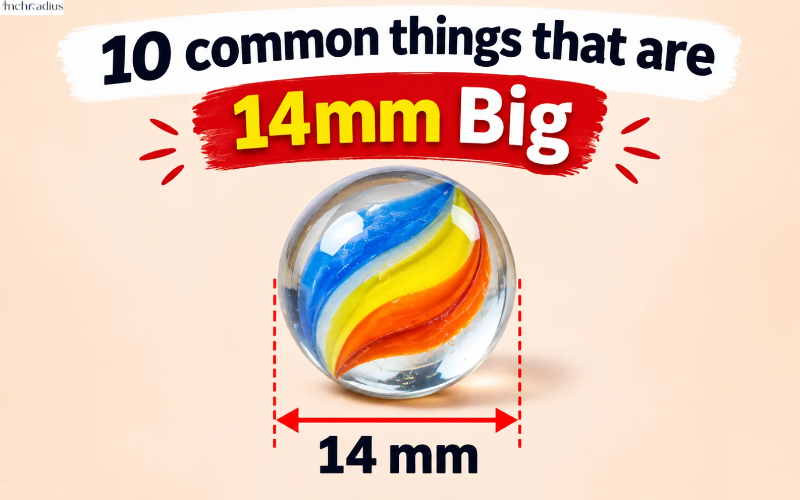
14 millimetres (mm) is a small measurement, but it is larger than many people expect. It equals 1.4 centimetres, 0.55 inches, or approximately half an inch. You can picture it as a short distance across a small button or the diameter of a little craft bead. Although 14mm may seem difficult to judge without a measuring tool, familiar household items can make it easier to visualise.
This measurement can be useful when checking small screws, choosing craft supplies, measuring accessories, or comparing the size of tiny household parts. A few everyday objects provide helpful reference points for seeing just how much space 14mm takes up.
How Long Is 14 Millimetres?
14 millimetres is exactly 1.4 centimetres. It is also equal to approximately 0.551 inches, making it slightly longer than half an inch.
Millimetres are commonly used for measuring small objects because they allow you to describe their dimensions more precisely than whole centimetres. For example, a small button might measure 14mm across, while a craft bead could have a diameter close to the same size.
To put the measurement into perspective, 14mm is a little more than the width of a standard adult fingernail. It is also shorter than the width of many small coins. These comparisons are useful because most people have handled objects of similar sizes.
You might encounter a 14mm measurement when shopping for jewellery, checking hardware, working on a small DIY project, or choosing replacement parts. Remember that the measurement describes a specific dimension, such as an object’s width, height, diameter, or length. It does not mean every part of the object measures 14mm.
Related Post: 11 Common Things That Are 13 Feet Long
How Big Is 14mm?
14mm is roughly half an inch. If you hold your thumb and index finger close together, the gap between them can help you picture this distance. However, finger sizes differ, so this should only be treated as a rough comparison.
Another way to visualise 14mm is to look at the width of a small shirt button. Many buttons used on shirts and lightweight clothing measure around this size. A small wooden bead with a 14mm diameter is another useful example.
Imagine drawing a straight line across a piece of paper that measures 14mm. It would be noticeably shorter than a 2cm line, since 2cm equals 20mm. The difference is 6mm.
A standard ruler makes the comparison easier. Find the 1cm mark and move another 4mm along the scale. The resulting distance is exactly 14mm.
This is a small measurement, but it is large enough to see clearly without a magnifying glass. Looking at familiar objects can help you estimate it when a ruler is not available.
Related Post: 12 Common Things That Are 14 Feet Long
10 Common Things That Are About 14mm Big
Several small household, craft, clothing, and hardware items have at least one dimension close to 14mm. Some are designed around this measurement, while others vary slightly depending on the manufacturer.
The following table provides ten different examples. For round objects, the measurement refers to their diameter. For flat or shaped objects, it refers to their width or another clearly defined dimension.
| Everyday Item | Actual Size |
| Small wooden craft bead | 14mm |
| Shirt button | 14mm |
| Narrow watch strap | 14mm |
| Small glass marble | 14mm |
| M8 hexagonal nut | 14mm |
| Small cork stopper | 14mm |
| Wooden dowel | 14mm |
| Crochet hook | 14mm |
| Craft pom-pom | 14mm |
| Small rubber furniture bumper | 14mm |
These are approximate comparison sizes, not universal specifications. Actual dimensions depend on the product and manufacturer.
1. Small Wooden Craft Bead
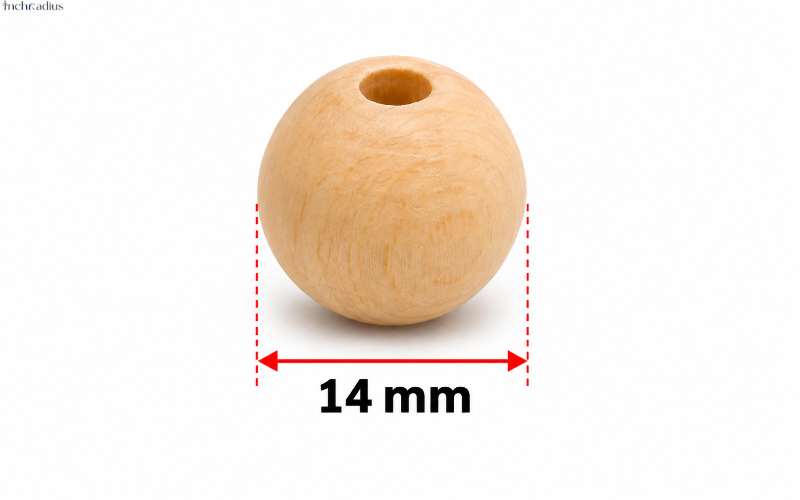
A small wooden craft bead measuring around 14mm in diameter is a useful way to picture this measurement. These beads are commonly used in jewellery making, decorative crafts, children’s craft projects, and handmade accessories.
Their round shape makes the comparison particularly simple. Imagine measuring straight across the widest part of the bead, from one outer edge to the opposite edge. That distance would be approximately 14mm.
Wooden beads are available in many sizes, including 6mm, 8mm, 10mm, and 14mm. The larger examples are easy to handle and can be used for necklaces, bracelets, keychains, and hanging decorations.
If you have a wooden bead collection at home, look for one that measures close to 1.4cm across. It offers a practical visual reference for understanding how big 14mm really is.
Related Post: 10 Common Things That Are 15 Feet Long
2. Shirt Button
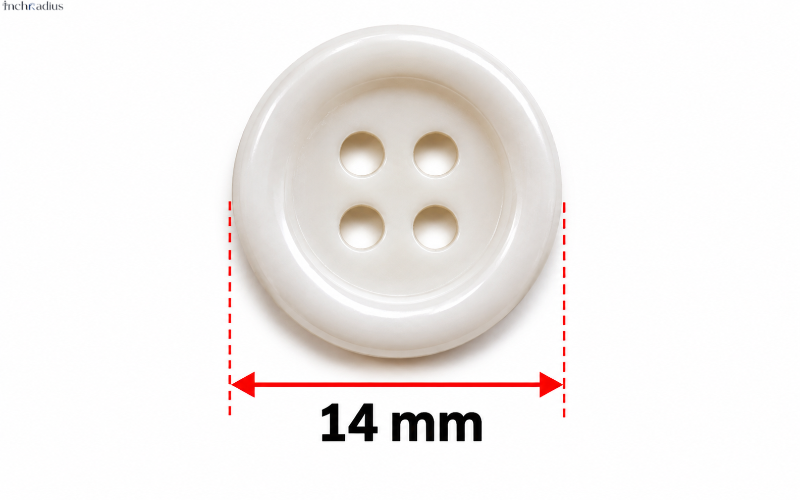
A small shirt button can have a diameter of approximately 14mm. This size is often found on lightweight shirts, children’s clothing, and some everyday garments.
To use it as a comparison, measure straight across the button’s circular face. Do not include the sewing thread or any fabric around it. A button measuring 14mm across has almost the same diameter as a small craft bead of the same size.
Buttons are made from plastic, wood, metal, shell, and other materials. Their dimensions vary according to the type of clothing and the design.
If you are replacing a missing button, checking its diameter is important because even a small difference can affect how it looks and fits through the buttonhole. A 14mm button is also a convenient object to compare with the half-inch mark on a ruler.
Related Post: 11 Common Things That Are 16 Feet Long
3. Narrow Watch Strap
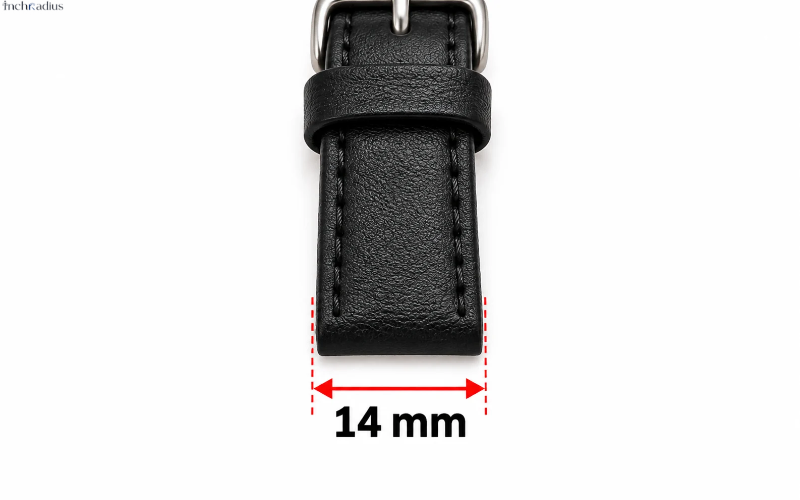
Some narrow watch straps are designed with a width of approximately 14mm. This measurement is taken across the strap, not along its length.
Watch straps are available in several widths, including 12mm, 14mm, 16mm, 18mm, and 20mm. A 14mm strap is relatively narrow and is commonly associated with smaller watches and delicate wristwatch designs.
You can use the width of a suitable watch strap to visualise 14mm. Place it flat on a table and look at the distance from one side to the other. That short span gives you a useful idea of the measurement.
This example is especially helpful when buying a replacement watch band. The strap width must match the watch’s lug width to fit properly. Always check the manufacturer’s stated dimensions rather than assuming every narrow strap measures 14mm.
4. Small Glass Marble
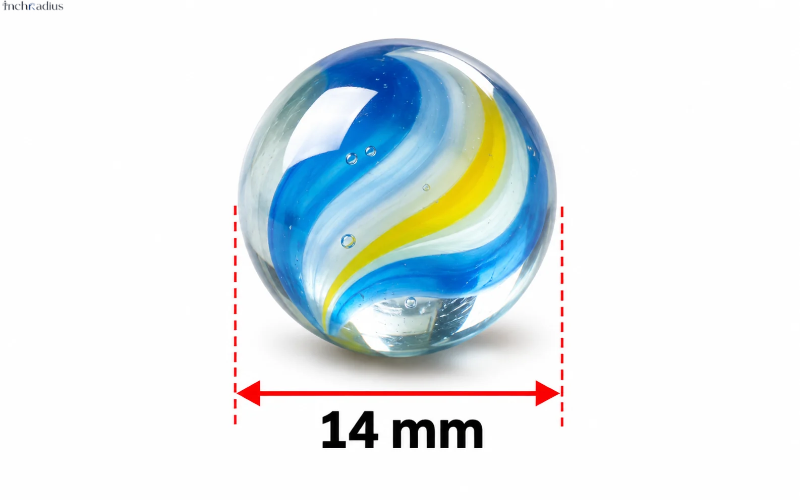
Small glass marbles are another interesting way to visualise a measurement close to 14mm. Although many traditional playing marbles are larger, smaller decorative and craft marbles are available in different diameters.
A marble measuring approximately 14mm across is just 1.4cm wide. Its round shape makes it easy to understand the measurement because you can look directly at its diameter.
Glass marbles are used in decorative jars, handmade ornaments, craft projects, and small display arrangements. They may be transparent, coloured, patterned, or completely opaque.
If you have several marbles at home, compare their sizes side by side. A smaller marble will help you picture how much space 14mm occupies. Just remember that marble sizes are not standard across every product range. Check the packaging or measure the marble before using it as an accurate reference.
Related Post: 11 Common Things That Are 17 Feet Long
5. M8 Hexagonal Nut
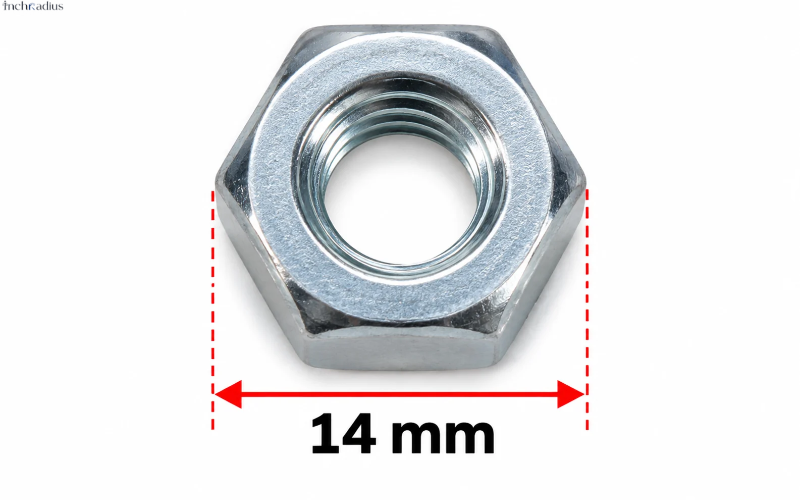
A standard M8 hexagonal nut is a useful hardware comparison, although its width across the flats is normally around 13mm rather than exactly 14mm under common metric standards.
The difference is just 1mm, making it a reasonably close visual reference. An M8 nut is designed to fit an 8mm threaded bolt. Its six-sided shape provides flat surfaces that a spanner can grip.
You can look at the distance between two opposite flat sides of the nut to understand its width. This is called the width across flats.
Small nuts are commonly found in furniture fittings, bicycle repairs, machinery, and household DIY projects. If you work with basic tools, you may already have several in a toolbox.
Although this nut is slightly smaller than 14mm across its flats, it helps demonstrate how compact a measurement of this size can be. For an exact 14mm hardware dimension, a 14mm spanner or socket provides a closer reference.
6. Small Cork Stopper
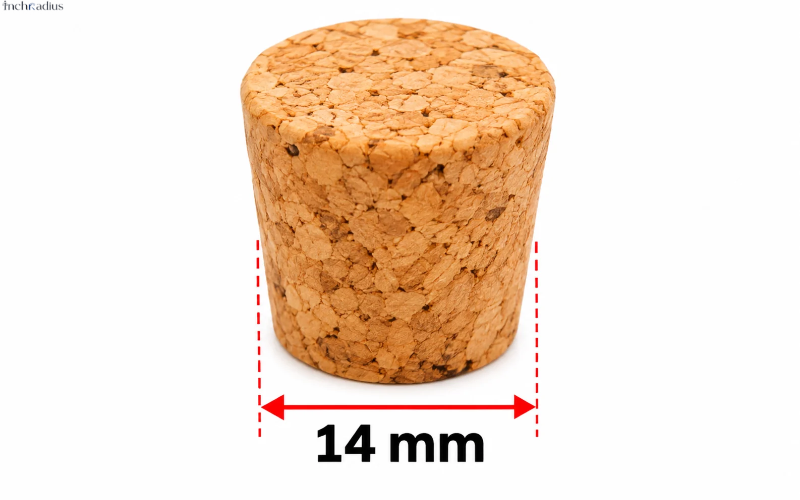
A small cylindrical cork stopper can have a diameter close to 14mm. These little plugs are used for bottles, miniature containers, craft projects, and decorative glass vessels.
To compare one with 14mm, look at its circular end. The distance from one side of the circle to the other represents its diameter. Some small cork stoppers are made with a diameter of around 1.4cm, although the exact size depends on the container they are designed to fit.
Cork is a lightweight natural material. It can be compressed slightly, which helps it form a snug fit inside a suitable opening.
You might find small cork pieces in craft shops or among the accessories supplied with miniature bottles. They are particularly useful for visualising a measurement because their circular ends provide a clear reference.
If you are buying a replacement stopper, measure the opening and the cork separately. A close visual match does not always guarantee a proper fit.
Related Post: 10 Common Things That Are 18 Feet Long
7. Wooden Dowel
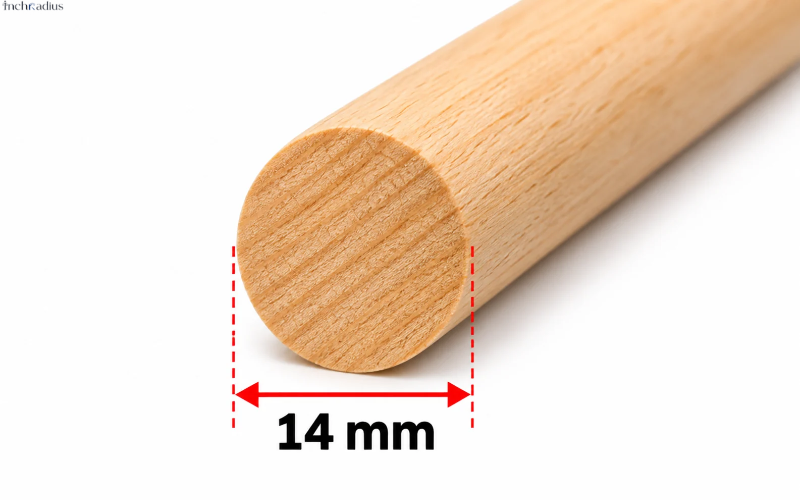
A wooden dowel with a diameter of 14mm provides a direct example of this measurement. Dowels are round wooden rods used in furniture construction, craft work, woodworking, and small repair jobs.
The 14mm measurement refers to the thickness of the rod, not its overall length. A dowel can be much longer than 14mm while still having a diameter of this size.
For example, a wooden rod measuring 30cm long could have a thickness of 14mm. Looking at its circular end gives you a clear idea of how wide 14mm is.
Wooden dowels are available in several thicknesses. The right size depends on the project, particularly when joining two pieces of wood or creating a support structure.
If you have a spare dowel at home, place its cut end next to a ruler. This makes it easier to see the difference between 1cm and 14mm.
8. Crochet Hook
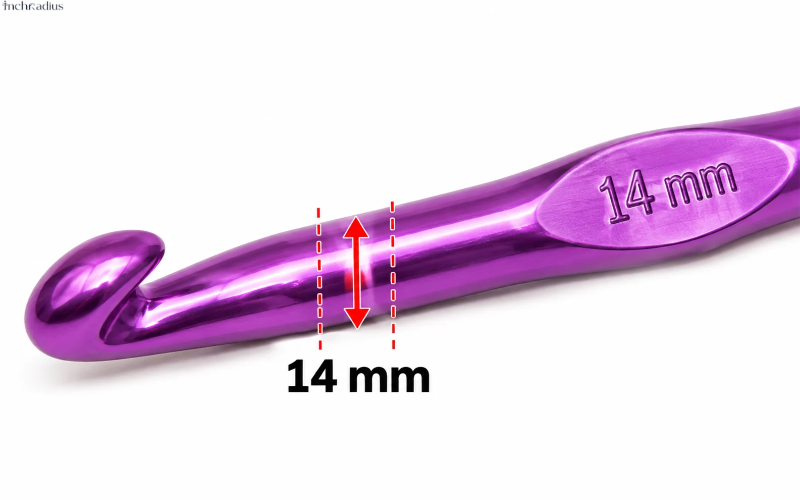
A 14mm crochet hook is a particularly useful comparison because the measurement is printed as part of its size specification.
Crochet hooks are available in different thicknesses, with smaller hooks used for fine thread and larger hooks used for bulky yarn. A 14mm hook is considered a large hook and is generally used with thick yarn or chunky materials.
The measurement refers to the diameter of the hook’s shaft. It does not describe the complete length of the tool.
If you have a crochet hook set, compare a large hook with a smaller one. The difference in thickness becomes easy to see. A 14mm hook has a shaft approximately 1.4cm across.
This example is particularly useful for people who enjoy knitting, crochet, or handmade crafts. It also demonstrates why millimetres are important when choosing tools: a difference of just a few millimetres can change how a project looks and feels.
Related Post: 11 Common Things That Are 19 Feet Long
9. Craft Pom-Pom
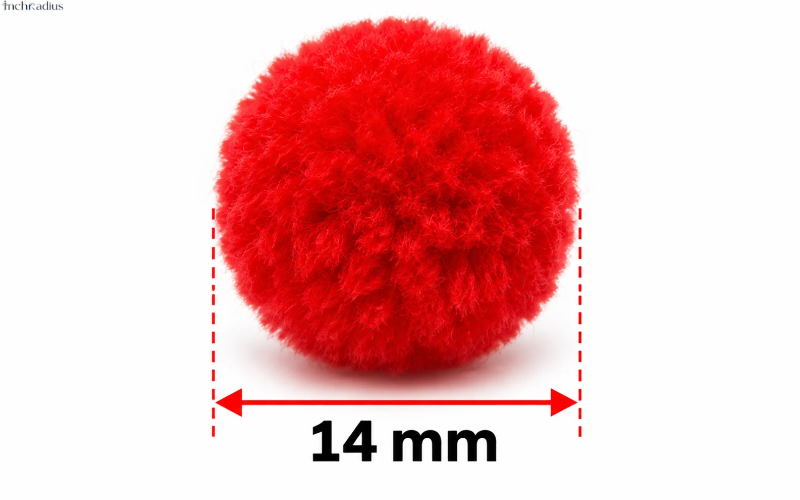
Small craft pom-poms are sold in a range of diameters, and some varieties measure approximately 14mm across.
These soft decorative balls are made from fibres that create a fluffy, rounded shape. They are used in school projects, handmade cards, decorations, toys, gift wrapping, and various DIY activities.
Unlike a solid wooden bead, a pom-pom does not always have a perfectly defined edge. Its fibres can spread out or become compressed when handled. This means its diameter is usually approximate rather than exact.
To picture 14mm, look at the widest part of a small pom-pom. A piece measuring close to 1.4cm across gives you a useful idea of the measurement.
You can also place it beside a ruler without pressing it down. This helps you compare its natural size with the 10mm and 20mm marks.
For accurate craft work, check the manufacturer’s listed diameter because different pom-pom packs may contain slightly different sizes.
10. Small Rubber Furniture Bumper
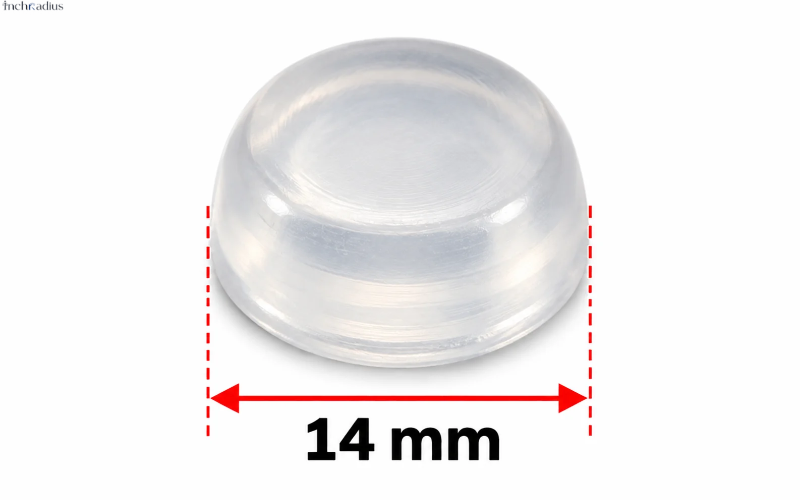
Small rubber furniture bumpers are commonly used to reduce noise and prevent surfaces from knocking against each other. They can be attached to cupboard doors, drawers, cabinets, and other household furniture.
Some round bumper pads have a diameter close to 14mm. This makes them a useful example of a small measurement found in everyday household fittings.
The measurement should be taken across the widest part of the circular bumper. Its thickness is a separate dimension and may be much smaller.
Rubber bumpers are available in transparent, white, black, and other finishes. Some are flat, while others have a slightly raised or domed shape.
If you have a spare bumper pad in your toolbox, compare its width with a ruler. You will see that a 14mm diameter takes up slightly more space than a 1cm mark.
These small fittings are easy to overlook, but their dimensions matter when choosing replacements for furniture and cabinets.
Related Post: 10 Common Things That Are 20 Feet Long
How to Measure 14mm Without a Ruler
You do not always need a measuring tape or ruler to get a rough idea of 14mm. A few familiar objects can help you estimate the distance.
1. Use the Width of Your Fingernail
Look at your thumb or index finger and estimate a distance across its nail. Depending on your hand size, the width may be close to 14mm.
Place the nail next to the object you want to compare. This gives you a quick visual reference.
Remember that fingernails vary considerably between people. Use this method only for rough estimates, not precise measurements.
2. Compare It with Half an Inch
14mm is approximately 0.55 inches, which is slightly longer than half an inch.
If you have a ruler marked in inches, locate the half-inch point. The 14mm distance extends just a little beyond it.
This is a practical method because half an inch is a familiar measurement for many people. It is also useful when checking small craft supplies or household fittings.
3. Use a Small Craft Bead
A wooden or plastic craft bead measuring approximately 14mm across can serve as a reusable reference.
Place the bead next to the item you want to measure. Compare their widest dimensions to see whether they are similar.
A bead with a known diameter is more reliable than estimating with your fingers. However, make sure its size is actually 14mm rather than assuming all small beads have the same dimensions.
Related Post: 11 Common Things That Are 21 Feet Long
FAQs
1. Is 14mm bigger than 1cm?
Yes. 14mm is bigger than 1cm because 1cm equals 10mm. The difference is 4mm. In centimetres, 14mm is exactly 1.4cm, making it noticeably longer than a single centimetre.
2. How many inches is 14mm?
14mm is approximately 0.551 inches. For everyday comparisons, you can round this to about 0.55 inches. It is slightly longer than half an inch, which measures exactly 12.7mm.
3. Is 14mm the same as 1.4cm?
Yes. 14mm and 1.4cm represent exactly the same distance. There are 10 millimetres in every centimetre, so dividing 14 by 10 gives 1.4cm.
4. What household object is approximately 14mm wide?
A small shirt button or a wooden craft bead can measure approximately 14mm across. Small rubber furniture bumpers may also have a similar diameter. Their actual dimensions vary, so check the product specifications if accuracy matters.
5. Is 14mm close to half an inch?
Yes. Half an inch is exactly 12.7mm, while 14mm is 1.3mm longer. The difference is quite small, so half an inch can be a convenient way to picture 14mm.
6. How can I measure 14mm accurately?
Use a millimetre ruler or digital calliper. Align one edge of the object with the zero mark and read the measurement at the opposite edge. For round objects, measure straight across the centre to find the diameter.
7. How many millimetres are in 14mm?
There are exactly 14 millimetres in 14mm. It is already expressed in millimetres, so no conversion is needed. The same measurement can also be written as 1.4cm or approximately 0.551 inches.
8. Is 14mm considered a small measurement?
Yes. 14mm is a relatively small measurement, measuring just over one centimetre. It is commonly useful for describing small fittings, buttons, beads, craft materials, and tool dimensions. Although small, it is easy to see and compare with everyday objects.
- Discover more everyday objects and their measurements in inches
- 9 Common Things That Are 27 Inches Long
- 9 Common Things That Are 26 Inches Long
- 9 Common Things That Are 25 Inches Long
- 9 Common Things That Are 24 Inches Long
- 9 Common Things That Are 23 Inches Long
Conclusion
14mm is a little more than half an inch and measures exactly 1.4cm. Small wooden beads, shirt buttons, narrow watch straps, and rubber furniture bumpers can all help you picture a distance close to this size. A 14mm crochet hook also provides a practical example because its thickness is based on a stated measurement.
If you need to remember this size, think of a small craft bead or a shirt button. Both offer familiar visual references. For accurate work, though, use a millimetre ruler or calliper rather than relying on an approximate comparison.
