
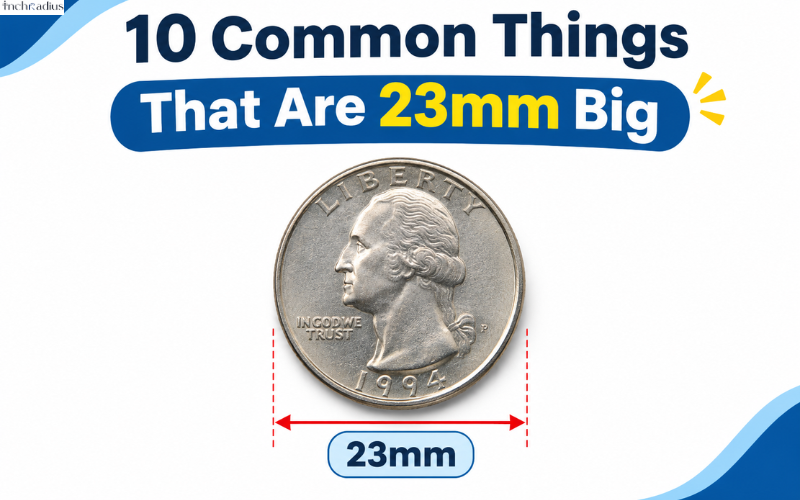
23 millimetres (23mm) is a small measurement, but it is larger than you might imagine. It equals 2.3 centimetres, 0.91 inches, or approximately 0.075 feet. It is just slightly shorter than one inch, making it easier to picture when compared with small coins, buttons, craft supplies and other everyday objects.
You might come across this measurement when checking the size of a small component, choosing a button, measuring a gap or looking at the dimensions of a household item. Since 23mm is not always easy to judge by eye, familiar objects can help you get a better sense of its width, height or length.
How Long Is 23mm?
23mm is exactly 23 millimetres on a ruler. It is a little less than one inch, which measures 25.4mm. The difference between the two measurements is only 2.4mm, so 23mm comes very close to the length of a standard inch.
Here are the exact conversions:
- Millimetres: 23mm
- Centimetres: 2.3cm
- Inches: 0.9055 inches (approximately 0.91 inches)
- Metres: 0.023 metres
- Feet: Approximately 0.0755 feet
In everyday terms, 23mm is a little more than two centimetres. It is a suitable size for small household components, craft materials and compact accessories.
You might encounter measurements around 23mm when looking at the diameter of a coin, the width of a button or the dimensions of a small decorative item. Remember that the measurement can describe different directions. For a round object, it usually refers to its diameter, while for a rectangular object, it might refer to its width, height or thickness.
Related Post: 10 Common Things That Are 10 Feet Big
How Big Is 23mm?
The easiest way to picture 23mm is to imagine a distance slightly shorter than the width of a standard one-inch section on a ruler. It is not particularly large, but it is big enough to see clearly without magnification.
A one-euro coin provides a particularly useful comparison. Its diameter is approximately 23.25mm, making it almost the same size as the measurement. A 20-cent euro coin is also close, although it is slightly smaller.
You can also picture 23mm as the width of a large shirt button or a small wooden craft cube. These objects help make the measurement feel more familiar because you can hold them between your fingers and compare their dimensions.
On a ruler, 23mm sits between the 2cm and 3cm marks, three millimetres beyond the 2cm line. This is a simple way to locate the measurement when you have a measuring tool available.
10 Common Things That Are 23mm Big
Several everyday objects have at least one dimension close to 23mm. Some are round, while others are square or rectangular. Their actual sizes can vary depending on their design and manufacturer, so the following examples are useful visual comparisons rather than universal exact measurements.
Related Post: 11 Common Things That Are 11 Feet Long
| Everyday Item | Actual Size |
| One-euro coin | 23mm |
| 20-cent euro coin | 23mm |
| Large shirt button | 23mm |
| Small wooden craft cube | 23mm |
| Round fridge magnet | 23mm |
| Small cork stopper | 23mm |
| Miniature building brick | 23mm |
| Round craft cabochon | 23mm |
| Small decorative badge | 23mm |
| Compact sewing button | 23mm |
1. One-Euro Coin
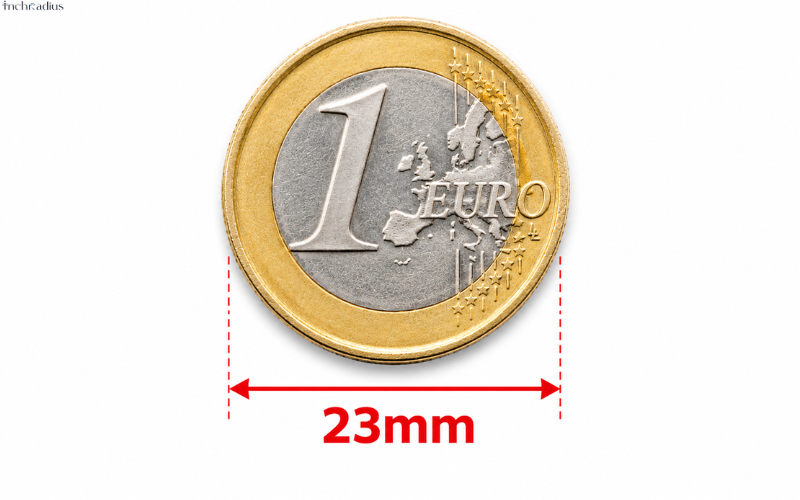
A one-euro coin is one of the closest everyday comparisons to 23mm. It has a diameter of approximately 23.25mm, which means it is only 0.25mm larger than the measurement. That tiny difference is difficult to notice without a precise measuring instrument.
The coin is also useful because most people can recognise its shape and understand its size immediately. Place it flat on a table and look at the distance from one outer edge to the opposite edge. That gives you a very close picture of 23mm.
If you have a one-euro coin available, compare it with the 23mm mark on a ruler. You will see that the two measurements are almost identical. It is a particularly reliable comparison because the coin has a standard diameter rather than a size that changes from one manufacturer to another.
Related Post: 10 Common Things That Are 12 Feet Long
2. 20-Cent Euro Coin
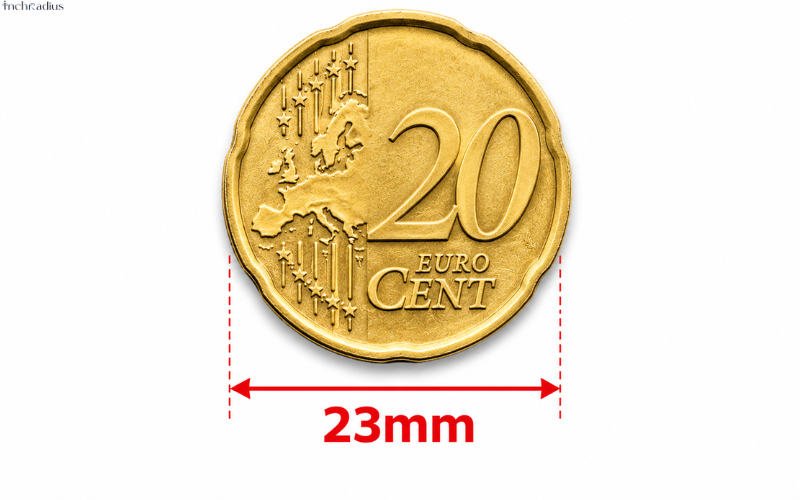
A 20-cent euro coin is another useful reference, although it is slightly smaller than 23mm. Its diameter is approximately 22.25mm, leaving a difference of just 0.75mm.
The coin has a distinctive seven-sided shape with rounded edges. This makes it easy to recognise when comparing it with other small objects. Its size is close enough to help you estimate 23mm without needing to carry a ruler.
Place the coin on a flat surface and measure across its widest part. The distance will be just under 23mm. You can imagine adding less than one millimetre to its width to reach the target measurement.
This comparison is particularly helpful if you live in a country where euro coins are commonly used. However, remember that the 20-cent coin is a little smaller, not an exact 23mm example.
Related Post: 11 Common Things That Are 13 Feet Long
3. Large Shirt Button
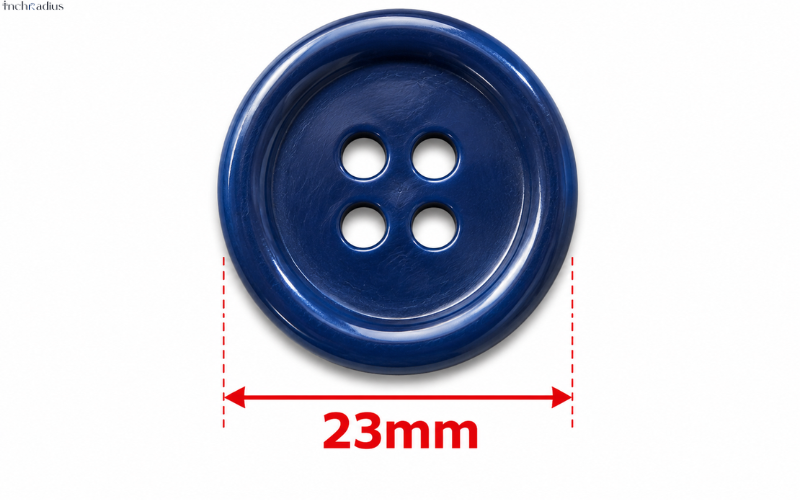
A large shirt button can provide a familiar comparison for 23mm. Buttons are manufactured in different diameters, and some larger clothing buttons measure around 22–24mm across.
You can find buttons of this size on coats, cardigans, jackets and heavier shirts. Their round shape makes it simple to compare the diameter with the measurement you are trying to picture.
To estimate 23mm, look at the button from directly above and imagine a straight line running from one outer edge to the opposite edge through its centre. That line represents its diameter.
Not every large shirt button will be this size. Some are considerably smaller, while decorative coat buttons can be larger. If you have a button close to 23mm, it makes a practical household reference for visualising a little less than one inch.
4. Small Wooden Craft Cube
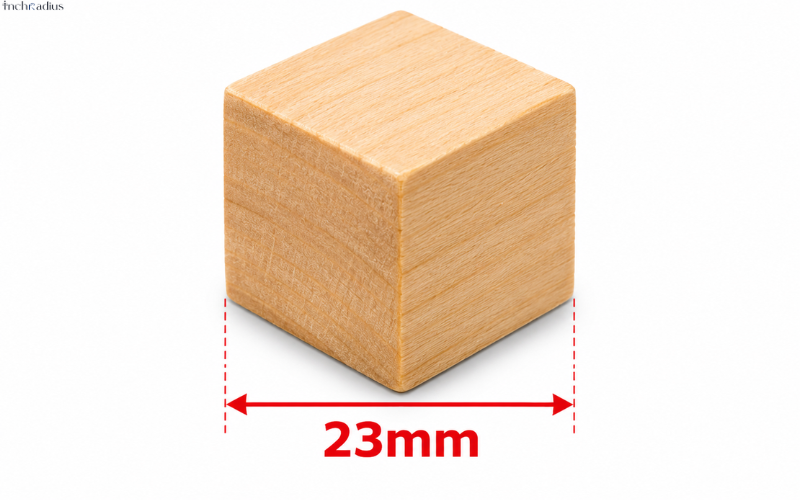
A small wooden craft cube measuring approximately 23mm on each side is another way to picture this measurement. These cubes are used in school projects, handmade decorations, craft activities and small DIY models.
Unlike a coin or button, a cube gives you several straight edges to compare. Each side can be close to 23mm, making it useful for understanding the measurement in three dimensions.
Hold the cube between your thumb and index finger. Its width gives you an idea of how much space 23mm occupies. You can also place it beside a ruler to check the length of one side.
Wooden craft cubes come in many sizes, so check the product dimensions before using one as a reference. A cube measuring 23mm on each side is particularly helpful because its width and height are both close to the target.
Related Post: 12 Common Things That Are 14 Feet Long
5. Round Fridge Magnet
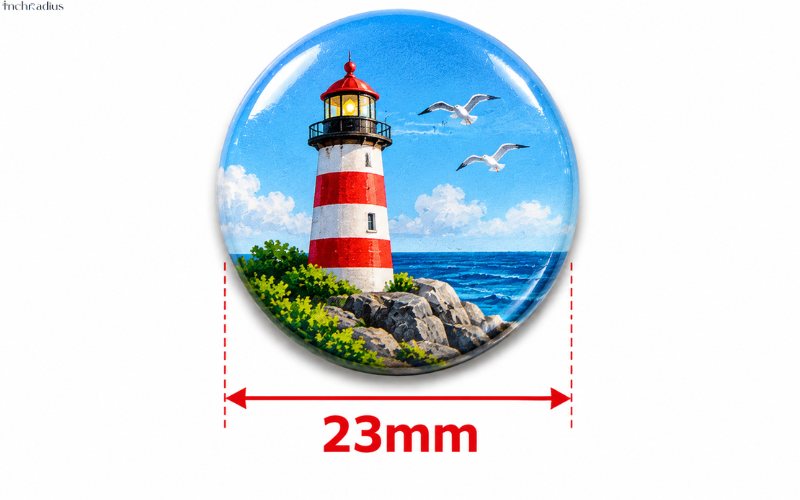
Small round fridge magnets are available in many shapes and sizes. Some decorative magnets have a diameter close to 23mm, making them a useful comparison for this measurement.
You might find these magnets on a refrigerator, magnetic noticeboard or metal cabinet. Their flat circular design makes the width easy to understand. Simply look at the distance across the centre, from one outer edge to the other.
A magnet measuring approximately 23mm across would look slightly shorter than a one-inch section on a ruler. You can also hold it between two fingers to get a sense of its size.
Keep in mind that fridge magnets are not made to one standard diameter. Some are tiny, while others are much larger. A small round magnet measuring around 22–24mm is the type that works best for this comparison.
Related Post: 10 Common Things That Are 15 Feet Long
6. Small Cork Stopper
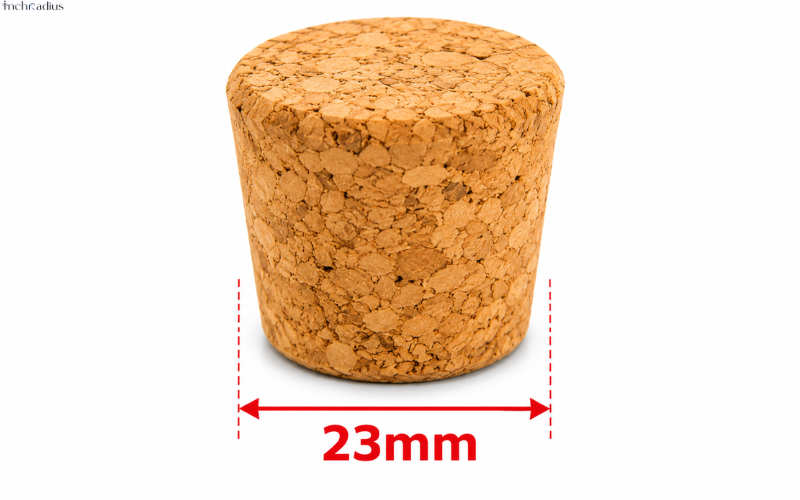
A small cork stopper from a miniature bottle can help you visualise a measurement close to 23mm. Depending on its design, the wider end or overall diameter may be around 22–24mm.
Cork stoppers are commonly used to seal small glass bottles, decorative containers and craft storage jars. Their slightly rough texture and natural colour make them easy to recognise.
For this comparison, focus on the width of the stopper rather than its length. Some corks are long and narrow, while others are short and fairly wide. The diameter of the wider section is the dimension that matters.
If you find a cork stopper measuring approximately 23mm across, place it next to a ruler to see how close it is to the target. It provides a useful example of a small cylindrical object with a width of just over two centimetres.
Related Post: 11 Common Things That Are 16 Feet Long
7. Miniature Building Brick
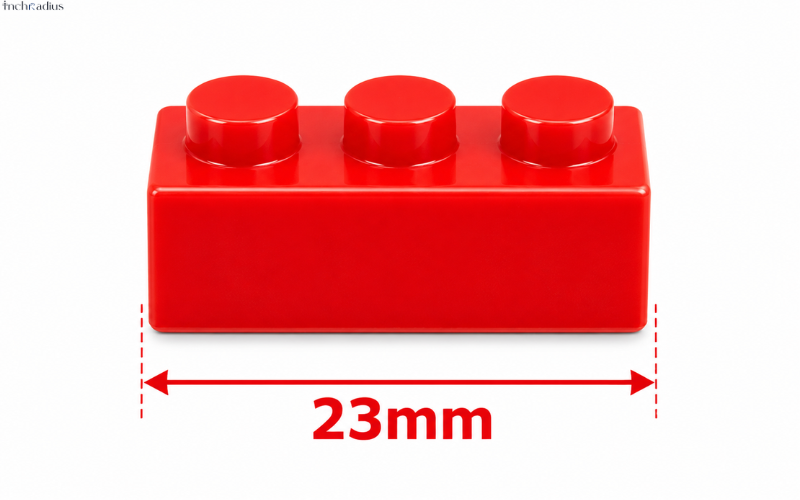
Small plastic building bricks are familiar to children and adults who enjoy construction toys. A brick with a width of approximately 23–24mm can give you a useful idea of how big 23mm is.
Some standard toy building systems use stud spacing of around 8mm. A brick measuring three stud spacings across can therefore have a width close to 24mm. That makes it just slightly wider than the target measurement.
The advantage of using a building brick is its straight-sided shape. You can easily identify its width and compare it with the distance on a ruler.
Be careful not to confuse the width with the length or height. Building bricks come in many combinations, and their dimensions depend on how many studs they have. A small three-stud-wide piece is the most relevant comparison here.
8. Round Craft Cabochon
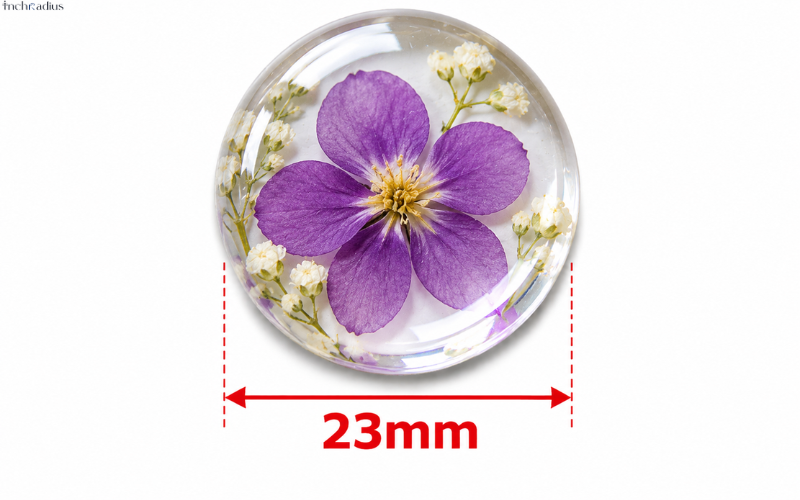
A round glass or resin cabochon is a small decorative piece used in jewellery making and craft projects. Some designs are available in diameters close to 23mm.
These pieces are usually smooth, rounded and slightly raised. They can be used to decorate pendants, rings, hair accessories and handmade ornaments.
The circular shape makes the comparison straightforward. Measure across the widest part of the cabochon, passing through its centre. If it measures around 23mm, it will provide a close visual reference.
One useful detail is that cabochons can have different thicknesses as well as different diameters. For this example, the important measurement is the width across the front, not the height of the raised surface.
A cabochon of this size is also small enough to sit comfortably between your thumb and forefinger, helping you picture how much space 23mm takes up.
Related Post: 11 Common Things That Are 17 Feet Long
9. Small Decorative Badge
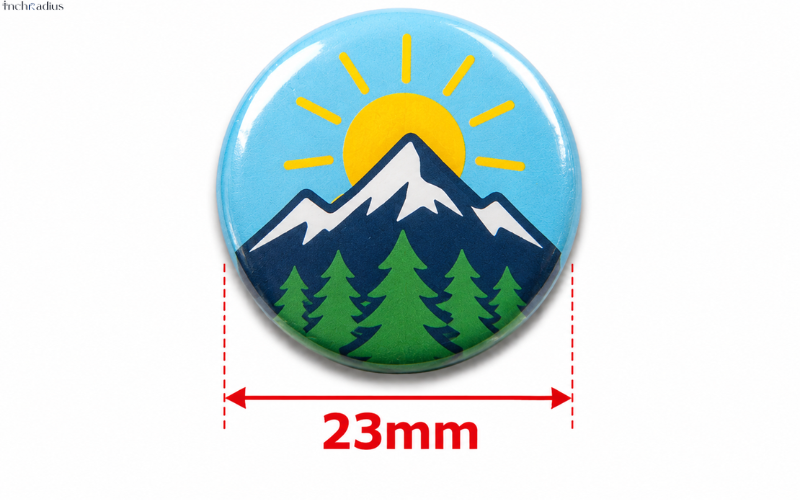
Small decorative badges are often attached to bags, jackets, pencil cases and other accessories. Some compact designs have a circular face measuring approximately 23mm across.
The front of the badge is the part to examine when making this comparison. Its diameter gives you a useful idea of the target measurement, especially if the badge has a simple round shape.
A badge around this size is noticeably smaller than a typical large jacket button but still easy to see and handle. Its surface provides a clear outline, which makes the width easier to judge by eye.
Decorative badges are available in many sizes, so the comparison depends on the particular design. Look for a compact badge with a diameter close to 23mm rather than a larger promotional or souvenir badge.
Related Post: 10 Common Things That Are 18 Feet Long
10. Compact Sewing Button
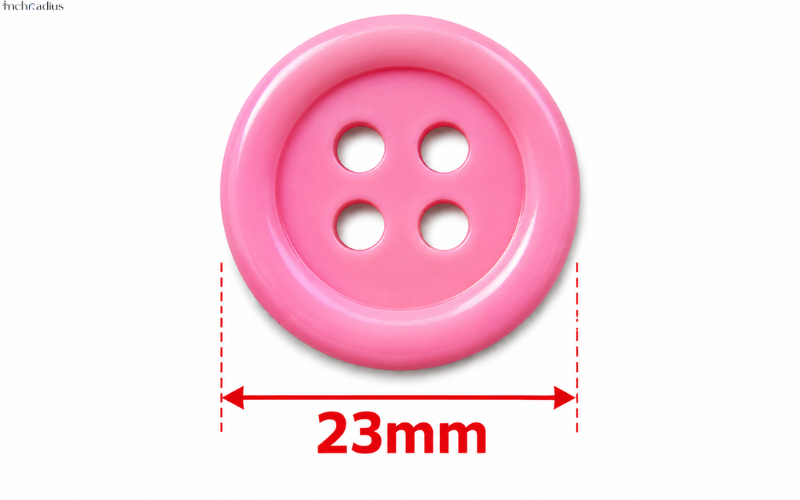
A compact sewing button can also help you understand a measurement close to 23mm. Some medium-to-large buttons used on shirts, cardigans and lightweight jackets have diameters around this size.
Unlike tiny buttons used on cuffs or children’s clothing, these buttons have enough surface area to make their width easy to see. Their holes also help distinguish them from coins and other circular objects.
Place the button on a flat surface and compare its diameter with a ruler. If it measures approximately 23mm, you will have a useful reference for the target size.
Buttons are manufactured in a wide range of diameters, so do not assume that every sewing button measures 23mm. Choose one that is close to the measurement. Its familiar shape and flat surface make it an easy object to keep as a quick visual reference.
Related Post: 11 Common Things That Are 19 Feet Long
How to Measure 23mm Without a Ruler
You do not always need a measuring tape or ruler to estimate 23mm. A few familiar objects and simple techniques can help you get reasonably close. These methods are useful for everyday tasks, although they should not replace accurate measuring equipment when precision matters.
1. Use a One-Euro Coin
If you have a one-euro coin, you already have an excellent reference. Its diameter is approximately 23.25mm, which is almost identical to 23mm.
Place the coin on a flat surface and look at its width from one edge to the other. This gives you a close estimate without needing to count individual millimetre marks.
2. Use Your Thumb and Index Finger
You can use the space between your thumb and index finger to estimate a small measurement. Gently position them about 23mm apart and remember how the distance feels.
However, finger sizes differ from person to person. A gap that looks like 23mm on one person’s hand may be larger or smaller on someone else’s. Treat this method as a rough visual estimate rather than an exact measurement.
3. Compare It with a One-Inch Mark
If you have access to a ruler marked in inches, locate the one-inch mark. One inch equals 25.4mm, so 23mm is slightly shorter.
Imagine removing approximately 2.4mm from the one-inch distance. The remaining length is very close to 23mm.
This technique is particularly useful if you are familiar with inches but do not regularly work with metric measurements.
Related Post: 11 Common Things That Are 21 Feet Long
FAQs
1. Is 23mm bigger than 2cm?
Yes. 23mm is bigger than 2cm because 2cm equals 20mm. The difference is 3mm. In centimetres, 23mm is exactly 2.3cm, so it extends slightly beyond the 2cm mark on a ruler.
2. How many inches is 23mm?
23mm is approximately 0.91 inches. More precisely, it equals 0.9055 inches. This makes it slightly shorter than one full inch, which measures exactly 25.4mm.
3. Is 23mm close to one inch?
Yes, 23mm is quite close to one inch. The difference is only 2.4mm. A one-euro coin, with a diameter of approximately 23.25mm, is an especially useful real-life comparison.
4. How many centimetres are in 23mm?
There are 2.3 centimetres in 23mm. To convert millimetres into centimetres, divide the millimetre value by 10. Therefore, 23 divided by 10 gives 2.3cm.
5. What does 23mm look like on a ruler?
On a metric ruler, 23mm is located between the 2cm and 3cm marks. It is three small millimetre divisions beyond the 2cm line. This makes it easy to locate when using a ruler with clear metric markings.
6. Is 23mm the same as 2.3cm?
Yes. Both measurements describe exactly the same distance. Millimetres and centimetres are metric units, and one centimetre contains 10 millimetres. Therefore, 23mm and 2.3cm are equal.
7. What common coin is closest to 23mm?
A one-euro coin is particularly close. Its diameter is approximately 23.25mm, only 0.25mm larger than 23mm. A 20-cent euro coin is another close comparison, measuring approximately 22.25mm across.
8. How can I measure 23mm accurately?
A metric ruler with millimetre markings is the simplest option. Place the starting edge of the object at the zero mark and read the distance at the opposite edge. For greater precision, particularly when measuring small components, use a digital calliper.
- Discover more everyday objects and their measurements in inches
- 10 Common Things That Are 30 Inches Long
- 8 Common Things That Are 29 Inches Long
- 9 Common Things That Are 28 Inches Long
- 9 Common Things That Are 27 Inches Long
- 9 Common Things That Are 26 Inches Long
- 9 Common Things That Are 25 Inches Long
Conclusion
23mm is a little less than one inch and measures exactly 2.3cm. The easiest way to remember its size is to picture a one-euro coin, which has a diameter of approximately 23.25mm. A 20-cent euro coin, large clothing buttons and small craft pieces also provide useful comparisons. If you do not have a ruler nearby, these familiar objects can help you estimate the distance.
For a more accurate result, place the object against a metric ruler and check the millimetre markings. Remember that 23mm sits just three millimetres beyond the 2cm mark.
