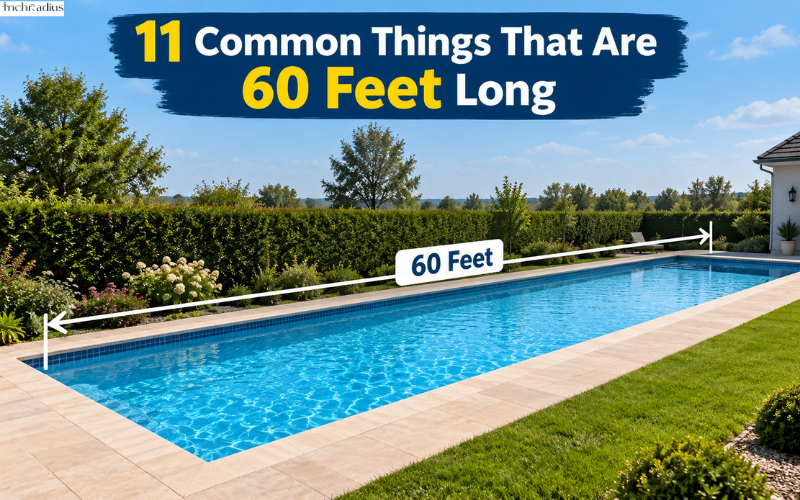
60 feet is exactly 720 inches, 18.288 metres, or 1,828.8 centimetres. It is a considerable length, roughly comparable to the height of a six-storey building or the length of a large recreational vehicle and trailer combination. Although most people can picture a few feet quite easily, visualising 60 feet can be more difficult without a familiar reference. This distance appears in everyday surroundings, including boats, garden spaces, swimming pools, ladders and large outdoor structures.
Comparing it with recognisable objects makes the measurement easier to imagine. These examples also help when estimating distances for home projects, planning outdoor spaces or simply satisfying your curiosity about how long 60 feet really is.
How Long Is 60 Feet?
Sixty feet is a linear measurement equal to 20 yards or 720 inches. In metric units, it measures 18.288 metres, which is approximately 18.29 metres when rounded to two decimal places. This length is nearly the same as the height of a six-storey building, although the height of individual buildings varies considerably.
To picture the distance, imagine walking along a straight path from one end of a large garden to the other. If the path measures 60 feet, you would cover the equivalent of 20 three-foot sections. That makes it a useful reference for planning garden layouts, checking available space or estimating the length of a driveway.
The measurement also appears in larger equipment and outdoor structures. A long recreational vehicle combination, a sizeable boat or a section of fencing may approach this length. Actual dimensions vary by model and design, so these objects should be treated as comparisons rather than exact standards.
Related Post: How Long Is 50 Feet? 12 Common Things That Are 50 Feet Long
How Big Is 60 Feet?
Sixty feet is long enough to span a substantial part of a garden, a large outdoor recreation area or a long driveway. Imagine marking a starting point on the ground and walking forwards for 20 yards. The distance covered gives you a useful sense of the length, especially if you are familiar with a sports field.
You can also picture a line of six objects, each measuring about 10 feet long, placed end to end. Together, they would cover 60 feet. This mental image is easier to manage than trying to imagine one uninterrupted distance.
Household objects are generally too small to provide a direct comparison. A standard sheet of A4 paper is only about 11.7 inches long, so more than 61 sheets placed end to end would be needed to reach 60 feet. That illustrates why larger references, such as boats, ladders and outdoor structures, are more practical for visualising this measurement.
11 Common Things That Are 60 Feet Long
The following examples show how 60 feet compares with larger objects and spaces from different categories. Some can measure close to this length, while others reach it only in particular configurations. Their dimensions are approximate unless otherwise stated.
| Everyday Item | Actual Size |
| Large recreational vehicle and trailer combination | 60 feet |
| Large sailboat | 60 feet |
| Commercial fishing boat | 60 feet |
| Garden fence run | 60 feet |
| Long swimming pool | 60 feet |
| Large water slide | 60 feet |
| Mature tree | 60 feet |
| Radio tower | 60 feet |
| Large grain silo | 60 feet |
| Long driveway section | 60 feet |
| Zip-line cable section | 60 feet |
1. Large Recreational Vehicle and Trailer Combination

A large recreational vehicle, or motorhome, towing a trailer can provide a useful comparison for a length of 60 feet. The total depends on the motorhome’s body length, the trailer’s size and the distance between the two when connected. A particularly long combination may approach 60 feet, although many are shorter and some configurations may exceed it.
This comparison is helpful because the combined length is easier to imagine than a single 60-foot object. Picture the motorhome and trailer parked in a straight line, with the trailer attached behind the vehicle. The complete arrangement might occupy much of a residential driveway.
If you are estimating the length of a similar vehicle combination, remember that its overall length is not the same as the length of the motorhome alone. Always check the manufacturer’s dimensions for an accurate figure, especially when planning parking space or access to a campsite.
2. Large Sailboat
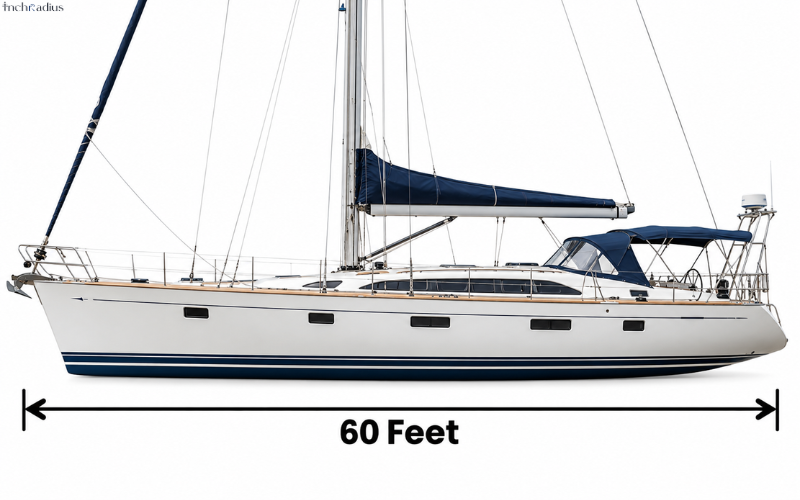
A large sailboat measuring 60 feet from bow to stern offers a direct example of the target length. Boats in this size range are substantial vessels, often designed for extended cruising, offshore sailing or use by several people. Their exact dimensions depend on the hull design and model.
Imagine a 60-foot sailboat tied alongside a marina pontoon. Its hull would stretch across a considerable section of the dock, making the distance easy to appreciate. The mast may rise much higher than the hull is long, so it should not be used to estimate the boat’s length.
Boat measurements can also be reported in different ways. The overall length may include features that are excluded from a manufacturer’s waterline measurement. If a sailboat is listed as 60 feet long, check which measurement is being used before treating it as an exact comparison.
3. Commercial Fishing Boat

A commercial fishing boat can be close to 60 feet long, particularly among vessels designed for coastal or offshore work. These boats need enough space for equipment, storage, crew areas and fishing operations. Their layouts vary depending on the species targeted, fishing method and waters in which they operate.
Picture the boat moving through a harbour, with its bow cutting through the water and its stern carrying fishing equipment. A vessel measuring 60 feet would occupy a sizeable area at a mooring, giving you a practical sense of the distance.
Not every commercial fishing boat reaches this length. Some are much smaller, while others are considerably larger. The 60-foot example refers to a possible vessel size rather than a standard measurement for the entire fishing fleet. Manufacturer specifications or vessel records are the best sources when an exact length matters.
4. Garden Fence Run

A straight garden fence run measuring 60 feet is a useful example because it relates directly to home improvement. Fencing is commonly installed in sections, and the total length depends on the shape and size of the property. A 60-foot stretch might run along one boundary of a garden or across the back of a small outdoor space.
You can visualise it by imagining a fence extending along the side of a house and continuing towards the rear boundary. If each fence panel covers roughly six feet, ten panels would span 60 feet, provided their installed widths add up to that total.
This comparison is especially useful when estimating materials. Fence posts, gates, panel widths and gaps can affect the final calculation, so measure the actual boundary before buying supplies. The 60-foot figure describes the complete straight run, not the height of the fence.
5. Long Swimming Pool
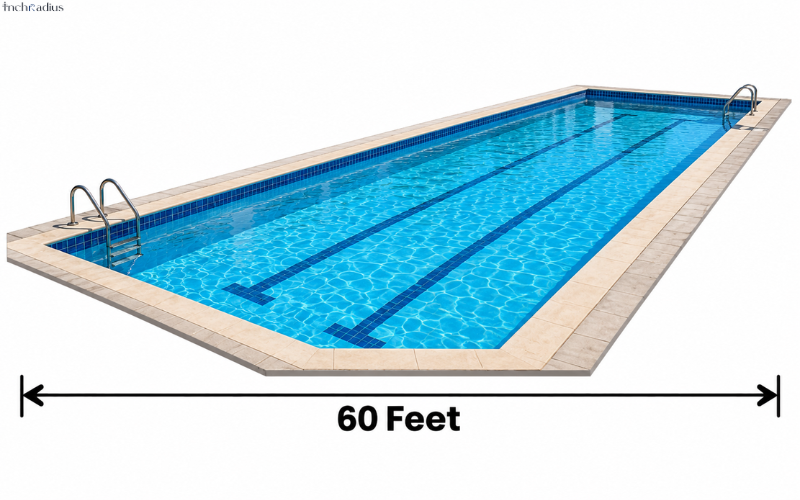
A swimming pool measuring 60 feet in length provides a familiar reference for people who enjoy swimming or visiting leisure facilities. Although many domestic pools are shorter, some private pools and training pools can approach this dimension. Pool sizes vary widely, so 60 feet should be treated as a possible length rather than a standard.
Imagine standing at one end of the pool and looking towards the opposite wall. The water would stretch 20 yards ahead of you. Swimming that distance once is equivalent to travelling 60 feet, making the measurement particularly easy to understand for regular swimmers.
A pool’s length is usually measured between its ends along the swimming direction. Steps, curved walls or irregular shapes can affect the usable swimming distance. If you are planning a pool installation, confirm the proposed internal dimensions rather than relying on the outside measurements of the structure.
6. Large Water Slide
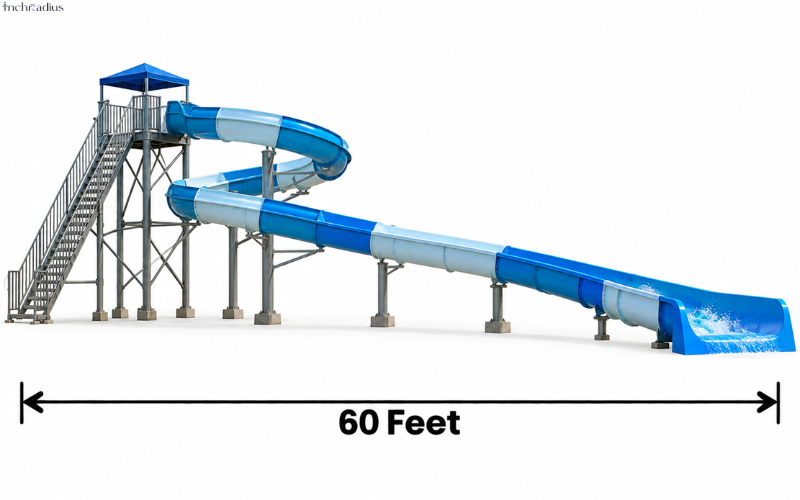
A large water slide can reach a length of 60 feet along its sliding surface or overall structure. Slides come in many forms, from compact garden models to tall attractions at water parks. Their length depends on the height, slope, curves and number of turns built into the design.
Imagine a long slide running from an elevated platform down towards a splash pool. The route may cover 60 feet even if the straight-line distance between the top and bottom is shorter. This distinction matters because the length measured along a curved slide is not necessarily the same as the horizontal ground distance it occupies.
For visualising 60 feet, picture the slide’s full path stretched out in a straight line. It would cover 20 yards. Real installations should be measured using their published specifications, since a slide’s advertised length may refer to the sliding surface rather than its footprint.
7. Mature Tree

Some mature trees can reach approximately 60 feet in height, depending on their species, growing conditions and age. This is particularly plausible for many established garden, park and woodland trees. However, a tree’s height is different from its trunk length or the width of its canopy.
Imagine standing at the base of a 60-foot tree and looking up towards its highest branches. The top would be far above the roof of many ordinary houses. This makes a mature tree a useful way to picture the scale of 60 feet in a vertical direction.
Tree height is rarely exactly 60 feet, and estimating it by eye can be difficult. A tree that appears tall from the ground may be shorter or taller than expected. If the precise height is needed for landscaping, maintenance or safety, use a suitable measuring method or consult a qualified tree professional.
8. Radio Tower
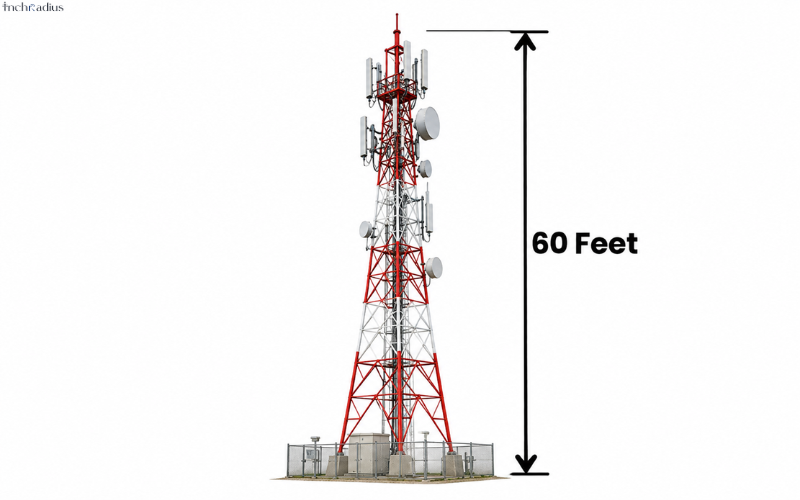
A small radio tower or communications mast can stand around 60 feet tall. Such structures support antennas and other equipment used for transmitting or receiving radio signals. Their height depends on the intended coverage, surrounding terrain, installation requirements and type of communications system.
A 60-foot tower would be taller than many houses and visible above nearby low-rise buildings. Picture a vertical structure rising from a base on the ground to a point well above the roofline. This gives a sense of the measurement without needing to imagine a horizontal object.
Radio towers are not all the same height. Some installations are much shorter, while major broadcast towers can reach hundreds of feet. Equipment mounted on top may also affect the overall height. The 60-foot example is an approximate comparison, not a claim that all radio towers share this dimension.
9. Large Grain Silo
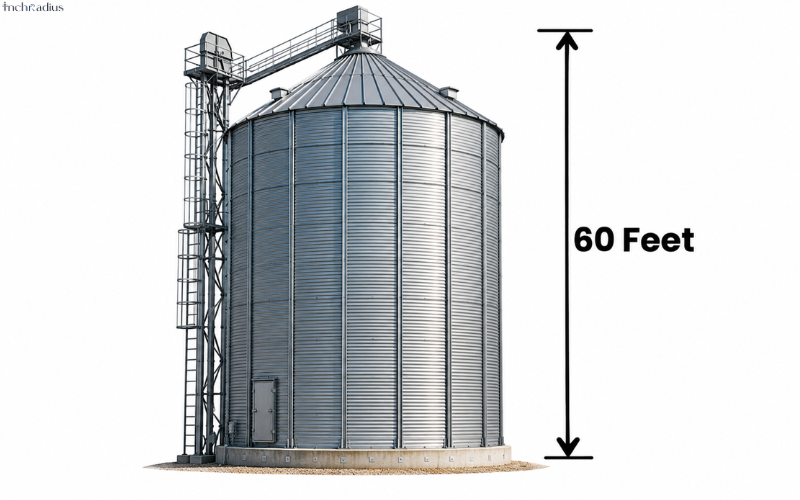
A large grain silo may stand approximately 60 feet tall, although agricultural storage structures come in a wide range of sizes. Silos are used to store grain and other bulk materials, protecting them from weather and making them easier to manage on farms or at processing facilities.
Picture a tall cylindrical silo beside a barn or a group of farm buildings. Its height might extend well above the surrounding rooflines. A 60-foot silo would be comparable in vertical scale to a six-storey building, although the proportions and appearance would be very different.
The overall height depends on the silo’s capacity, diameter, roof design and intended use. Some grain silos are much taller, particularly at commercial storage facilities. For this reason, the 60-foot figure is best used as a visual reference rather than a standard dimension for agricultural equipment.
10. Long Driveway Section
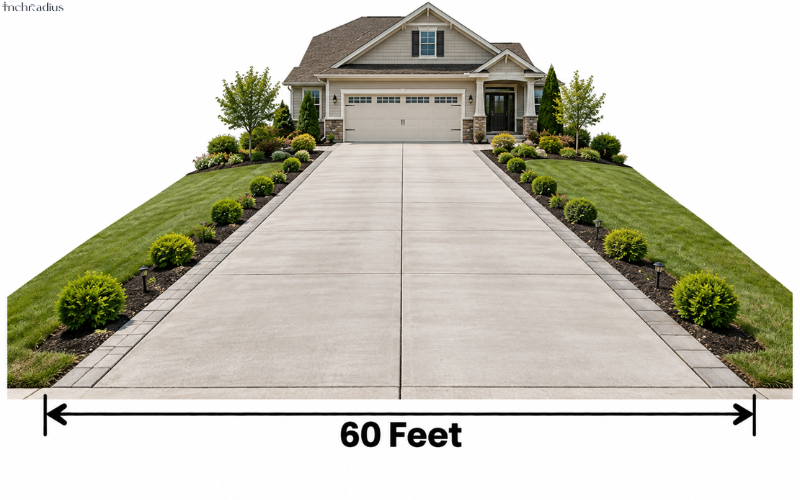
A 60-foot driveway section is a practical example for anyone planning a home entrance, parking area or access route. Depending on the property, this distance could run from the pavement towards a garage, connect a gate to a parking area or form part of a longer private drive.
To picture the measurement, imagine a car travelling along a straight driveway for 20 yards. That is the same distance as 60 feet. A driveway of this length may provide room for parking, but its suitability depends on vehicle size, turning space, gradient and the width of the entrance.
Driveway lengths vary significantly between properties. A short urban driveway may be far smaller, while a rural access road may extend hundreds of feet. If you are ordering paving materials or planning drainage, measure the actual length and width rather than relying on a visual estimate.
11. Zip-Line Cable Section

A zip-line cable section measuring 60 feet provides another useful comparison, particularly in outdoor adventure parks and recreational gardens. A zip-line allows a rider to travel along a cable between two points, usually with a suitable harness and pulley system. The cable’s length depends on the installation and the distance between its supports.
Imagine a straight cable stretched between two secure platforms, with 60 feet separating the relevant points along the cable. The distance is equivalent to 20 yards, making it easy to compare with a sports-field marking or a long garden boundary.
The cable length is not always the same as the horizontal distance between the platforms. A cable may slope downwards, and its installed length can differ from the ground distance. Zip-lines must be designed and installed according to appropriate safety requirements; a rough visual comparison is not enough to determine a safe cable length.
How to Measure 60 Feet Without a Ruler
Measuring 60 feet without a tape measure is possible if you use a known distance or repeat a smaller measurement. These methods are useful for rough estimates, but they should not replace accurate measuring equipment where precision matters.
1. Walk a measured 20-yard distance. Sixty feet equals 20 yards exactly. If you can find a marked sports area or another location with a verified 20-yard span, use it as a reference. Walking the same distance along a garden or driveway can help you estimate whether the available space is close to 60 feet.
2. Count ten six-foot sections. If you know a section measures six feet, mark or visualise ten consecutive sections. Their combined length is 60 feet. This works well for a straight fence line or a garden boundary, but the individual sections need to be measured or reliably established first.
3. Use a familiar large object. A vehicle, boat or other long object with published dimensions can provide a useful reference. For example, if a vehicle combination is known to be close to 30 feet long, two similar lengths placed end to end would give a rough estimate of 60 feet. Do not assume that two vehicles are identical in size; check their actual dimensions when accuracy matters.
Related Post: How Long Is 40 Feet? 11 Common Things That Are 40 Feet Long
FAQs
1. How many inches are there in 60 feet?
There are exactly 720 inches in 60 feet. Each foot contains 12 inches, so multiplying 60 by 12 gives 720. This conversion is useful when working with plans or measurements that use inches rather than feet.
2. How many metres is 60 feet?
Sixty feet equals exactly 18.288 metres. For everyday use, you can round this to approximately 18.29 metres. If you are measuring materials or setting out a construction project, use the precision required by the plans and avoid rounding too early.
3. Is 60 feet longer than 20 yards?
No. Sixty feet is exactly equal to 20 yards because one yard contains three feet. Multiplying 20 yards by three gives 60 feet. The two measurements describe the same distance, just using different units.
4. How many centimetres is 60 feet?
Sixty feet equals 1,828.8 centimetres. This is calculated by converting the measurement into inches and then using 2.54 centimetres per inch. In metres, the same distance is 18.288 metres.
5. What does 60 feet look like compared with a building?
A 60-foot vertical structure may be similar in height to a six-storey building, depending on the height of each storey and the building’s design. This is only an approximation. Buildings with high ceilings, commercial floors or different roof structures can be much taller or shorter.
6. Can a tree be 60 feet tall?
Yes. Some mature trees reach approximately 60 feet, depending on the species, age and growing conditions. Many trees remain shorter, while others grow much taller. A tree’s height is best measured or professionally estimated if the exact figure is needed.
7. How can I mark out 60 feet in a garden?
A tape measure is the simplest option. If you do not have one, use a verified 20-yard distance or establish a shorter measured section and repeat it carefully. Mark each point with a garden peg or another visible marker, keeping the line straight to avoid accumulating errors.
8. Is 60 feet a long distance for a driveway?
It can be a substantial driveway length for a typical home, but suitability depends on the property and intended use. A 60-foot driveway may provide space for a vehicle and additional access area, though turning room, width, gradient and parking requirements all affect how practical it is.
Conclusion
Sixty feet is a substantial distance equal to 720 inches, 18.288 metres or 20 yards. Large boats, long fence runs, swimming pools and sections of driveway can help you picture the measurement in everyday surroundings. For vertical comparisons, a mature tree, radio tower or grain silo may provide a similar sense of scale, although their actual heights vary.
The easiest way to remember 60 feet is to picture a straight 20-yard line or six sections of 10 feet each. These references are useful for estimating space around a home, planning a garden or visualising the size of a large object. For any project requiring an accurate result, confirm the dimensions with a tape measure or other suitable measuring tool.