
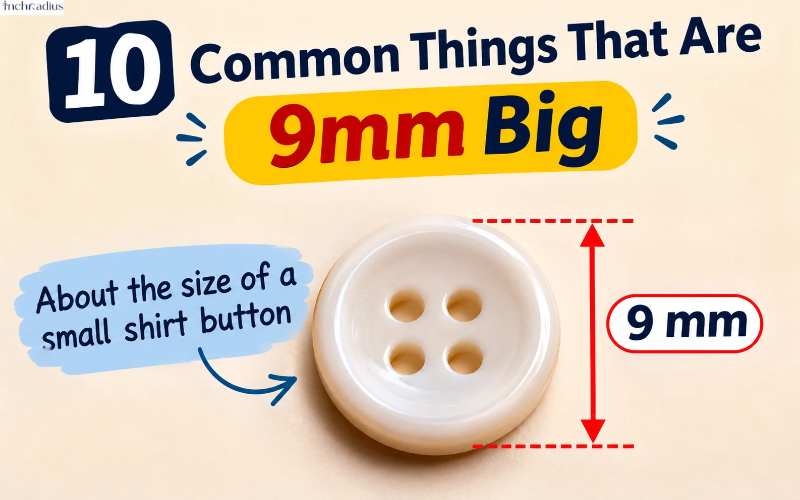
Nine millimetres (9mm) is a very small measurement, equal to 0.9 centimetres, 0.354 inches, or just over one-third of an inch. It is less than the width of most adult fingers, but it is large enough to see clearly on everyday objects such as buttons, beads and small tools.
You might come across this measurement when checking jewellery, choosing craft supplies, measuring a small screw or looking at the diameter of a cable. Since 9mm can be difficult to picture on its own, comparing it with familiar objects makes the size easier to recognise. Ten everyday examples can help you visualise just how big 9mm really is.
How Long Is 9mm?
Nine millimetres is a short distance, measuring exactly 0.9 centimetres. It is also approximately 0.354 inches, which is slightly more than one-third of an inch. If you place a ruler on a flat surface, the 9mm mark sits just before the 1cm line.
Although the difference between 9mm and 10mm seems small, that extra millimetre can matter when measuring small parts. For example, a button, jewellery bead or tool fitting may need to be close to a particular size to fit properly.
A useful way to picture 9mm is to imagine a little less than the full width of a typical adult fingernail. It is also shorter than the diameter of a standard pencil. These comparisons give you a rough sense of the measurement without needing to carry a ruler everywhere.
Related Post: 9 Common Things That Are 10 Centimeters Long
How Big Is 9mm?
Nine millimetres is roughly the width of a small button or a jewellery bead. It is not a large object size, but it is easy to notice when you hold something of that measurement between your fingers.
Imagine looking at the end of a small wooden dowel or a round craft bead. If its diameter is around 9mm, it will look noticeably wider than a matchstick but much smaller than a standard coin.
You can also compare it with a centimetre on a ruler. The 9mm distance stops just 1mm before the 1cm mark. That tiny gap makes it easier to remember the measurement.
Keep in mind that 9mm describes a specific length. An object’s diameter, thickness and width are different measurements, so always compare the correct dimension when checking its size.
10 Common Things That Are 9mm Big
Several small household, craft and hardware items can help you picture a measurement of 9mm. Some are manufactured in this exact size, while others come in different sizes depending on the product.
The following examples include a mixture of tools, jewellery supplies and everyday objects. Their measurements refer to the particular dimension mentioned in each description.
| Everyday Item | Actual Size |
|---|---|
| 9mm drill bit | 9mm |
| Small round craft bead | 9mm |
| Small shirt button | 9mm |
| Wooden dowel | 9mm |
| Jewellery pearl bead | 9mm |
| Small rubber grommet | 9mm |
| Miniature cable | 9mm |
| Small metal socket | 9mm |
| Round craft cabochon | 9mm |
| Small decorative stud | 9mm |
1. Drill Bit
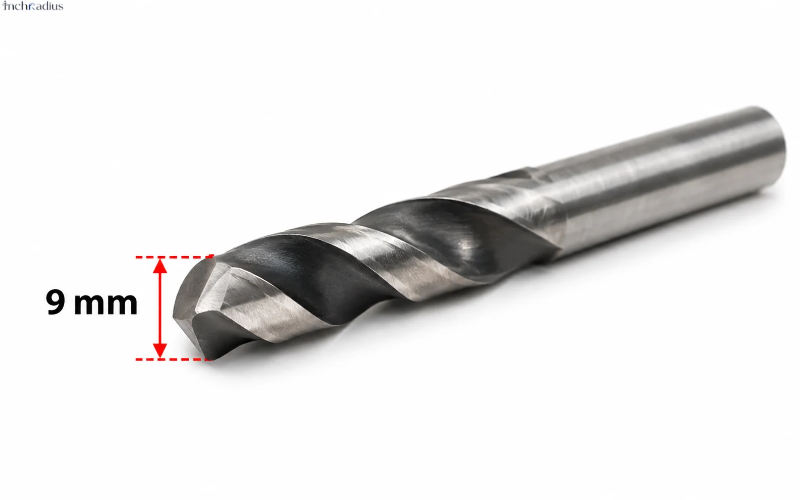
A 9mm drill bit is one of the clearest examples because it is manufactured to a specific measurement. The cutting end of the drill bit has a diameter of 9mm, making it a useful reference when trying to picture this small size.
You can find drill bits of this measurement in hardware shops and tool collections. They are used for making holes in wood, metal and other materials, depending on the bit’s design.
Look at the circular cutting end rather than the full length of the drill bit. Its width from one side to the other is 9mm. This gives you a direct visual comparison without needing to estimate the size of an unrelated object.
A 9mm drill bit is particularly useful because its measurement is clearly marked on the tool or its packaging. Unlike natural objects, its diameter is not simply an estimate.
Related Post: 10 Common Things That Are 9 Centimeters Long
2. Small Round Craft Bead
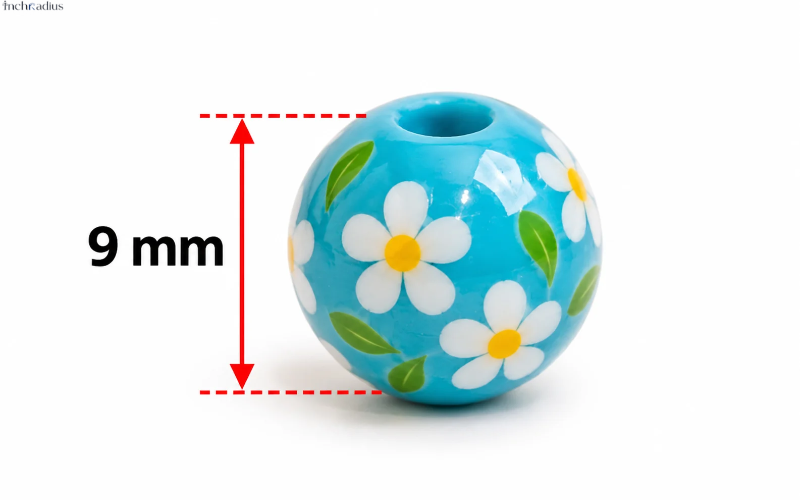
Small round craft beads are available in many different diameters, including 9mm. They are used in bracelets, necklaces, children’s craft projects and decorative work.
A bead measuring 9mm across is small enough to fit comfortably between two fingertips. It is also large enough to see its rounded shape and any colour or pattern on its surface.
For a useful comparison, imagine a bead resting on a flat table. Measure from one outside edge straight across to the opposite edge, passing through its centre. That distance is its diameter.
Not every craft bead measures 9mm. Some are 6mm, 8mm, 10mm or larger. Look for the diameter on the product packaging if you want a close match. A genuine 9mm bead is an excellent object for remembering this measurement.
3. Small Shirt Button
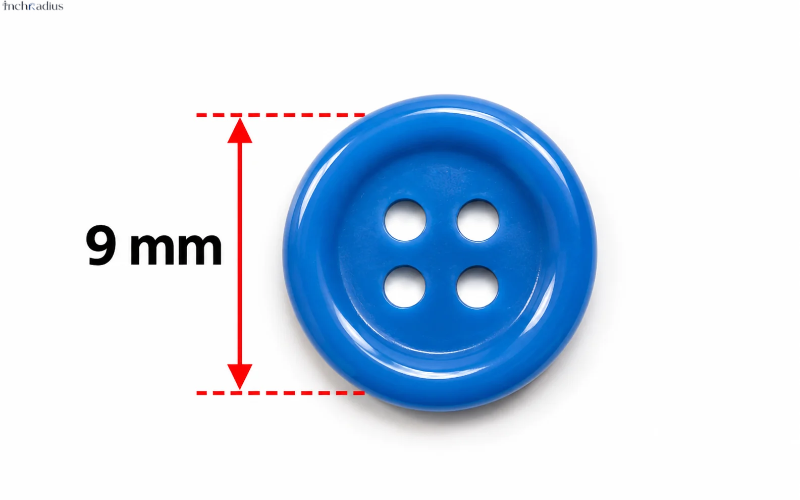
Small shirt buttons can provide a familiar way to visualise a measurement close to 9mm. Buttons used on dress shirts, cuffs and children’s clothing often come in different sizes, with some measuring around this diameter.
A 9mm button is roughly the size of a small circular disc. It is easy to hold between your fingers and compare with the width of a centimetre marked on a ruler.
The measurement refers to the button’s diameter, not its thickness. This distinction matters because a button may be only a few millimetres thick while being 9mm wide.
Take a small button from an old shirt and measure across its widest part. If it measures close to 9mm, you have a handy household reference. However, buttons vary by design and manufacturer, so not every shirt button will match this measurement.
Related Post: 11 Common Things That Are 8 Centimeters Long
4. Wooden Dowel
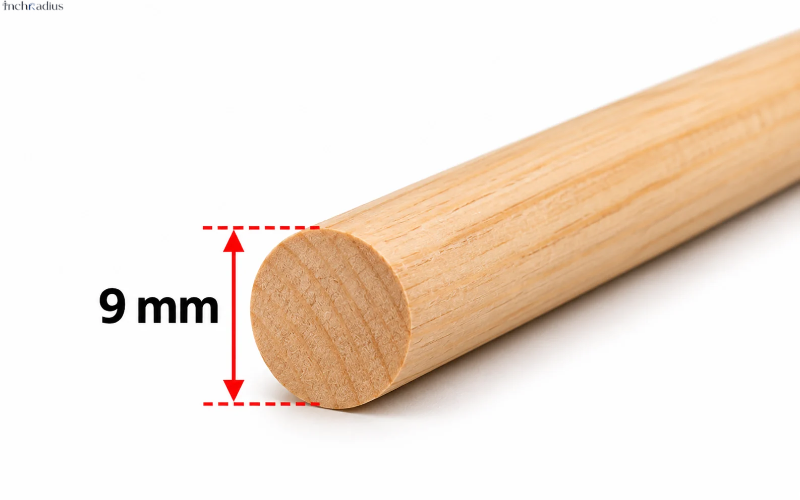
A wooden dowel is a round wooden rod used in furniture making, woodworking, model building and craft projects. Smaller dowels are available in several diameters, including 9mm.
The easiest way to picture this size is to look directly at the cut end of the dowel. The circular surface measures approximately 9mm from one side to the other.
A dowel of this diameter is thicker than a thin wooden skewer but still small enough to handle easily. It may be used to join wooden pieces, support small structures or create decorative items.
If you have a piece of 9mm dowel at home, place its end beside the 1cm mark on a ruler. You will see that it is just 1mm narrower than a centimetre. This makes it a practical reference for understanding the size.
5. Jewellery Pearl Bead
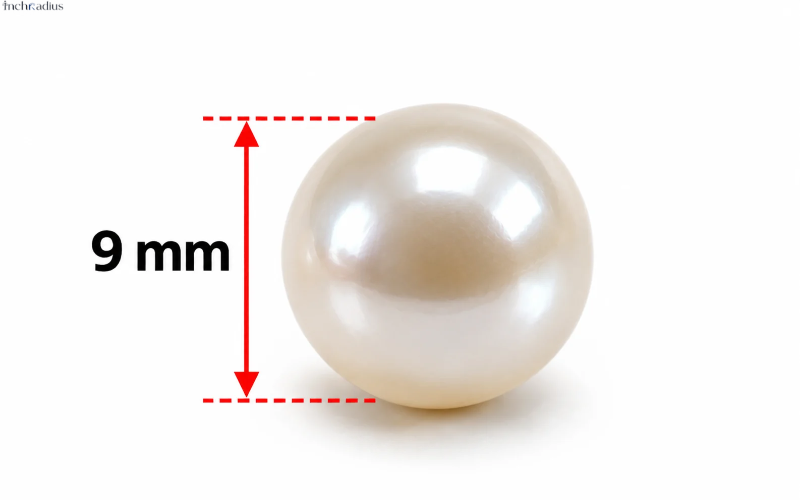
Small pearl beads are used in jewellery making, necklaces, bracelets and decorative accessories. They come in different sizes, and 9mm is a useful size for a noticeable but relatively small pearl.
A round pearl measuring 9mm across has a diameter just below 1cm. Its smooth surface makes the measurement easy to observe when the bead is placed beside a ruler.
Pearl beads are often selected by diameter because their size affects the appearance of finished jewellery. A 9mm pearl will look larger than a tiny seed pearl but smaller than the larger statement pearls used in some necklaces.
When comparing pearl sizes, check whether the seller gives the measurement in millimetres. Natural pearls may have slightly uneven shapes, while manufactured or uniform jewellery beads tend to have more consistent dimensions.
6. Small Rubber Grommet
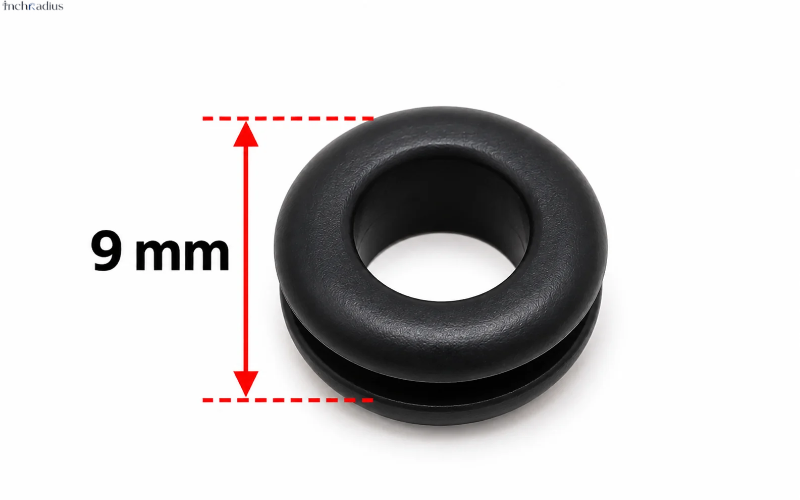
A rubber grommet is a small ring-shaped fitting used to protect cables and wires when they pass through holes in metal, plastic or wooden surfaces.
Some small grommets have an opening or outside diameter measuring around 9mm. The exact dimension depends on the type of grommet, so it is important to check which part is being measured.
For visualising 9mm, focus on the width of the circular opening or the outside diameter of a suitably sized grommet. Both can help you recognise a distance close to the target measurement.
Grommets are commonly used in electrical equipment, computer cases, vehicle panels and workshop projects. Their purpose is to prevent sharp edges from damaging wires.
If you have a small rubber grommet, place it beside a ruler and compare its diameter with the 9mm mark. Its circular shape makes it a useful reference.
Related Post: 10 Common Things That Are 7 Centimeters Long
7. Miniature Cable
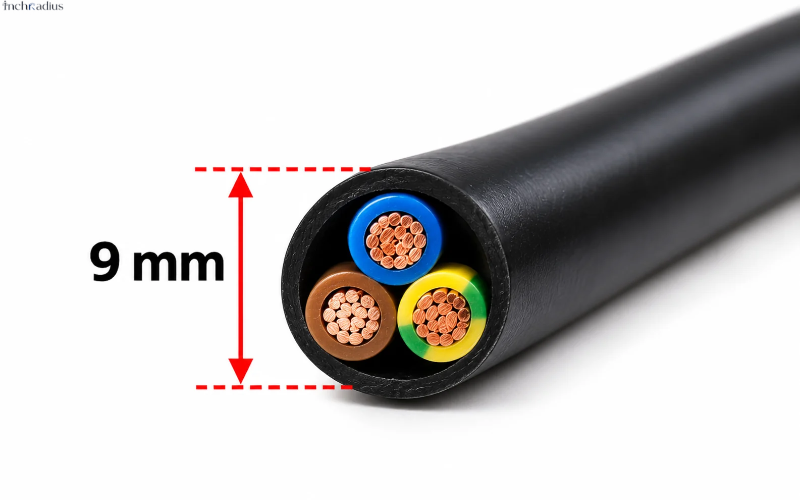
Small electrical and electronic cables are available in different thicknesses. Some miniature cables have an outside diameter close to 9mm, particularly when they include protective insulation around their internal wires.
Imagine looking at the cable from the end rather than along its length. The distance across the outside insulation gives you the diameter. If that distance is 9mm, the cable provides a practical example of the measurement.
Cables of this thickness may be found in certain power connections, equipment wiring and specialist electrical installations. However, cable sizes vary considerably according to their purpose.
It is also important not to confuse the outside diameter with the thickness of the metal conductor inside. Insulation adds to the overall width. A cable labelled as 9mm should be checked against its manufacturer’s specifications before being used as an exact reference.
8. Small Metal Socket
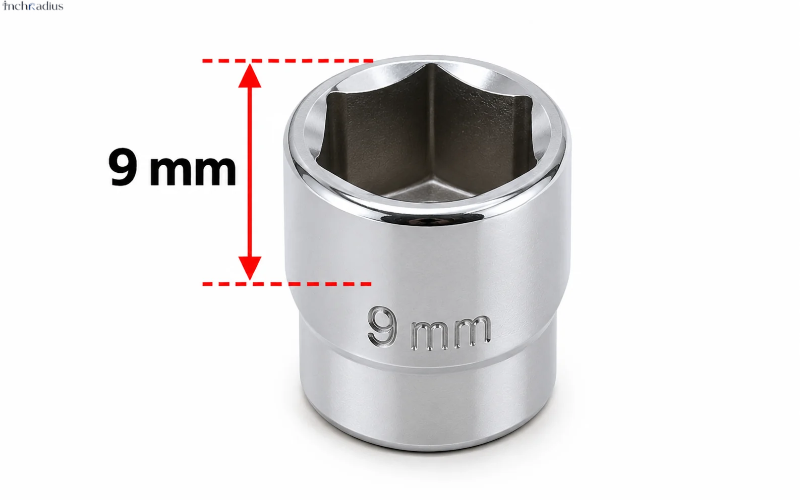
A metal socket is a tool attachment used with a ratchet or socket wrench to tighten and loosen nuts and bolts. Small sockets are commonly sold in metric sizes, including 9mm.
In this case, the 9mm measurement refers to the width across the flat internal faces of the socket. It is designed to fit a compatible hexagonal fastener.
A 9mm socket is a useful visual reference because its size is clearly identified. You can hold it beside a ruler and compare the opening with the distance between the 0mm and 9mm marks.
The socket itself will have a larger outside diameter because its walls surround the opening. Therefore, do not measure the outside of the tool and assume that it represents 9mm.
This example is especially helpful for people who work with household repairs, bicycles, machinery or small mechanical fittings.
9. Round Craft Cabochon
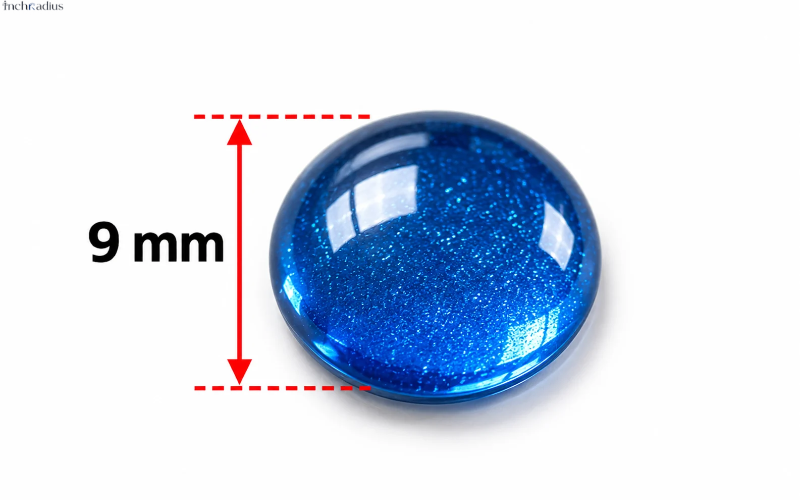
A cabochon is a small decorative stone or glass piece with a smooth, rounded surface. It is commonly used in jewellery making, handmade accessories and craft projects.
Round cabochons are sold in several diameters, including 9mm. A piece of this size is small enough to fit on a fingertip but large enough to show its colour, pattern or polished finish.
To visualise the measurement, place a 9mm cabochon on a flat surface. Look at its widest point, measuring straight across the centre. This is the diameter.
Cabochons are often used in rings, pendants, earrings and miniature decorative designs. Their smooth shape also makes them easier to compare with the circular measurement on a ruler.
Check the listed diameter before buying one. Similar-looking cabochons may measure 8mm or 10mm, which can make a difference when selecting a matching jewellery setting.
10. Small Decorative Stud
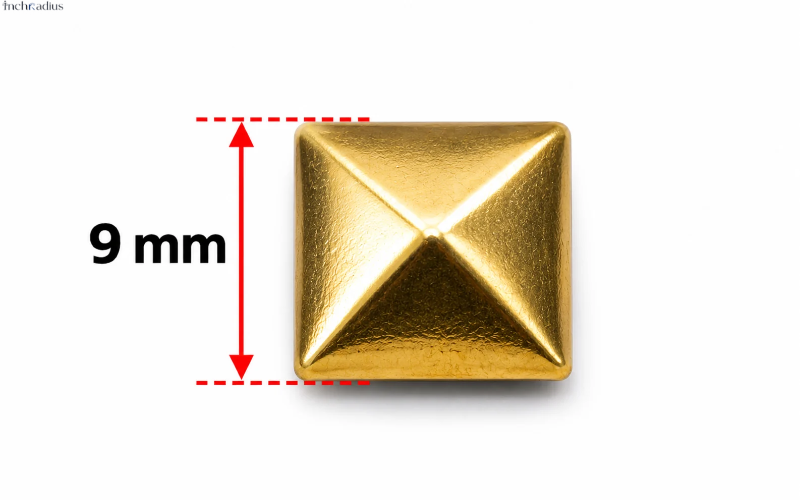
Small decorative studs are used on clothing, leather accessories, bags and handmade craft projects. Some round studs are manufactured with a head diameter of approximately 9mm.
Their flat or slightly raised heads make it easy to compare their width with the 9mm mark on a ruler. They are usually much wider than their narrow fixing pins or posts.
A decorative stud measuring 9mm across can add a small detail to a leather bag, belt or clothing item without taking up much space. Its size is also easy to picture when placed beside a centimetre marking.
Not all decorative studs have the same dimensions. Some are designed with narrow heads, while others have wider or more noticeable surfaces. Always check the head diameter rather than the length of the fixing post when using one as a comparison.
Related Post: 10 Common Things That Are 15 Centimeters Long
How to Measure 9mm Without a Ruler
You do not always need a measuring tool to get a rough idea of 9mm. A few familiar objects can help you estimate this distance, although a proper ruler is best when accuracy matters.
1. Use a centimetre marking
If you have a ruler with centimetre markings, look at the space between 0cm and 1cm. Nine millimetres covers almost the entire distance. It stops just 1mm before the 1cm mark.
2. Compare it with a small button
Find a small round button that looks close to 9mm wide. Place it on a flat surface and compare its diameter with a familiar centimetre measurement. This will give you a rough visual reference, although buttons are not all the same size.
3. Use a fingertip as a rough reference
The width of an adult fingertip is usually much greater than 9mm, but you can use a small section of it to picture the measurement. Imagine a distance slightly smaller than the width of a typical fingernail. Finger sizes differ from person to person, so this method should only be used for an approximate estimate.
For anything that needs a precise fit, such as a drill bit, jewellery setting or replacement component, use a millimetre ruler or calliper.
Related Post: 9 Common Things That Are 14 Centimeters Long
FAQs
1. Is 9mm bigger than 1cm?
No. Nine millimetres is slightly smaller than 1 centimetre. One centimetre equals 10mm, so the difference is just 1mm. Although the difference looks small, it can matter when choosing small fittings, jewellery components or hardware parts.
2. How many inches is 9mm?
Nine millimetres is approximately 0.354 inches. This is slightly more than one-third of an inch. For everyday comparisons, you can remember that 9mm is close to 0.35 inches rather than trying to remember a longer decimal value.
3. Is 9mm the same as 0.9cm?
Yes. Nine millimetres is exactly 0.9 centimetres. Both measurements describe the same distance, just using different units. This conversion is useful when a product lists its dimensions in centimetres instead of millimetres.
4. How big is 9mm compared with a finger?
Nine millimetres is generally much narrower than an adult finger. It is closer to a small section of a fingertip or fingernail than the full width of a finger. Finger sizes vary, so this is only a visual comparison rather than an accurate measuring method.
5. Is 9mm considered a small measurement?
Yes. Nine millimetres is less than one centimetre, making it a small measurement. It is commonly useful for describing small hardware components, jewellery beads, buttons and other compact objects. Despite its small size, a difference of just 1mm can affect whether a component fits correctly.
6. How can I measure 9mm accurately?
Use a ruler with millimetre markings or a digital calliper. Place the starting edge at the 0mm mark and measure to the 9mm line. A calliper is especially useful when measuring the diameter of round objects, such as beads, dowels and small metal components.
7. Is 9mm close to half an inch?
No. Half an inch equals 12.7mm, which is noticeably larger than 9mm. The difference is 3.7mm. Nine millimetres is closer to one-third of an inch, making 0.354 inches a better conversion to remember.
8. What everyday object is closest to 9mm?
A small round craft bead or a 9mm drill bit is a useful example. A manufactured 9mm drill bit has an exact stated diameter, while a craft bead can also be purchased in this size. Both are easy to hold and compare with a ruler.
- Discover more everyday objects and their measurements in inches
- 9 Common Things That Are 25 Inches Long
- 9 Common Things That Are 24 Inches Long
- 9 Common Things That Are 23 Inches Long
- 10 Common Things That Are 22 Inches Long
- 10 Common Things That Are 21 Inches Long
Conclusion
Nine millimetres may be difficult to picture as a number, but small everyday objects make it easier to recognise. A 9mm drill bit provides an exact reference, while a small craft bead, pearl bead or wooden dowel gives you a simple visual comparison. Remember that 9mm is just 1mm short of a full centimetre and approximately 0.354 inches.
That is a handy way to recall its size when shopping for small components, working on a craft project or checking a household fitting. If accuracy matters, always measure the actual object rather than relying on a visual estimate.
