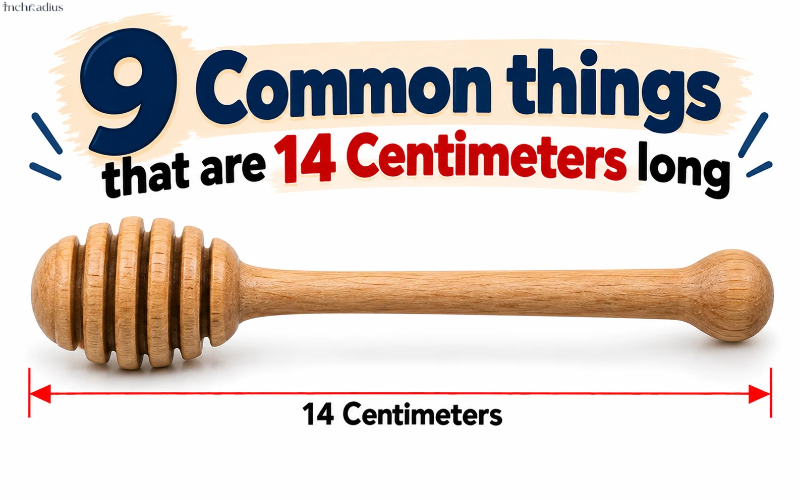
14 centimetres is equal to 5.51 inches or 140 millimetres. This is a handy length to recognise when measuring small household items, choosing craft materials or checking whether an object will fit into a compact space. Although it is shorter than a typical pencil, it is long enough to be easy to picture using familiar objects.
You can visualise 14 cm by comparing it with small items from your home, garden or workshop. The key is to choose objects with a similar end-to-end length rather than relying on appearance alone. The nine examples below use different objects from varied categories, giving you fresh ways to picture this measurement without repeating the usual phone, notebook and cutlery comparisons.
How Long Is 14 Centimeters?
14 centimetres measures exactly 140 millimetres. In imperial units, it is approximately 5.51 inches, while in metres it equals 0.14 m. These values describe the same distance in different measurement systems.
This length is useful for describing compact objects, small accessories and parts of everyday equipment. It might be the length of a miniature model, a small garden accessory or a component used in a hobby project. The actual dimensions depend on the particular item, so a visual match should not be mistaken for an exact measurement.
Imagine the distance between the zero mark and the 14 cm mark on a metric ruler. It extends just beyond five and a half inches. This simple reference can help when estimating spaces in a drawer, planning a craft project or checking the approximate size of a small object before buying it.
Related Post: How Long Is 13 Centimeters?
How Big Is 14 Centimeters?
A length of 14 cm is small enough to handle comfortably but long enough to see clearly when an object is placed on a table. It is a little longer than the length of many small accessories and shorter than many full-sized household tools.
One way to picture it is to imagine a straight line across a small work surface. The distance is roughly the length of a compact hobby model or a short gardening accessory. Unlike a measurement based on your hand, these objects can be checked against a ruler and reused as personal references.
Remember that length and width are different dimensions. A small object might be 14 cm long but much wider or thicker than another object of the same length. For a useful comparison, measure from one end to the other and keep the object straight. This gives you a much clearer idea of what 14 cm looks like in real life.
9 Common Things That Are 14 Centimeters Long
These nine examples come from different categories, including model making, gardening, photography, stationery accessories and household maintenance. Some products are available in sizes close to 14 cm, but not every version will match exactly. Check the actual dimensions if you need a precise reference.
| Everyday Item | Actual Size |
| Miniature model railway carriage | 14 centimetres |
| Garden dibber | 14 centimetres |
| Camera lens cap keeper strap | 14 centimetres |
| Small leathercraft stitching tool | 14 centimetres |
| Miniature wooden clothes peg | 14 centimetres |
| Compact bicycle tyre lever | 14 centimetres |
| Decorative drawer pull handle | 14 centimetres |
| Small bird-feeder perch | 14 centimetres |
| Miniature fossil replica | 14 centimetres |
1. Miniature Model Railway Carriage
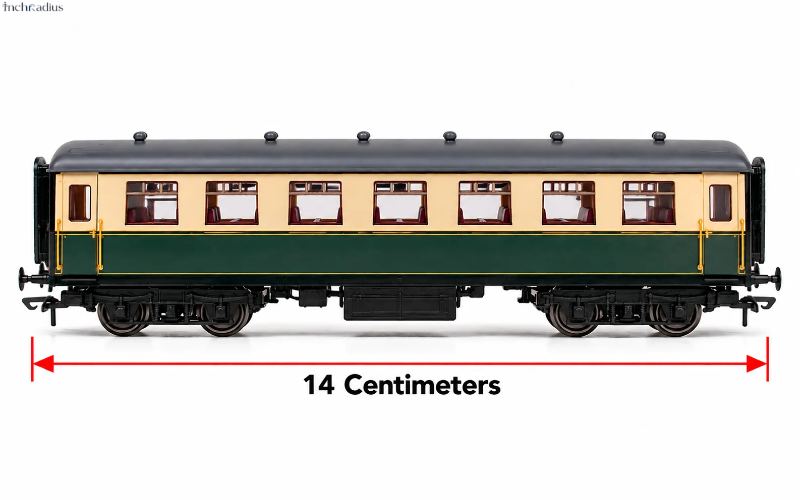
A miniature model railway carriage can provide an interesting way to visualise 14 cm. Model trains are made in different scales, so the length of a carriage depends on the manufacturer, the scale and the type of vehicle being represented. Some compact models are close to this measurement.
Place the carriage on a flat surface and compare its full length with the distance you want to estimate. Include the body from one end to the other, but do not add extra space for a separate track or display base.
This example is particularly useful for hobbyists who collect miniature trains or build model railway layouts. It also shows why scale matters: a model of a long real-world passenger carriage can be much shorter than 14 cm, depending on the scale used. Check the product dimensions before treating it as an exact reference.
2. Garden Dibber

A garden dibber is a tool used to make small holes in soil for planting seeds, bulbs and seedlings. Short versions can be made close to 14 cm long, although many traditional dibbers are longer. They are commonly made from wood, metal or durable plastic.
To use a dibber as a visual comparison, lay it on a flat surface and measure from the bottom of its pointed end to the top of the handle. The complete length is what matters, rather than the depth of the point alone.
This tool is useful when planting seeds in pots, trays or small garden beds. A compact dibber is easy to handle and store with other gardening supplies. Since garden tools vary in size, use a model with verified dimensions if you want a dependable 14 cm reference.
3. Camera Lens Cap Keeper Strap
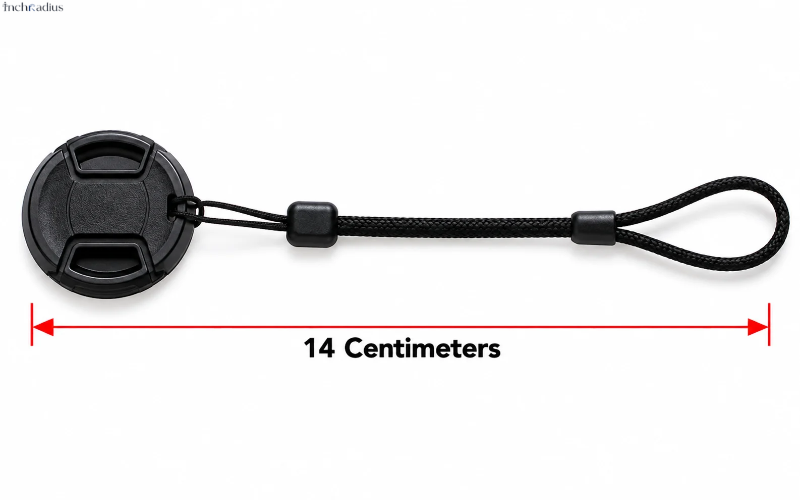
A camera lens cap keeper strap is a small accessory that helps prevent a lens cap from being lost while taking photographs. Depending on its design, the strap may include an elastic section, a small adhesive attachment or a connector for the cap.
Some tether straps can measure around 14 cm when laid flat, although their dimensions vary and flexible versions may stretch. For a useful comparison, measure the strap in its relaxed state from one end to the other. Do not pull it tight unless the manufacturer’s measurement specifies its stretched length.
This is a different kind of reference from a rigid tool because its length can change with tension. It is suitable for a rough visual estimate when the strap is not stretched, but a rigid 14 cm object is preferable if accuracy matters. Photographers can also use it to judge how much tether length they need for a particular camera setup.
4. Small Leathercraft Stitching Tool

A leathercraft stitching tool is used to make holes or guide stitching when working with leather. Some compact awls and hand tools have an overall length close to 14 cm. Their shape usually includes a handle and a narrow metal shaft.
Measure the complete tool from the end of the handle to the tip. The handle may account for most of its length, while the shaft provides the working point. Avoid measuring only the metal section if you want to compare the overall size with 14 cm.
This tool is a useful reference for people who repair bags, make wallets or work on small leather projects. Its straight shape makes it easy to compare with a short gap or storage compartment. However, sharp tools should be handled carefully, and their dimensions should be checked before use in any precision project.
5. Miniature Wooden Clothes Peg

A miniature wooden clothes peg is often used in crafts, gift decoration and miniature displays. Unlike a full-size laundry peg, a miniature version is designed for lightweight materials such as paper tags, photographs and small decorative pieces.
A single miniature peg is generally much shorter than 14 cm, so it should not be presented as an exact match. A better comparison is a short row of miniature pegs arranged end to end, provided the combined length is measured and adjusted to reach the target. This illustrates the measurement without claiming that one tiny object is 14 cm long.
These small pegs are useful in school projects, party decorations and handmade cards. If you use them to estimate a distance, place them in a straight line without overlapping. The combined measurement can then be compared with a ruler or another known length.
6. Compact Bicycle Tyre Lever

A bicycle tyre lever is a small tool used to help remove a tyre from a wheel rim during repairs. Many plastic and metal versions are compact enough to fit into a saddle bag or cycling repair kit. Some models are close to 14 cm long, although shorter levers are also common.
To estimate 14 cm, place the lever on a flat surface and measure its full length from the handle end to the tip. Its curved or hooked end should be included because it forms part of the tool’s overall length.
This object is useful for cyclists who want to picture the size of a small repair tool before buying a storage pouch. It also offers a recognisable comparison for a short, rigid object. Check the product specifications first, especially if you need the lever to fit into a limited space inside a compact repair kit.
7. Decorative Drawer Pull Handle
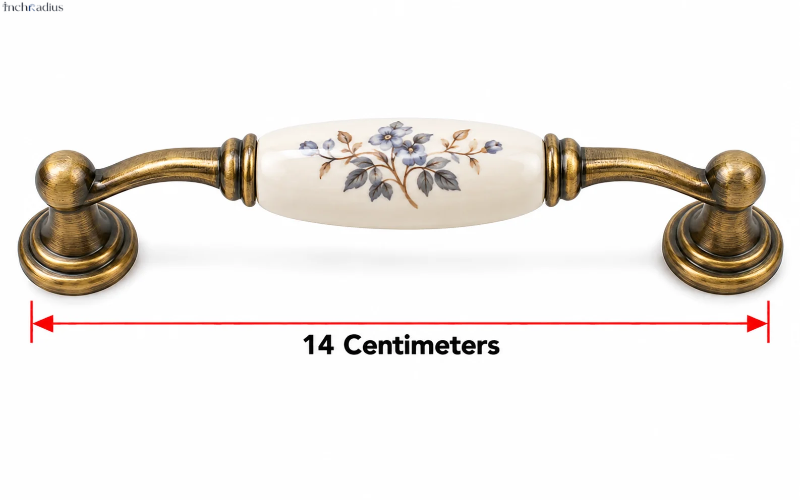
A decorative drawer pull handle can be close to 14 cm across, particularly among small cabinet handles with an extended bar design. These fittings are used on cupboards, dressers, desks and kitchen drawers. Their dimensions vary depending on the style and the distance between the mounting points.
When comparing a handle with 14 cm, measure its total end-to-end length. Do not confuse the overall length with the fixing-hole spacing, which is the distance between the screws and is often shorter.
This distinction is important when replacing cabinet hardware. A handle may look long enough but have mounting holes that do not line up with the existing holes. If you are estimating the space needed for a new fitting, check both the overall length and the mounting dimensions before purchasing it.
8. Small Bird-Feeder Perch
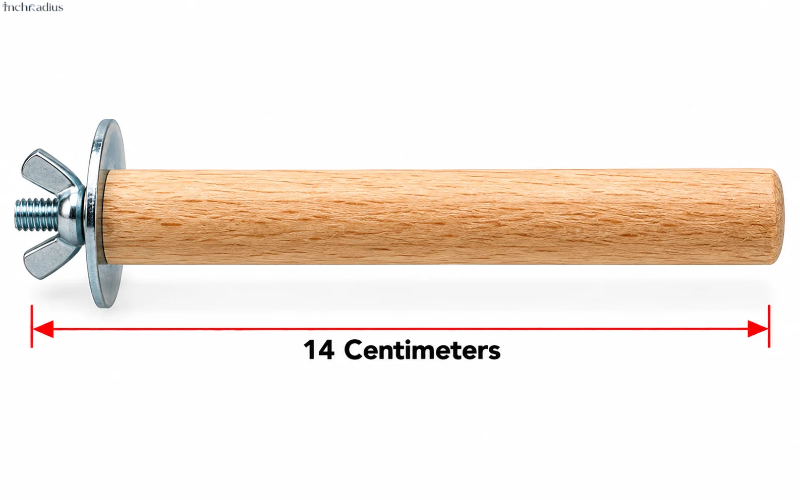
A short wooden perch used on a bird feeder can be made close to 14 cm long. Perches give small birds a place to land while approaching a feeder. Some are separate wooden rods, while others are built directly into the feeder’s frame.
To picture the measurement, place a separate perch horizontally on a table and compare its two ends. A straight rod makes the length easy to judge, though the dimensions depend on the feeder design and the type of birds it is intended to support.
This example is useful for people who build or maintain garden feeders. If you are replacing a damaged perch, measure the existing piece rather than assuming all feeders use the same size. Diameter also matters because the perch needs to suit the feeder’s mounting holes and provide a stable landing surface.
9. Miniature Fossil Replica
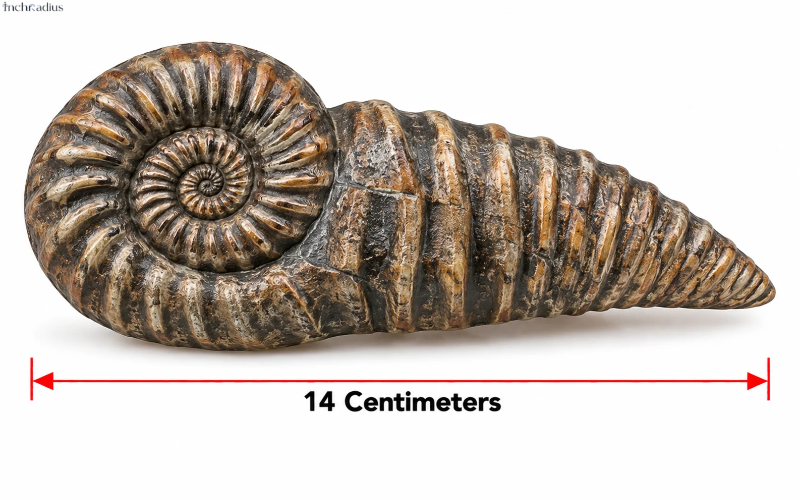
A miniature fossil replica can provide a distinctive comparison for 14 cm when its longest dimension is close to that measurement. Educational replicas may represent ammonites, trilobites, shells or other prehistoric specimens. Their shapes and sizes vary widely, so the comparison depends on the particular model.
For an accurate length comparison, measure the replica across its longest straight dimension. A rounded fossil may appear smaller than an elongated object of the same length, which is why using a ruler can help clarify the distance.
This object is especially useful for students, collectors and anyone interested in natural history. A replica can sit on a desk or display shelf, making it easy to compare with other small items. Be sure to distinguish a replica’s dimensions from those of a real fossil, which can vary greatly between specimens.
How to Measure 14 Centimeters Without a Ruler
You can estimate 14 cm using familiar objects, but the accuracy depends on how closely your reference matches the target.
1. Use a Standard Bank Card
A standard bank card is approximately 8.56 cm long. It is shorter than 14 cm, so it can help you judge the scale, but one card alone is not a close match. Two card lengths placed end to end total about 17.12 cm, which is longer than the target.
2. Use Your Hand as a Personal Reference
The width of your palm or the distance across several fingers may help you estimate the length. Hand sizes vary, so first measure your own hand when you have a ruler. You can then use that personal measurement as a rough guide in future situations.
3. Compare a Rigid Everyday Object
A compact bicycle tyre lever, garden tool or cabinet handle may be close to 14 cm. Check the item’s length once, then use it as a reference when you need to estimate a similar distance. Choose rigid objects rather than flexible straps, which can stretch and produce inconsistent results.
For accurate measurements, use a metric ruler or tape measure and line up the starting point with zero.
Related Post: How Long Is 12 Centimeters?
FAQs
1. How many inches is 14 centimetres?
14 centimetres is approximately 5.51 inches. This is slightly longer than five and a half inches. The conversion is useful when comparing product dimensions listed in metric and imperial units. For a tight fitting or craft project, use the most precise conversion required rather than rounding the measurement too early.
2. How many millimetres are in 14 cm?
14 centimetres equals exactly 140 millimetres. Since each centimetre contains 10 millimetres, multiplying 14 by 10 gives 140. Millimetres are particularly helpful for small components, craft materials and hardware where a difference of just a few millimetres can affect the fit.
3. Is 14 cm half a foot?
No. Half a foot is 6 inches, equal to 15.24 cm. Therefore, 14 cm is 1.24 cm shorter than half a foot. The two lengths are close enough for a rough mental comparison, but they should not be treated as identical when precise measurements are required.
4. Can I use a bicycle tyre lever to estimate 14 cm?
Yes, provided the particular tyre lever is close to 14 cm long. Bicycle levers come in different sizes, so check the product dimensions first. Place the tool flat and compare its full length, including the hooked end, with the space you want to estimate.
5. How do I convert 14 cm into metres?
Divide the centimetre measurement by 100. This means 14 cm equals 0.14 metres. Metres are useful for larger distances, while centimetres are generally easier to picture when measuring compact household items, small tools and craft supplies.
6. Why should I check an object’s actual size?
Objects that look similar can have different dimensions because manufacturers use different designs and sizes. A compact tool from one brand might be several centimetres longer than another. Checking the listed dimensions helps you avoid errors when buying accessories, fitting hardware or organising small items in a drawer.
7. Is 140 mm the same as 14 cm?
Yes. Both measurements describe exactly the same length. Centimetres are often easier to use for everyday objects, while millimetres can make small differences more apparent. For example, a 2 mm difference may matter when fitting a small component into a narrow opening.
8. What is the most accurate way to measure 14 cm?
Use a metric ruler or tape measure. Align one end of the object with the zero mark, then read the measurement at the opposite end. Keep the ruler straight and check the correct dimension. If the object is curved, decide whether you need its straight-line length or the distance along its surface.
Conclusion
14 centimetres equals 140 millimetres or approximately 5.51 inches. To picture this length, think of a compact bicycle repair tool, a small cabinet fitting or a short gardening accessory. Each provides a different way to imagine a distance that is easy to overlook when you do not have a ruler nearby.
Choose an object with a known length whenever possible. Rigid items are usually more reliable than flexible ones because they keep the same dimensions when handled normally.
Visual comparisons are useful for quick estimates, but exact measurements matter when fitting hardware, choosing replacement parts or completing detailed projects. A metric ruler remains the simplest way to confirm that a distance is precisely 14 cm.