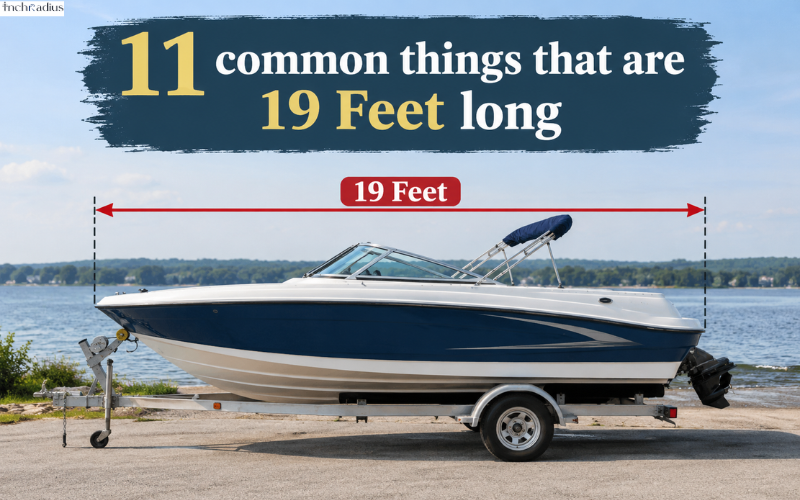
19 feet is a substantial length. It equals 228 inches, 5.79 metres, or 5,791.2 millimetres. To picture it, think of a small boat, a long travel trailer, or several household objects arranged end to end. A 19-foot length is far longer than an ordinary room, car, or dining table, but it is still a manageable size for many recreational vehicles and boats.
Visualising 19 feet can be useful when checking whether a trailer will fit in a driveway, estimating the size of a boat, planning a room, or comparing the length of a vehicle. The examples below give you practical ways to picture this measurement without relying entirely on a tape measure.
How Long Is 19 Feet?
Nineteen feet is exactly 19 feet long, which works out to 228 inches. In metric measurements, it is 5.79 metres, or approximately 579 centimetres and 5,791 millimetres.
That makes 19 feet roughly the length of a small recreational boat or a medium-sized travel trailer. It is also considerably longer than most family cars. For example, many large cars and SUVs are somewhere around 15 to 18 feet long, so 19 feet would extend a little beyond them.
Another useful comparison is a row of nineteen 1-foot rulers placed end to end. That gives you exactly 19 feet. You could also picture a little more than three standard 6-foot sofas arranged in a straight line. The actual dimensions of furniture vary, but the comparison gives a useful sense of scale.
How Big Is 19 Feet?
Visualising 19 feet can be tricky because most everyday objects are much shorter. A typical sheet of paper is only 11 inches long, while a household door is usually around 6.5 to 7 feet high. Nineteen feet therefore requires several familiar objects placed together.
One simple mental picture is nineteen 12-inch rulers lined up end to end. Since each ruler represents one foot, the complete row measures exactly 19 feet. A person’s arm span can also help, although this is only a rough estimate because everyone’s proportions differ.
You could also imagine three people lying head-to-foot, with some extra length left over. A large sofa, dining table, or bed can help as smaller reference points, but their dimensions vary considerably.
For a more realistic comparison, picture a travel trailer or recreational boat stretching almost the length of a typical two-car driveway. That gives 19 feet a much stronger sense of scale than a small household object.
11 Common Things That Are 19 Feet Long
The following examples are useful because several are designed or commonly available around the 19-foot mark. Some are very close rather than precisely 19 feet, so the descriptions explain where the comparison is approximate.
| Everyday Item | Actual Size |
| 19-foot travel trailer | 19 feet |
| 19-foot fishing boat | 19 feet |
| 19-foot pontoon boat | 19 feet |
| 19-foot sailboat | 19 feet |
| 19-foot camper trailer | 19 feet |
| 19-foot box truck | 19 feet |
| 19-foot telescoping ladder | 19 feet |
| 20-foot shipping container | About 19 feet |
| Large SUV with trailer | About 19 feet |
| Long garden shed | About 19 feet |
| Small recreational boat | About 19 feet |
19-Foot Travel Trailer
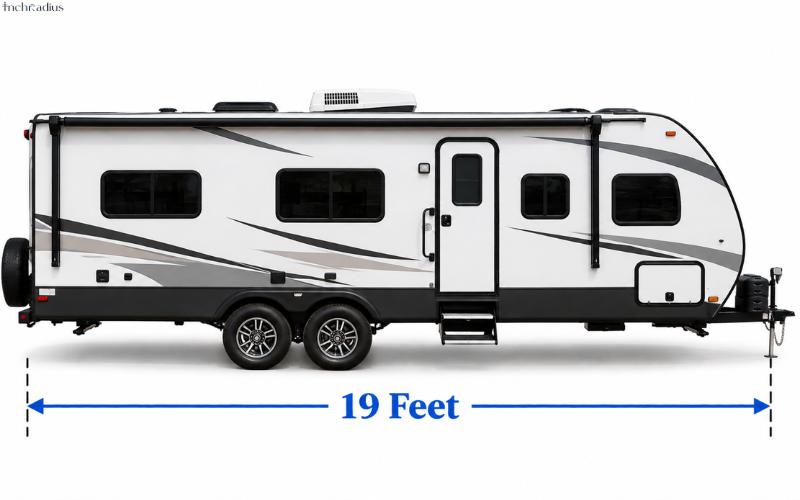
A 19-foot travel trailer is one of the easiest ways to picture this measurement. These trailers are made in many layouts, but models around 19 feet long are common in the compact recreational trailer market.
The length usually includes the main trailer body, although manufacturers can measure trailers in slightly different ways. Some measurements include the hitch, while others refer only to the box or living area. It is therefore worth checking the manufacturer’s specifications when space is tight.
For a visual comparison, imagine a trailer stretching almost 20 feet from front to back. It would take up a significant part of a driveway and would be much longer than a normal family car.
A trailer of this size can contain sleeping areas, a small kitchen, storage and seating. That makes it a useful real-world example of just how much space 19 feet represents.
19-Foot Fishing Boat
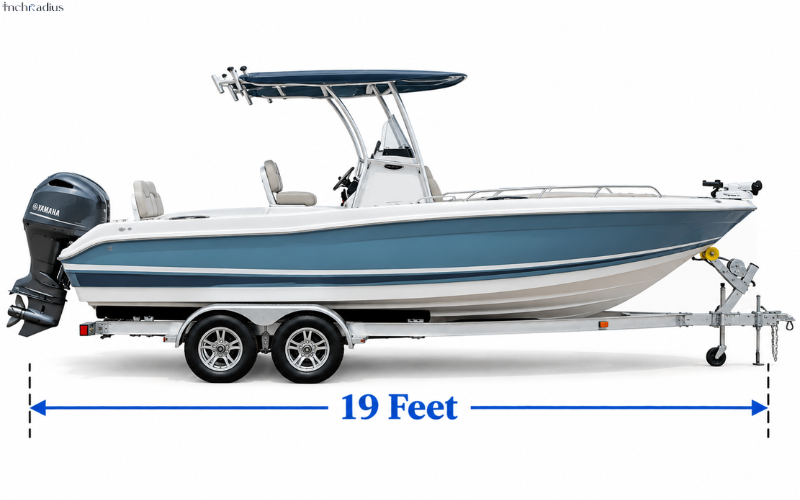
A 19-foot fishing boat gives another clear picture of the measurement. Boats around this size are large enough for several passengers while still being relatively manageable compared with much larger offshore vessels.
The hull itself can be close to 19 feet, although the overall length may change when features such as an outboard motor, swim platform or other equipment are included.
Imagine standing beside the boat and walking from the bow to the stern. Nineteen feet is roughly the distance you would cover.
This comparison is particularly useful because boat lengths are commonly given in feet. If someone says they have a 19-foot fishing boat, the measurement is not just an abstract number. It represents a vessel that occupies nearly 6 metres of physical space.
19-Foot Pontoon Boat
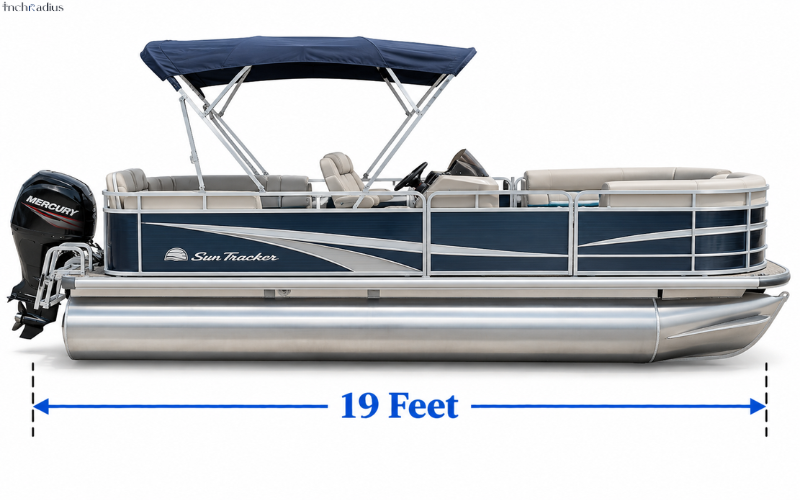
Pontoon boats are often available in a range of lengths, including models around 19 feet. Their long, open decks make them easy to compare with a straight 19-foot measurement.
Unlike a narrow canoe or kayak, a pontoon boat also has noticeable width. That means the overall footprint can be quite large even though the length is only 19 feet.
A 19-foot pontoon is useful for visualising the measurement because you can imagine its deck running almost six metres from one end to the other. If you stood at one end and looked towards the opposite end, the distance would be similar to walking across a sizeable room and continuing beyond it.
When storing a boat of this size, owners need to consider the trailer and motor as well, because the total length can be greater than the advertised boat length.
19-Foot Sailboat
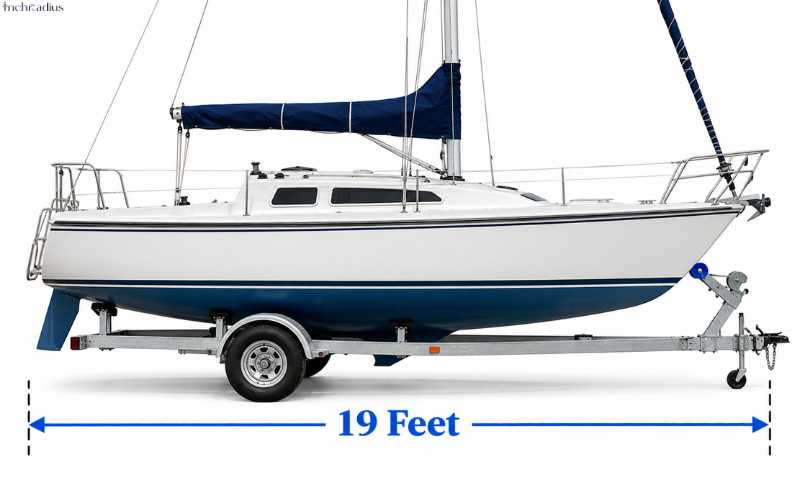
A 19-foot sailboat is another practical example. Small sailing boats around this length can have a surprisingly large visual presence because their masts and sails extend high above the hull.
The hull length itself is the useful comparison here. At 19 feet, it measures exactly 228 inches or about 5.79 metres.
Sailboats are especially helpful for understanding the difference between length and height. The boat may be 19 feet from bow to stern, while its mast can rise much higher. This means you should not use the mast to estimate the 19-foot length.
Picture the hull sitting on a trailer or in the water. Walking from the bow to the stern would cover almost six metres. That is a good practical representation of 19 feet.
19-Foot Camper Trailer
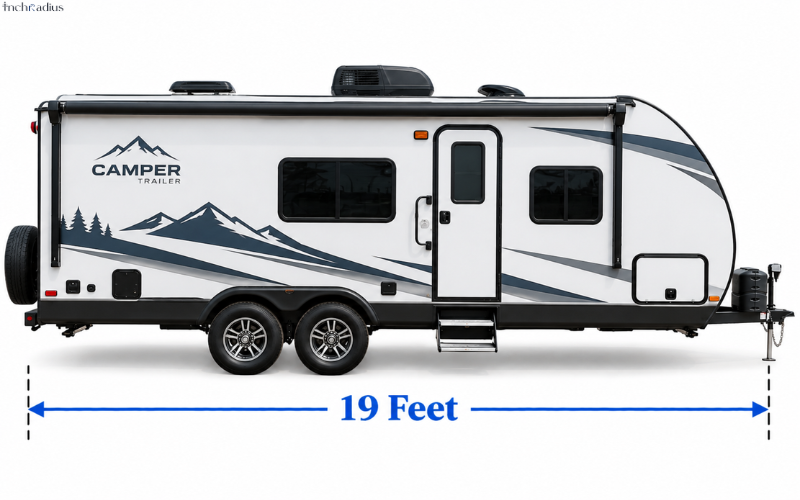
A 19-foot camper trailer is closely related to a travel trailer but may have a different layout or construction style. Camper trailers around this size provide enough room for sleeping and basic living features while remaining smaller than many full-sized recreational trailers.
The exact dimensions vary between manufacturers, so a trailer described as 19 feet may be slightly shorter or longer depending on how its length is measured.
For visualising 19 feet, imagine a trailer almost as long as a typical parking space plus a little extra. A standard parking space varies by location, so this is only a rough comparison.
The important point is that 19 feet represents a substantial vehicle-sized length. It is not simply the size of a large piece of furniture; it is enough space for a compact mobile living area.
19-Foot Box Truck
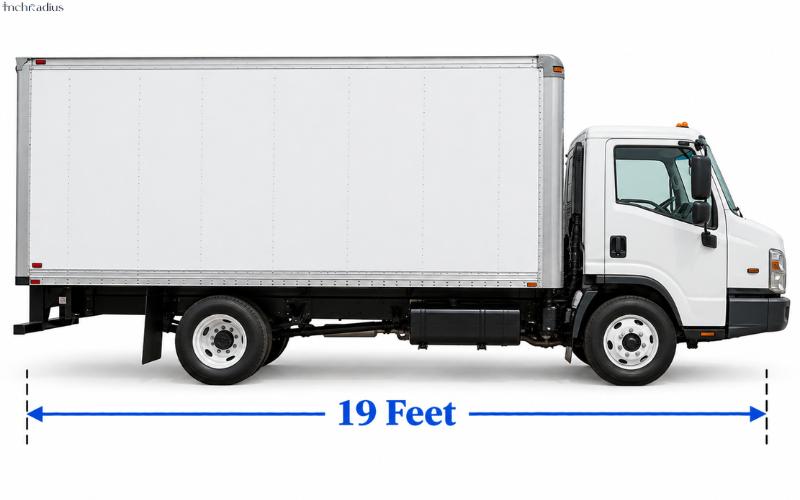
A small box truck can have an overall length around the 19-foot range, depending on the cab, chassis and cargo body. Commercial truck sizes vary, so this should be treated as an approximate comparison rather than a universal specification.
The long, rectangular cargo section makes these trucks easy to visualise. Picture the vehicle parked in a straight line and measure from the front bumper towards the rear. A truck around 19 feet long would occupy nearly six metres of road space.
This example is useful when thinking about parking, loading areas and driveways. A vehicle of this size needs considerably more room than an ordinary car.
If you are estimating whether a truck can fit into a particular space, use its manufacturer’s stated overall length rather than relying on the 19-foot comparison alone.
19-Foot Telescoping Ladder
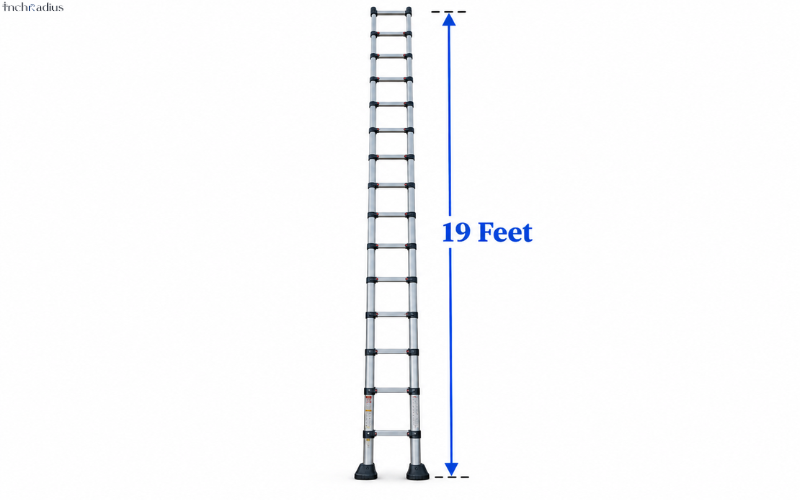
A telescoping ladder can reach around 19 feet when fully extended. Unlike a rigid ladder, a telescoping model collapses into a much shorter form for storage and transport.
At full extension, a 19-foot ladder gives a very clear vertical or horizontal reference. If placed safely against a suitable structure, its top can reach almost 19 feet above the ground.
This comparison also shows why 19 feet feels much larger when viewed vertically. A person standing beneath a 19-foot ladder would have to look well above normal ceiling height to see its top.
A ladder’s stated maximum length does not necessarily mean it should be used at that exact height in every situation. Safe operating angles, support conditions and manufacturer instructions still matter.
20-Foot Shipping Container
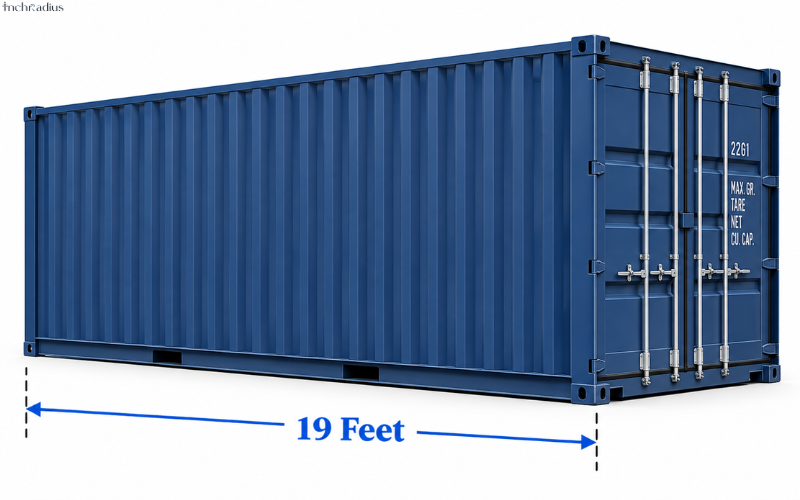
A standard shipping container is commonly described as 20 feet long, making it just one foot longer than 19 feet. That small difference makes a 20-foot container a useful approximate comparison.
The standard external length is about 20 feet, so it is roughly 5.6% longer than 19 feet. If you stood beside one, the difference would be noticeable but not dramatic.
A shipping container is much wider and taller than most household objects, which makes it particularly useful for visualising overall scale. Its long rectangular shape gives you a clear idea of how far 19 feet stretches.
If you need an exact 19-foot space, however, do not assume a 20-foot container will fit. That extra foot can make a major difference in a tight location.
Large SUV With Trailer
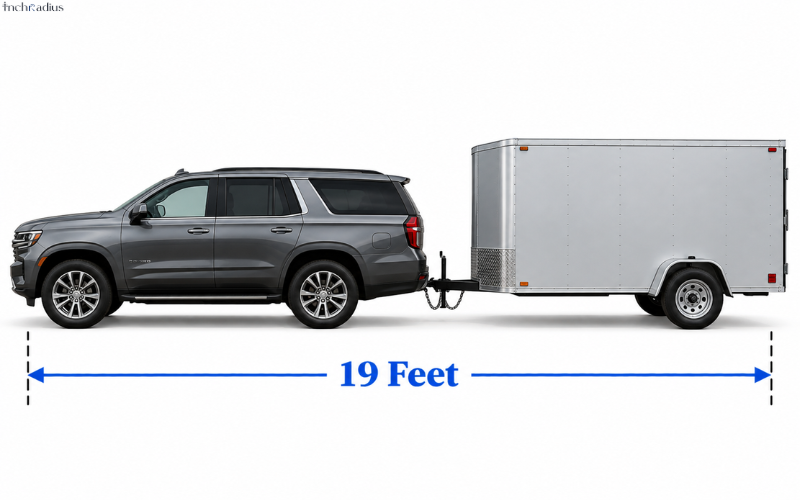
A large SUV combined with a small trailer can approach 19 feet in total length. The exact figure depends heavily on both vehicles, so this is an approximate example rather than a fixed 19-foot object.
Imagine the SUV parked directly in front of a short utility or camping trailer. When the two are connected, their combined length can stretch close to six metres.
This is a useful comparison for driveways and parking areas because it shows how quickly several smaller lengths can add up. An SUV that looks manageable on its own can require much more space once a trailer is attached.
For accurate planning, measure from the very front of the SUV to the furthest rear point of the trailer, including any equipment that extends beyond the trailer body.
Long Garden Shed
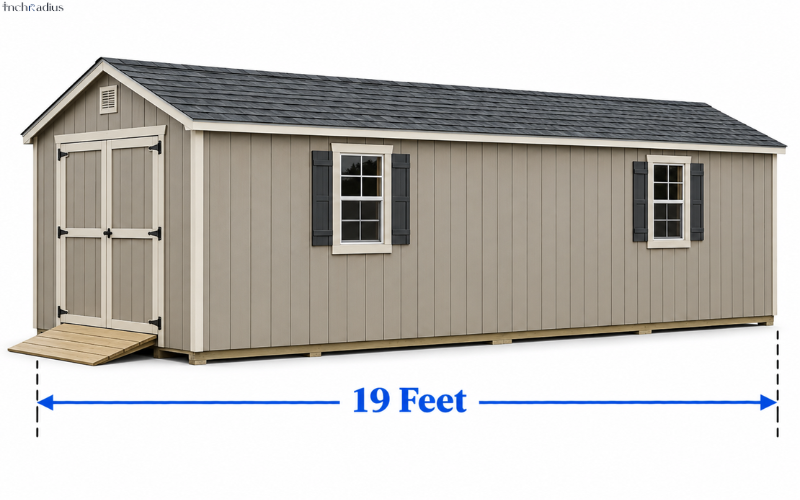
Some large garden sheds can measure around 19 feet along their longest side. Shed dimensions vary widely, so this example should be treated as approximate.
A 19-foot shed would be considerably larger than the small storage sheds found in many gardens. It could provide room for garden equipment, bicycles, tools, shelving and other belongings.
To picture the length, imagine standing at one end of the shed and walking almost six metres to reach the other. The long wall would be close to the length of a small boat or travel trailer.
If you are planning a shed of this size, remember that the building’s footprint is only part of the space needed. Doors, access paths, roof overhangs and local planning requirements can also affect the amount of garden space required.
Small Recreational Boat
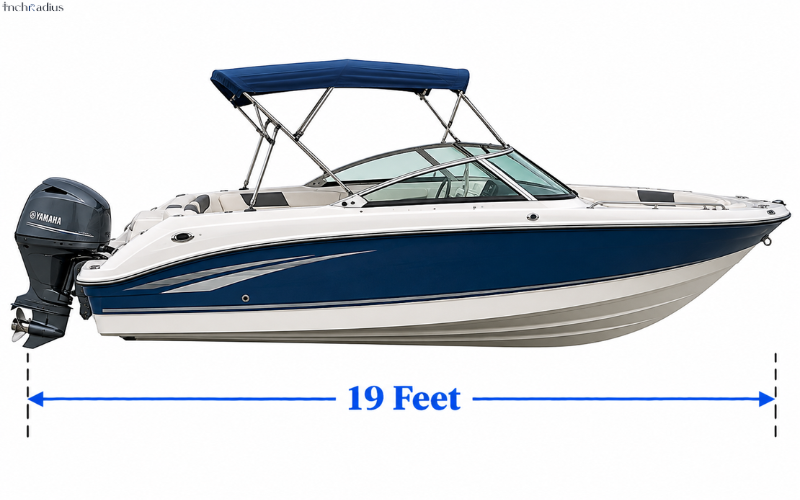
Some smaller recreational boats fall close to 19 feet in length. These can include various designs used for fishing, cruising and family outings.
Unlike a standard household object, a boat gives you a strong horizontal reference. A 19-foot boat stretches nearly six metres from bow to stern, making it easy to compare with other vehicles and outdoor spaces.
The advertised boat length can differ from its total length once an outboard motor, swim platform or other equipment is included. That is why two boats described as being around 19 feet may not occupy exactly the same amount of storage space.
Still, if you need a quick mental picture, imagine a boat nearly as long as 20 feet. That is a useful way to remember the scale without reaching for a measuring tape.
Measurement Without a Ruler
You can estimate 19 feet without a ruler, but any method based on your body or household objects will be approximate.
Use one-foot rulers: If you have a standard 12-inch ruler, place 19 of them end to end. Nineteen rulers represent exactly 19 feet. This is accurate only if each ruler is actually 12 inches long.
Use sheets of paper: A standard A4 sheet is about 11.7 inches long on its longest side. Roughly 19 A4 sheets placed end to end would be close to 18.5 feet. Adding another half-sheet gives you a reasonable visual estimate of 19 feet.
Use your hand span carefully: Many adults have a hand span of around 8 inches, but this varies significantly. You would need roughly 29 average 8-inch spans to reach 19 feet. This is best used as a rough check rather than a precise measurement.
For anything involving a vehicle, building, trailer or other tight space, use a proper tape measure rather than relying on these estimates.
Related Post: 10 Common Things That Are 18 Feet Long
FAQs
Is 19 feet the same as 6 metres?
No. Nineteen feet equals about 5.79 metres, so it is slightly shorter than 6 metres. The difference is around 0.21 metres, or roughly 21 centimetres. If you need exactly 6 metres of space, 19 feet will leave you short by about 21 centimetres.
How many inches are in 19 feet?
There are 228 inches in 19 feet. You can calculate this by multiplying 19 by 12 because every foot contains 12 inches. This conversion is useful when comparing 19 feet with smaller objects or measurements normally given in inches.
How many centimetres is 19 feet?
Nineteen feet equals approximately 579.12 centimetres. Since one foot is 30.48 centimetres, multiplying 19 by 30.48 gives 579.12 centimetres. That is the same as about 5.79 metres.
How many millimetres are in 19 feet?
Nineteen feet equals 5,791.2 millimetres. This is calculated by converting the 19 feet into metres and then multiplying by 1,000. Millimetres are more useful for smaller measurements, but this conversion shows the full metric equivalent.
Is 19 feet longer than a car?
For many cars, yes. Large cars and SUVs can approach 19 feet, but many ordinary passenger cars are shorter. The exact length depends on the model, so a particular vehicle should be checked using its manufacturer’s dimensions rather than assuming all cars are shorter than 19 feet.
What does 19 feet look like in real life?
A 19-foot length looks similar to the length of a small recreational boat, a compact travel trailer or some larger trailers. Another simple way to picture it is nineteen 1-foot rulers placed end to end. That gives an exact 19-foot line.
Can I measure 19 feet with my steps?
You can estimate it, but the result will depend on your stride length. If your average step is around 2.5 feet, you would need roughly eight steps to cover 19 feet. Count your steps over a known distance first if you want a more useful personal estimate.
Is a 19-foot travel trailer actually 19 feet long?
Not always in exactly the same way. Manufacturers can measure trailer length differently, with some specifications referring to the body and others including the hitch or other components. Always check the manufacturer’s stated overall length if you are planning storage, parking or transport.
Conclusion
Nineteen feet is a sizeable distance that becomes much easier to picture when compared with familiar large objects. A 19-foot travel trailer, fishing boat, pontoon boat or sailboat gives a strong real-world reference. You can also imagine nineteen 1-foot rulers placed end to end, creating an exact 19-foot line.
In metric terms, 19 feet is 5.79 metres, while in smaller imperial units it is 228 inches. For a quick mental picture, think of a vehicle-sized object stretching almost six metres from one end to the other. That is the practical scale of 19 feet.