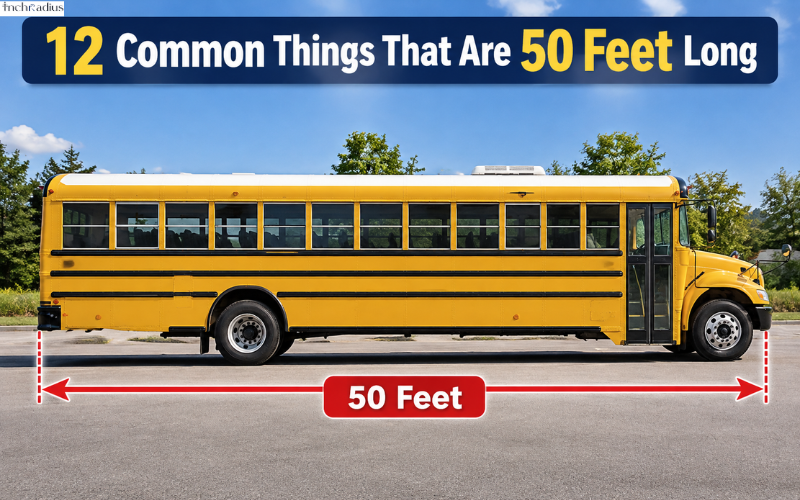
50 feet is equal to 600 inches, 15.24 metres, 1,524 centimetres, or 15,240 millimetres. It is a substantial length, roughly comparable to the height of a five-storey building or the length of a large recreational vehicle and trailer combination. Although 50 feet can be difficult to picture on its own, comparing it with familiar structures, vehicles and outdoor objects makes the distance easier to imagine.
You might encounter this measurement when planning a garden, estimating a fence line, measuring a driveway or working on a building project. The exact dimensions of real objects vary, but several everyday examples provide a useful starting point for visualising a 50-foot distance.
How Long Is 50 Feet?
A length of 50 feet equals exactly 600 inches, 15.24 metres, 1,524 centimetres and 15,240 millimetres. These conversions are useful when working with different measuring systems, particularly for building projects, property measurements and outdoor planning.
To picture the distance, imagine walking along a straight line for 50 feet. An adult walking at a normal pace might cover this distance in around 15–20 steps, depending on stride length. It is also a little shorter than the length of two standard 26-foot shipping containers placed end to end.
In practical terms, 50 feet is long enough to span a sizeable garden, cover much of a residential driveway or stretch across a large outdoor area. Builders may use this distance when measuring boundaries, while homeowners might need it to estimate fencing, garden hoses or outdoor lighting cables. Remember that these examples are visual references, not proof that every object of a particular type measures exactly 50 feet.
How Big Is 50 Feet?
Fifty feet is easier to visualise when you compare it with things you can see around you. Imagine a straight line stretching across a garden or from the front of a house towards the pavement. That distance may be close to 50 feet, depending on the property layout.
A school bus is another useful reference. Some full-size school buses measure around 35–45 feet, so 50 feet would be slightly longer than many of them. A large motorhome with a separate trailer may approach the same overall length, although the combined measurement depends on the vehicle and trailer.
You can also picture the height of a five-storey building. At an average of around 10 feet per storey, five storeys would give a rough height of 50 feet. Actual buildings vary considerably, especially when ceiling heights, floors and roof structures are included. These comparisons help you judge the scale without needing to see a measuring tape stretched across the full distance.
Related Post: How Long Is 30 Feet? 10 Common Things That Are 30 Feet Long
12 Common Things That Are 50 Feet Long
The following examples help put 50 feet into perspective. Some are close to this length, while others can reach or exceed it in particular designs. The descriptions explain where the measurements are approximate rather than exact.
| Everyday Item | Actual Size |
| 1. Large recreational vehicle and trailer combination | 50 feet |
| 2. Commercial fishing boat | 50 feet |
| 3. Large sailboat | 50 feet |
| 4. Garden fence run | 50 feet |
| 5. Outdoor swimming pool and surrounding span | 50 feet |
| 6. Large water slide | 50 feet |
| 7. Mature tree | 50 feet |
| 8. Water tower | 50 feet |
| 9. Radio tower | 50 feet |
| 10. Large grain silo | 50 feet |
| 11. Long driveway section | 50 feet |
| 12. Zip-line cable section | 50 feet |
1. Large Recreational Vehicle and Trailer Combination
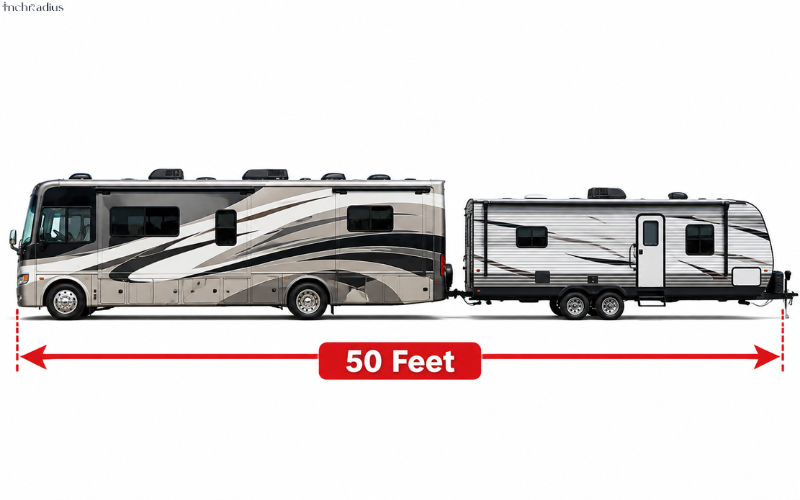
A large recreational vehicle, or motorhome, combined with a trailer can approach 50 feet in total length. The exact figure depends on the motorhome’s body length and the trailer being towed. Some combinations are shorter, while larger setups can reach or exceed this distance.
Picture a motorhome measuring about 35 feet with a trailer measuring around 15 feet. Together, their nominal lengths add up to 50 feet, although the overall space occupied on the road can vary with the towing arrangement.
This is a useful comparison for anyone who has seen a large touring vehicle at a campsite or on a motorway. The combined length is much greater than that of an ordinary family car, which is usually around 12–16 feet long. Thinking of several car lengths placed end to end helps convey the scale of 50 feet.
2. Commercial Fishing Boat
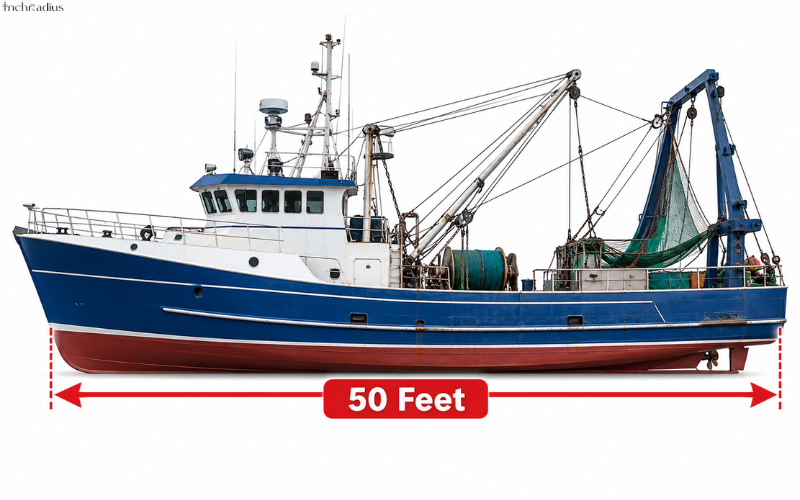
Some commercial fishing boats are around 50 feet long. These vessels are designed to carry fishing equipment, supplies and crew while providing enough deck space to handle catches. Their size depends on the type of fishing they support and the waters in which they operate.
A boat measuring 50 feet from bow to stern provides a clear example of how much space this distance represents. The deck may accommodate equipment, storage areas and working space, though the layout differs between boats.
Boat measurements can sometimes refer to the hull alone rather than the total length including projecting fittings. If a vessel is advertised as 50 feet long, check how its length has been measured before using it for a precise comparison.
For visualising the distance, imagine a boat extending along a marina berth. Its length gives a more tangible sense of 50 feet than a number on a tape measure, particularly when viewed from the side.
3. Large Sailboat
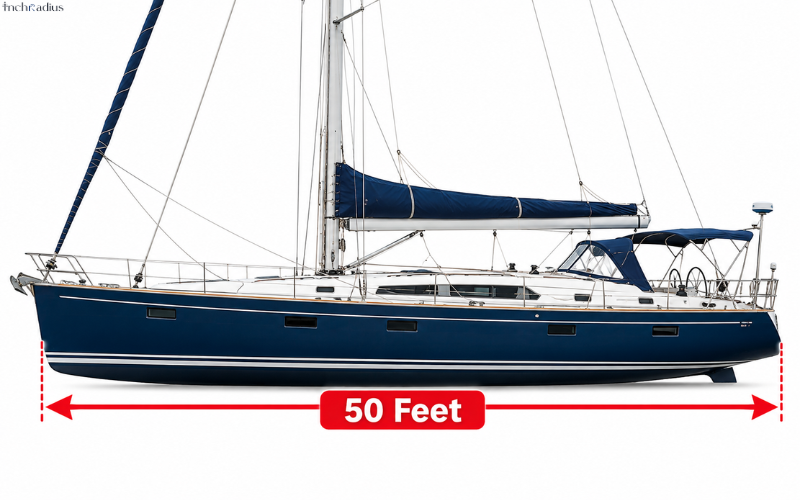
A large sailing yacht can measure approximately 50 feet from its bow to its stern. Boats of this size often have space for sleeping cabins, a galley, seating areas and storage. Their layout depends on whether they are intended for family cruising, long-distance sailing or racing.
The hull length provides a helpful way to picture 50 feet in a single object. Unlike a car or a garden fence, a sailboat also has a tall mast and rigging that extend well above the deck. These features can make the vessel appear larger, but they do not change its hull length.
Not every large-looking yacht measures 50 feet. Some are considerably shorter, and others are much longer. Still, a sailing yacht of this size is a realistic example of an object that can occupy roughly the same horizontal distance as a 50-foot line.
4. Garden Fence Run
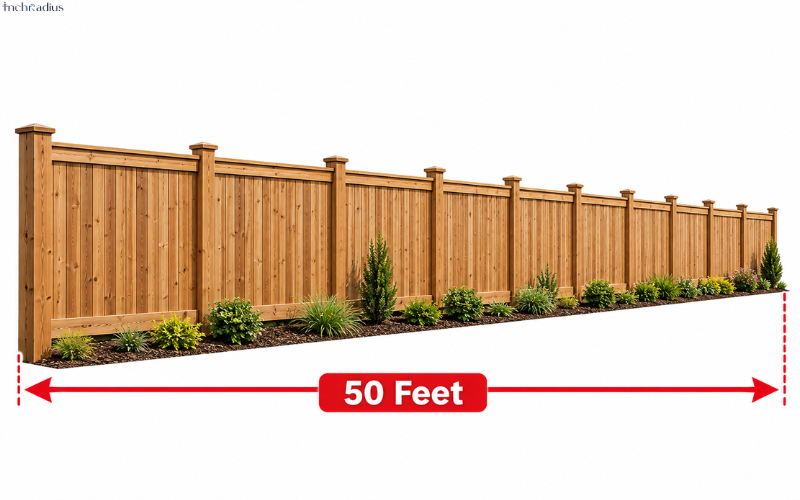
A garden fence is a practical way to visualise 50 feet because its length can be measured along a straight boundary. A section of fencing that runs for 50 feet covers 600 inches from one end to the other.
For example, a homeowner might need a 50-foot fence to separate part of a lawn from a neighbouring property or to enclose one side of a garden. The finished length depends on the number and spacing of the fence panels, as well as the width of the posts and any gates.
Fence panels are sold in different widths, so the number required varies. If each panel covers 6 feet, eight panels would span 48 feet before accounting for posts or gaps. Additional measurements may therefore be needed to reach an exact 50-foot boundary.
This example is particularly useful because you can pace out the proposed line before purchasing materials.
5. Outdoor Swimming Pool and Surrounding Span
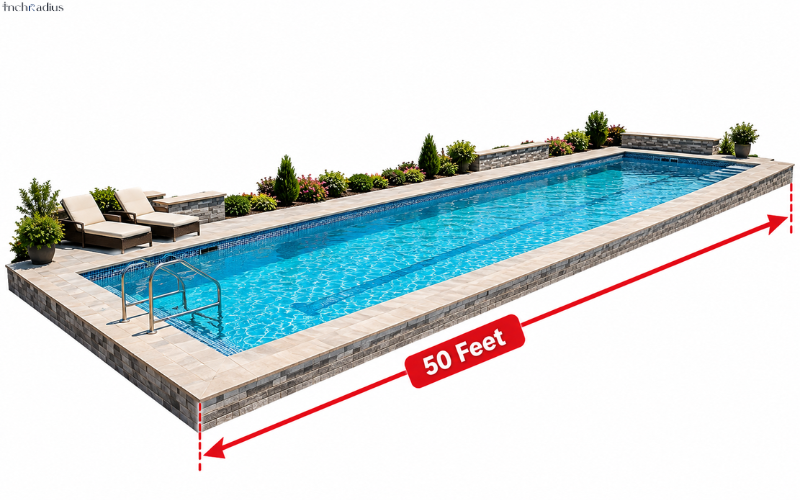
A long outdoor swimming pool can provide a useful comparison for 50 feet. Some residential and training pools approach this length, although many home swimming pools are shorter. The dimensions depend on the available space, intended use and local design choices.
Imagine standing at one end of a pool and looking towards the other. A 50-foot stretch would be about 15.24 metres long. That distance is longer than many small garden pools and provides plenty of room for recreational swimming.
Be careful when comparing pool sizes because a pool’s quoted dimensions usually describe the water area, not the surrounding paving or deck. A pool with an overall landscaped span of 50 feet might have a much shorter swimming area.
If you are planning a pool, measure the intended water length and the additional space needed for safe access separately.
6. Large Water Slide
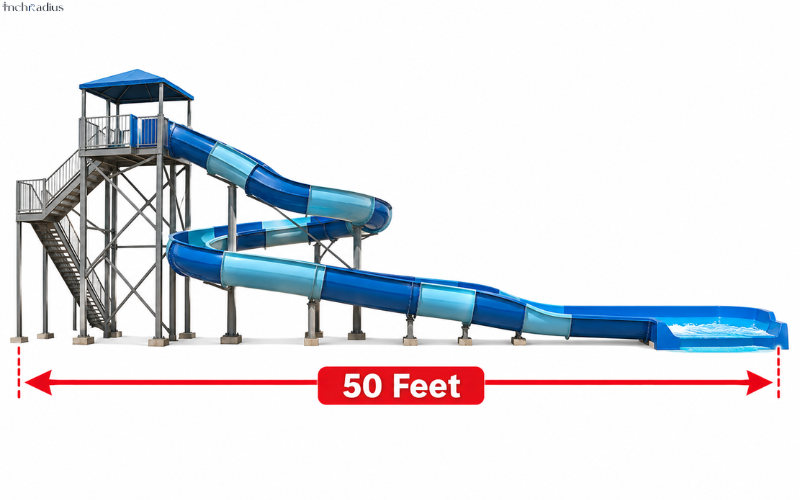
A large water slide can have a sliding path of 50 feet or more. The measurement is not always the same as the straight-line distance between the top and bottom because many slides curve, twist or descend at an angle.
For instance, a slide with a 50-foot riding surface may occupy a much smaller horizontal area if the route bends around a support structure. A straight slide, by contrast, may use more direct space. The design and height of the installation determine how the total length is distributed.
This comparison helps illustrate why length and distance are not always interchangeable. A tape measure following the slide’s surface could show 50 feet, while measuring directly from one end to the other might give a shorter result.
When using a slide as a reference, check whether the stated size describes its full path or its horizontal footprint.
7. Mature Tree
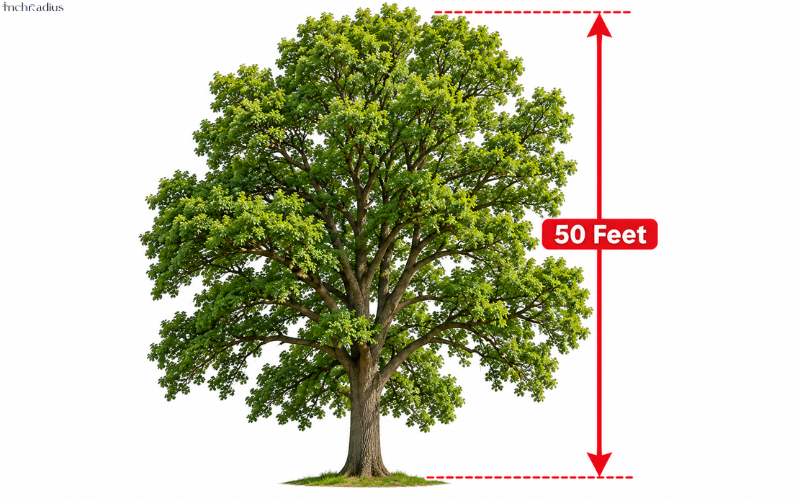
Some mature trees grow to around 50 feet tall, depending on the species, growing conditions and age. Trees such as certain maples, birches and ornamental varieties can reach this height, while other species grow much taller.
A 50-foot tree is roughly as tall as a five-storey building with modest floor-to-floor heights. Looking from its trunk towards the top of the crown helps convey the scale, although a tree’s irregular branches make its outline less precise than a building’s walls.
Tree height also differs from trunk length. A tree standing upright measures vertically from the ground to its highest point, whereas a 50-foot board would measure along its longest edge.
If you are estimating a tree’s height, avoid assuming that every mature tree reaches this size. Species identification and local growing conditions are important when making a more accurate estimate.
8. Water Tower

A small water tower or elevated water-storage structure may stand around 50 feet tall. Larger municipal towers can rise far higher, so this example applies to certain smaller installations rather than every water tower.
Water towers store water above ground level to help maintain pressure in a supply system. Their elevated tanks allow gravity to contribute to the movement of water through connected pipes. The structure may include a tank, supporting legs or a central column, depending on its design.
A 50-foot tower is a useful visual reference because it places the measurement in a vertical setting. Looking at the height of a modest tower can help you imagine the same distance laid flat across a garden or driveway.
When checking a tower’s dimensions, distinguish between the height of the support structure and the total height to the top of the tank.
9. Radio Tower
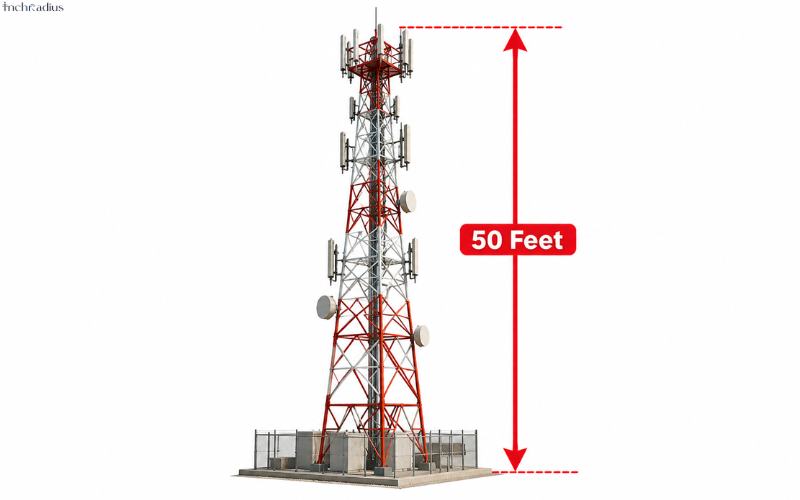
A small radio communications tower or antenna mast may measure around 50 feet tall. The exact height depends on the equipment it carries, the signal coverage required and the site where it is installed. Some installations are much shorter, while others extend hundreds of feet into the air.
Radio towers support antennas used for communications, broadcasting and other signal services. A relatively short tower may be installed on private land, at a commercial site or beside a building.
The height is useful for picturing 50 feet because towers usually form a narrow, upright line. Their shape makes it easier to compare the vertical distance with a horizontal measurement on the ground.
Keep in mind that the antenna itself may extend above the main tower. For an accurate figure, use the total height specified by the installer rather than estimating from a photograph.
10. Large Grain Silo
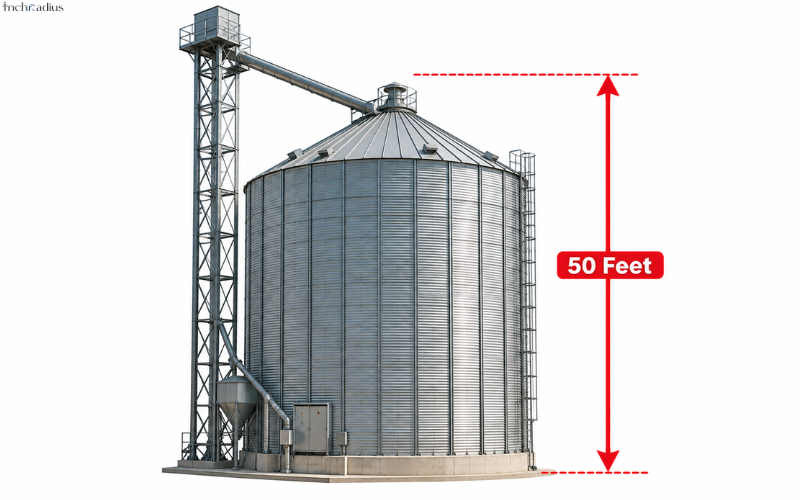
A large grain silo at a farm or agricultural storage site can stand approximately 50 feet tall. Silos come in many sizes, and the height depends on how much grain they are designed to hold and how the structure is built.
These tall, cylindrical buildings store crops such as wheat, maize and barley. Their narrow shape allows a substantial amount of material to be stored in a relatively small ground area. Some silos have conical roofs, while others use flatter or more complex roof structures.
A 50-foot silo is a useful comparison because its height is easy to distinguish from nearby farm buildings, vehicles and fencing. If you imagine laying the silo’s height along the ground, the resulting line would stretch for 50 feet.
Actual silo dimensions vary widely, so treat this as an example of a possible size rather than a standard measurement for agricultural storage buildings.
11. Long Driveway Section
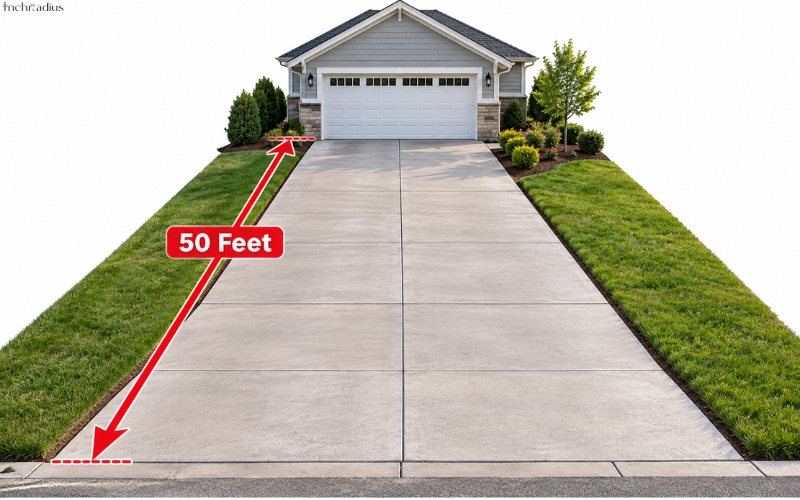
A straight section of driveway measuring 50 feet is a practical reference for homeowners. It might extend from a garage towards the road or cover the distance between a parking area and the entrance to a property.
Driveway lengths differ greatly. A small urban property may have a short entrance, while a house set back from the road may have a much longer approach. A 50-foot section is therefore realistic for some homes, but it is not a standard driveway length.
To picture the measurement, imagine a car parked at the beginning of the driveway and another point 50 feet away. The distance between those points would be longer than the length of most passenger cars by several times.
If you are planning paving, drainage or outdoor lighting, measure the route itself. A sloping or curved driveway may require a different measurement from the straight-line distance shown on a site plan.
12. Zip-Line Cable Section
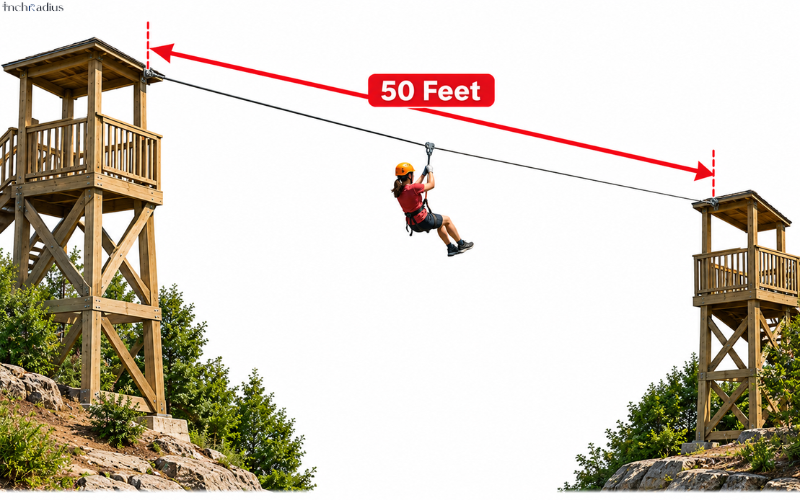
A section of zip-line cable measuring 50 feet provides another way to visualise this length. Short recreational zip lines may be installed in gardens or adventure parks, while longer installations can span much greater distances.
The cable runs between anchor points and supports a pulley system that carries the rider along the route. A 50-foot cable section is relatively short compared with many commercial zip lines, but it still represents a noticeable stretch across an open space.
The cable’s total length and the horizontal distance between its endpoints are not always identical. A cable may sag slightly or follow a sloping route, so the distance measured along it can differ from the straight-line separation between the anchor points.
This example is useful for understanding how a 50-foot span can cross a garden or small outdoor area. Any real zip-line installation must use suitable equipment, secure anchors and professional safety checks.
Measurement Without a Ruler
You can estimate 50 feet without a measuring tape by using familiar distances. These methods are helpful for rough planning, but they should not replace accurate measurements for construction or safety-related work.
1. Count Your Walking Steps
An adult’s ordinary walking step may cover roughly 2–2.5 feet, depending on height and stride. At that rate, 50 feet takes approximately 20–25 steps.
Choose a straight path, walk at your usual pace and count each step. The result will only be an estimate because your stride may change with the ground, footwear or walking speed. For a better estimate, measure a shorter distance first, such as 10 feet, and use it to calibrate your steps.
2. Use the Length of a Car
Many passenger cars are around 12–16 feet long. Three cars placed end to end would therefore cover roughly 36–48 feet, depending on their sizes. Four cars would usually extend beyond 50 feet.
You can use a familiar parked car as a visual reference, but allow for variation between vehicle models. This method is most useful for judging whether a garden, driveway or parking space is close to the target length.
3. Measure in Short Sections
If you have a known 5-foot or 10-foot reference, mark that distance along the ground repeatedly. Five sections of 10 feet make exactly 50 feet, while ten sections of 5 feet give the same total.
A measured piece of rope, a tape measure or a marked length of garden hose can help you create the reference section. Keep the sections straight and place each mark carefully. This approach is more dependable than estimating with body measurements, provided the original reference length is accurate.
Related Post: How Long Is 40 Feet? 11 Common Things That Are 40 Feet Long
FAQs
1. How many inches are in 50 feet?
There are exactly 600 inches in 50 feet. One foot contains 12 inches, so multiplying 50 by 12 gives 600. This conversion is useful when measuring furniture, building materials or other objects using an inch-based tape measure.
2. How many metres is 50 feet?
Fifty feet equals exactly 15.24 metres. To convert feet into metres, multiply the number of feet by 0.3048. This is useful for comparing building dimensions, garden boundaries and vehicle lengths with measurements given in the metric system.
3. Is 50 feet longer than a school bus?
Fifty feet is longer than many full-size school buses, which commonly measure around 35–45 feet. However, bus dimensions vary by model and country. A particularly long bus may be closer to 50 feet, so the comparison should be treated as approximate.
4. How many steps does it take to walk 50 feet?
Most adults may cover 50 feet in approximately 20–25 ordinary walking steps. The number depends on stride length, which varies with height, walking style and ground conditions. If you need a more reliable estimate, calibrate your steps over a measured 10-foot distance first.
5. How tall is a 50-foot building?
A 50-foot building could be roughly five storeys tall if each storey accounts for about 10 feet. The actual number depends on ceiling heights, floor structures and roof design. Commercial buildings with taller floors may have fewer storeys within the same overall height.
6. How do I measure 50 feet without a tape measure?
You can estimate the distance by counting walking steps, comparing it with familiar vehicle lengths or marking several shorter sections. For example, five accurately measured 10-foot sections equal 50 feet. These methods are useful for rough estimates, but precise projects require a suitable measuring tool.
7. Is 50 feet the same as 15 metres?
No. Fifty feet equals 15.24 metres, which is 0.24 metres longer than 15 metres. The difference is 24 centimetres. The two lengths may be treated as similar for a rough visual estimate, but they are not interchangeable when precise dimensions matter.
8. What is the easiest way to picture 50 feet?
A straight garden fence, a long driveway section or a large boat provides a practical reference. You can also imagine a line roughly as long as three large passenger cars placed end to end. These comparisons make the distance easier to picture, although individual object sizes vary.
Conclusion
Fifty feet is a distance of 600 inches, or 15.24 metres. It becomes easier to picture when you compare it with a long driveway section, a garden fence or a large boat. You can also think of a small water tower standing roughly 50 feet tall, then imagine that height laid horizontally across the ground.
For a quick estimate, count around 20–25 normal walking steps, keeping in mind that stride length differs from person to person. If you need to measure a fence, driveway or building project accurately, use a tape measure or another suitable measuring tool. Familiar objects help you picture the distance, but careful measurement gives you the dependable figure you need.