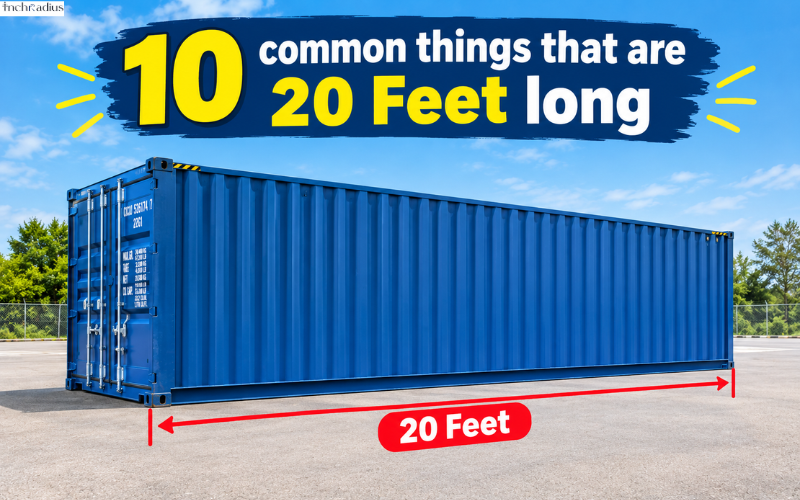
20 feet is a length of 240 inches, 609.6 centimetres, or 6,096 millimetres. It is roughly twice the length of an average family car, so it is much easier to picture when you compare it with familiar objects or spaces. A 20-foot length can be found in shipping containers, boats, trailers, swimming pools, rooms, and other large everyday structures.
If you do not have a tape measure nearby, these comparisons can help you form a rough idea of how far 20 feet actually stretches. The examples below are not all exact 20-foot measurements, so each one is described as either an exact match or a close approximation.
How Long Is 20 Feet?
Twenty feet is exactly 240 inches. In metric units, it equals 609.6 centimetres, or 6.096 metres. Since one foot contains 12 inches, multiplying 20 by 12 gives the 240-inch measurement.
In everyday terms, 20 feet is a substantial distance. A typical passenger car is often around 14 to 16 feet long, meaning 20 feet would extend several feet beyond many cars. It is also about the length of a small room or the overall length of some boats and trailers.
A standard 20-foot shipping container provides one of the clearest real-world examples because its nominal external length is 20 feet. Standing beside one makes the measurement much easier to appreciate than simply looking at a number.
How Big Is 20 Feet?
Twenty feet can be difficult to picture because most people do not regularly measure large distances in feet. A useful starting point is to imagine a line extending from one end of a room to the other. A large bedroom, garage, classroom, or similar space can sometimes be close to 20 feet across or long.
You can also compare it with familiar objects. A car measuring about 15 feet would leave roughly another 5 feet to reach 20 feet. Two 10-foot lengths placed end to end would give you exactly 20 feet. Likewise, four 5-foot sections would cover the same distance.
For a rough visual estimate, an adult’s arm span can be useful, although this varies considerably between people. Several arm spans placed end to end can give you an approximate sense of the distance, but a tape measure is still needed for an accurate measurement.
10 Common Things That Are 20 Feet Long
The following examples give you different ways to visualise 20 feet. Some have a standard or nominal length close to exactly 20 feet, while others can vary depending on the model, design, or setting.
| Everyday Item | Actual Size |
| Shipping Container | 20 feet |
| Small Sailboat | 20 feet |
| Utility Trailer | 20 feet |
| Swimming Pool | 20 feet |
| Motorhome | 20 feet |
| Large Room | 20 feet |
| Flatbed Trailer | 20 feet |
| Racing Canoe | 20 feet |
| Small Cabin | 20 feet |
| Garden or Driveway Section | 20 feet |
Shipping Container
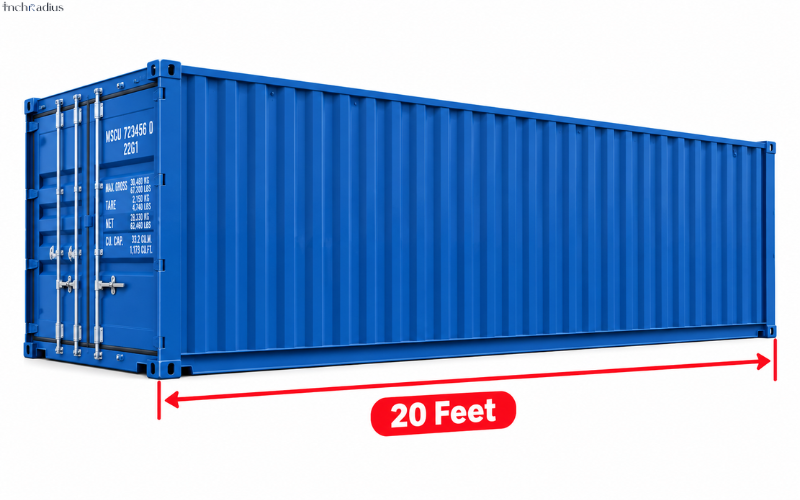
A 20-foot shipping container is one of the clearest examples of this measurement. The standard container is named for its nominal external length of 20 feet, making it a useful real-world reference when visualising the distance.
A container of this size is roughly 240 inches long. Its actual dimensions can vary slightly depending on the manufacturer and container type, but the 20-foot designation remains standard for this common format.
If you have seen a shipping container at a port, warehouse, construction site, or storage yard, imagine its full length from one end to the other. That gives you a strong visual reference for 20 feet.
It is also useful because you can compare the container with other objects. A person standing at one end would need to walk a noticeable distance to reach the other. For someone trying to picture how long 20 feet is, a shipping container is probably one of the easiest physical references to find.
Small Sailboat
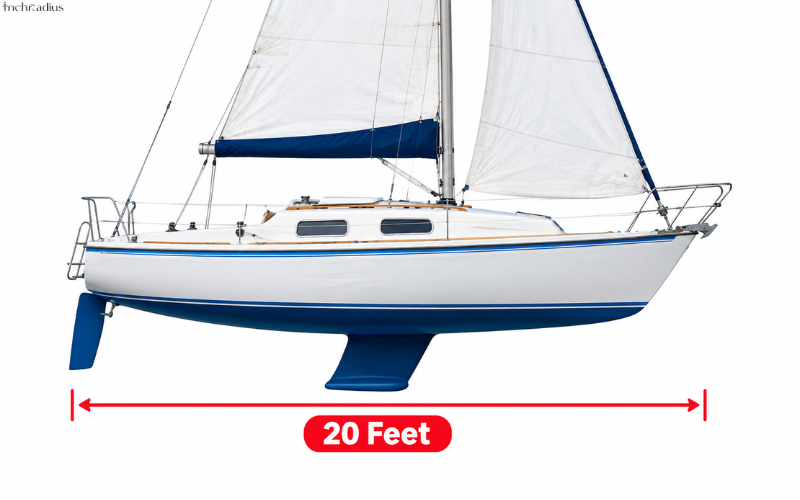
Some small sailboats can be around 20 feet long, particularly boats designed for cruising, training, racing, or recreational sailing. Their exact length varies by model, so this should be treated as an approximate comparison unless the particular boat is specified as 20 feet.
A 20-foot sailboat gives you a particularly useful visual because boats have a long, narrow shape. Looking from the bow to the stern makes the full distance easy to see.
If you have ever stood beside a small sailing boat, its length can seem greater than expected. The mast also makes the boat appear much larger, although the mast height should not be confused with the boat’s length.
To estimate 20 feet using a boat, focus only on the distance from the very front of the hull to the very back. That horizontal distance is the useful comparison.
Utility Trailer
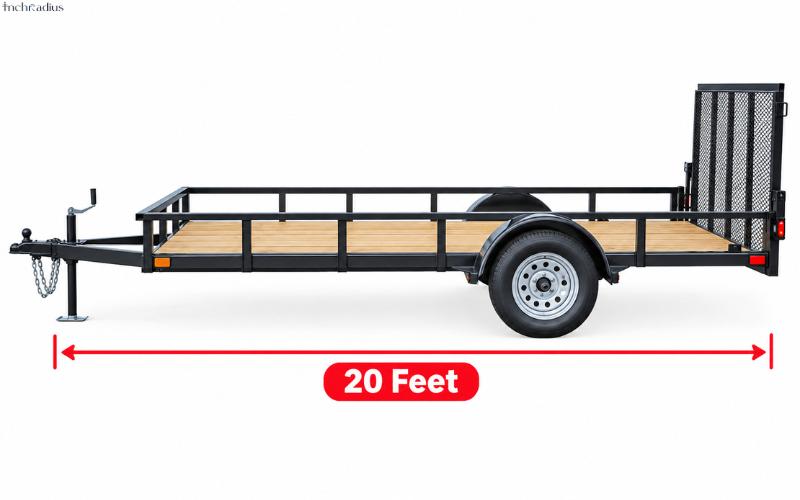
A large utility trailer can measure around 20 feet in length, although trailer dimensions differ according to their intended use. Some are much shorter, while specialised trailers can be considerably longer.
A 20-foot trailer is long enough to carry sizeable equipment, building materials, vehicles, or other bulky loads. When parked, it creates a useful straight-line reference for the measurement.
Imagine standing at the hitch and looking towards the rear of a trailer measuring 20 feet. The distance from one end to the other represents the full measurement. This is especially helpful because trailers usually have a clear, straight profile.
If you are estimating the size of a driveway or parking area, a 20-foot trailer can also provide a practical comparison. Remember that the overall trailer length may include the drawbar or hitch, so the usable bed length may be shorter than the total length.
Swimming Pool
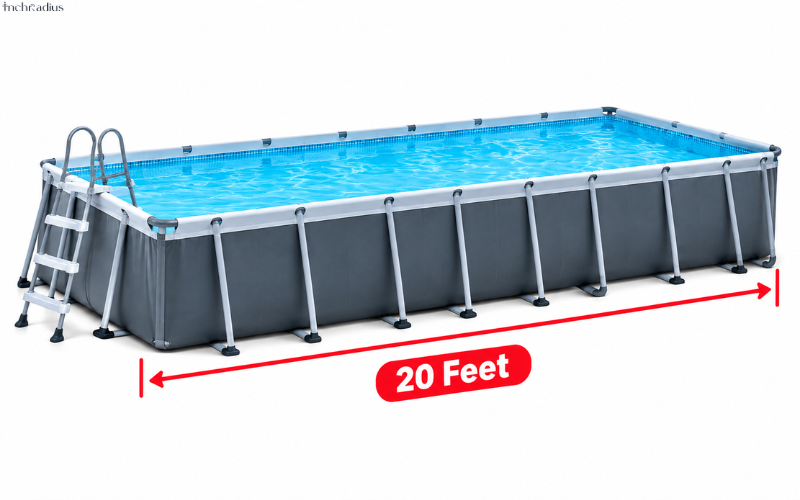
A 20-foot swimming pool is another easy way to picture this measurement. Small residential pools can be designed with a length of 20 feet, although pool sizes vary widely.
Picture a rectangular pool that is 20 feet from one short end to the other. Swimming from the wall at one end to the opposite wall would cover 20 feet. That is equivalent to 240 inches or just over 6 metres.
A pool gives you a particularly strong sense of distance because the measurement can be viewed from above or while standing beside it. If you have access to a 20-foot pool, simply looking along its longest side can make the size much easier to understand.
A pool that is 20 feet long may still have a different width, depth, and shape, so only the stated length should be used when comparing it with the measurement.
Motorhome
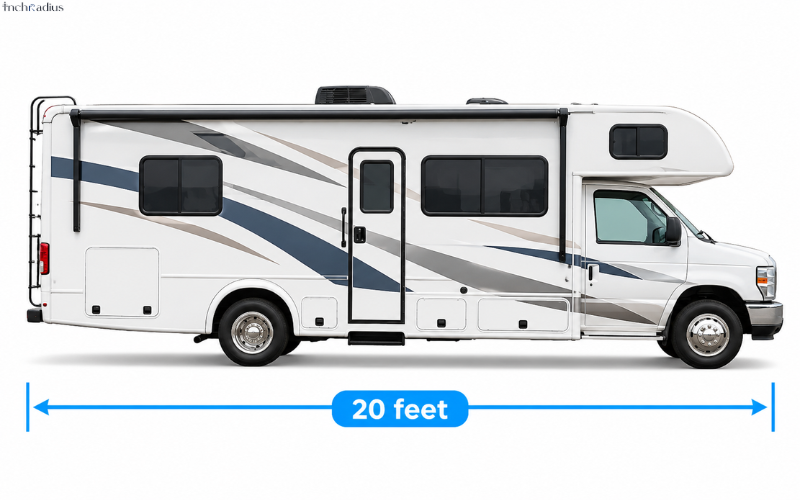
Some compact motorhomes and campervans are around 20 feet long. Their exact dimensions depend heavily on the model, layout, and manufacturer.
A motorhome is useful for visualising 20 feet because it is a familiar large vehicle. It is substantially longer than many ordinary family cars, yet it is still small enough to be used on normal roads and in many campsites.
Imagine a motorhome parked in front of you. Walking from the front bumper to the rear would cover approximately 20 feet if it has that stated length. The interior will naturally be shorter because the exterior body includes walls, doors, storage areas, and other components.
For a rough comparison, placing a 20-foot motorhome beside a 15-foot car would leave about another 5 feet of length. That difference helps show why 20 feet feels noticeably larger than an ordinary passenger vehicle.
Large Room
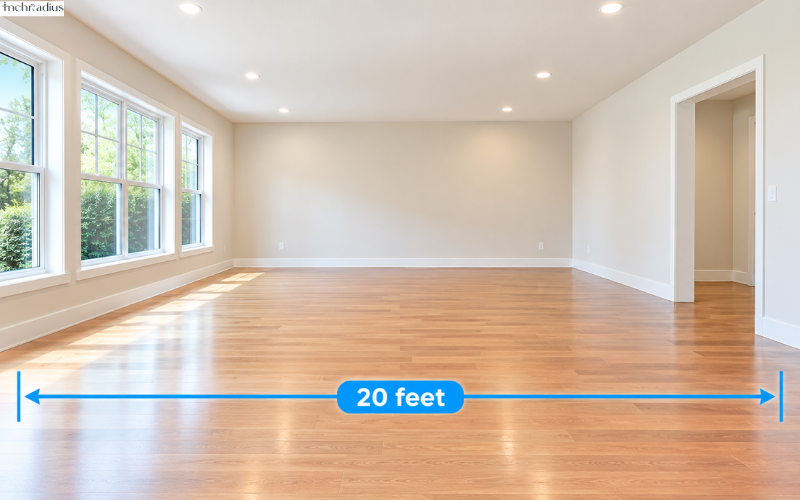
A large room can sometimes measure 20 feet from one wall to another or from one end to the opposite end. This is not a fixed standard, so the actual dimensions need to be checked for a particular room.
A 20-foot room is easier to imagine if you picture a long rectangular living room, classroom, garage, or meeting room. Walking from one end to the other gives you a practical sense of the distance.
If you have a room that is close to this length, count your normal walking steps from one end to the other. An adult’s stride varies, so this will only provide an estimate, but it can make the measurement more familiar.
A 20-foot room could also be divided into four 5-foot sections. Thinking about the space in smaller pieces is useful when a full 20-foot distance is difficult to visualise at once.
Flatbed Trailer
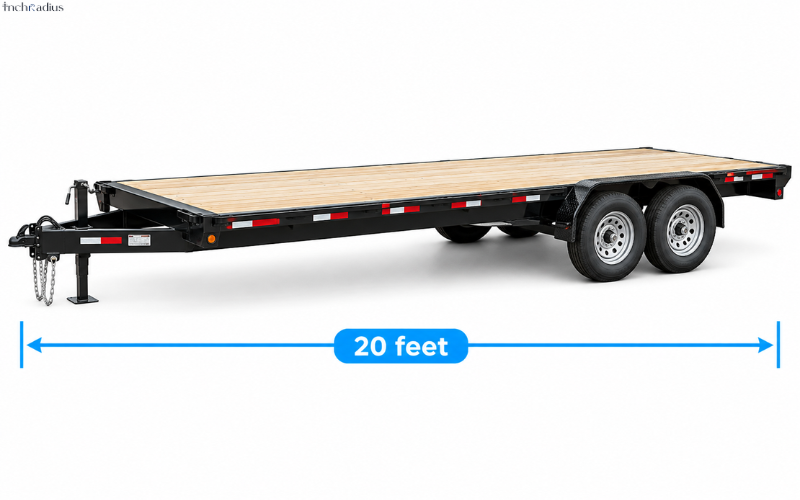
A 20-foot flatbed trailer provides another long, straight comparison. Flatbed trailers come in many different sizes, but 20-foot versions are available for transporting materials and equipment.
Unlike a normal enclosed trailer, a flatbed has an open platform. This makes its overall length particularly easy to see. You can look from the front end of the deck to the rear and directly visualise the distance.
For someone estimating 20 feet, the trailer can be treated as a long measuring line. If you were standing at the front and walked to the back of a 20-foot flatbed, you would have travelled the full 20 feet.
Keep in mind that the total trailer length and deck length are not always identical. The tongue or coupling section may extend beyond the main platform. Always check the manufacturer’s stated dimensions if precision matters.
Racing Canoe
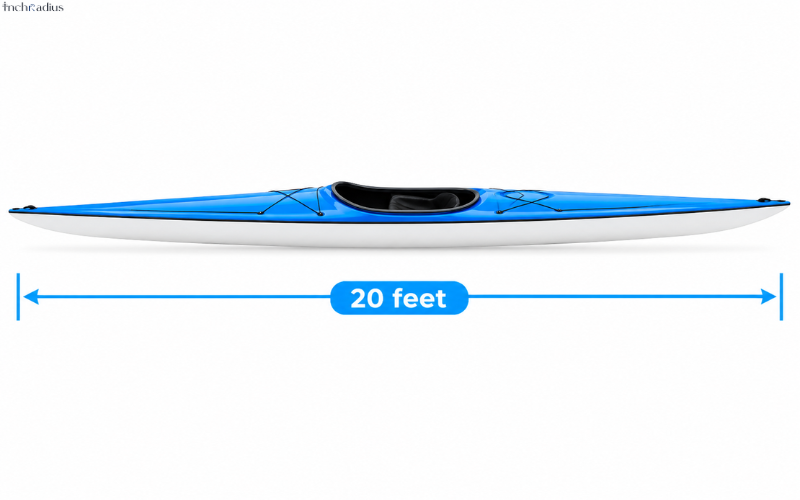
Some racing canoes can approach 20 feet in length, particularly longer competition-style designs. The exact size depends on the type of canoe and the rules governing the class.
A canoe is an interesting comparison because its narrow shape makes its length visually obvious. From the pointed bow to the stern, the distance can stretch considerably farther than the width of the boat.
If you have seen a long racing canoe, imagine placing it on the ground and measuring from its front tip to its rear end. A canoe around 20 feet long would cover the same distance as 240 inches laid in a straight line.
This comparison works best as an approximation unless you know the canoe’s exact specifications. Recreational canoes are often considerably shorter, so a random canoe should not automatically be assumed to be 20 feet long.
Small Cabin
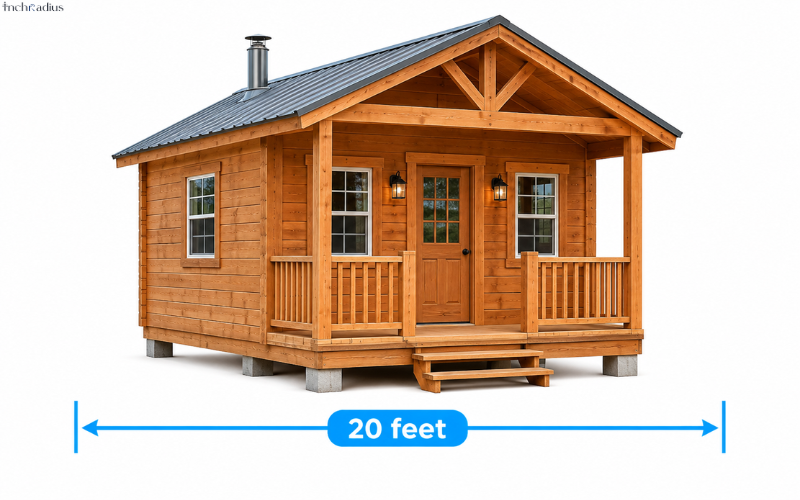
A small cabin can have a floor plan that is approximately 20 feet long. This is particularly common in compact cabins where the building is designed around a narrow rectangular layout.
Picture a cabin measuring 20 feet from its front wall to its back wall. The total length would be just over 6 metres. Depending on the width, this could provide enough space for a simple living area, sleeping space, kitchen, or storage.
The cabin itself gives you a useful three-dimensional reference. Instead of imagining a single line, you can picture a complete building stretching 20 feet in one direction.
A cabin’s external length may include walls, porches, steps, or other features depending on how its dimensions are described. For an accurate comparison, use the stated building dimensions rather than estimating from appearance.
Garden or Driveway Section
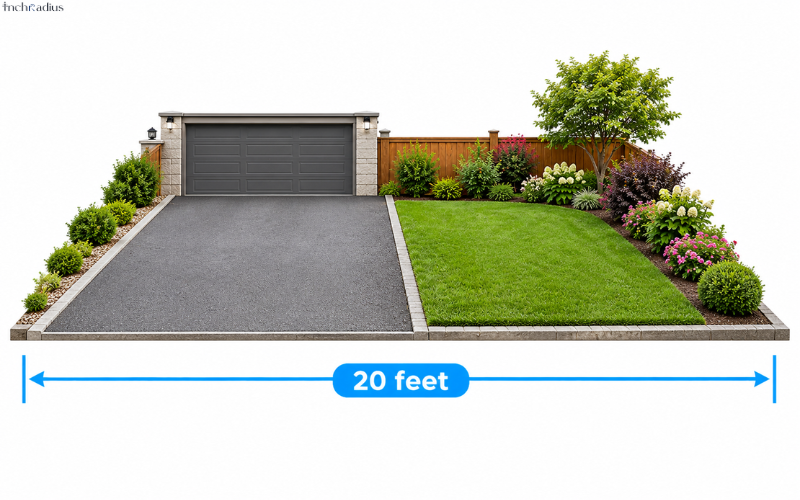
A section of garden, path, or driveway can easily be 20 feet long, making this one of the simplest household references. Unlike manufactured objects, outdoor spaces are not normally built to one universal length, so this is an approximate example unless measured.
Imagine a straight driveway section extending 20 feet from one point to another. It would cover 240 inches, or just over 6 metres. Marking the starting point and walking to the end can help you understand how far the distance actually feels.
You can also split the length into four equal 5-foot sections. This makes it easier to estimate if you do not have a tape measure available.
For a garden, a 20-foot border might run along a fence, flower bed, lawn, or pathway. Measuring these familiar spaces can turn an abstract number into something you can see and walk alongside.
Related Post: 11 Common Things That Are 19 Feet Long
Measurement Without a Ruler
You can estimate 20 feet without a ruler by breaking the distance into smaller, familiar sections. These methods will not provide the precision of a tape measure, but they can be useful for a quick visual estimate.
Use five 4-foot sections: Imagine the distance as five sections, each roughly 4 feet long. If you know the approximate height or length of a familiar object that is around 4 feet, place five imagined sections end to end.
Use four 5-foot sections: Five feet is close to the height of many adults, although body height varies. Imagine four lengths of about 5 feet placed consecutively. Together, they make 20 feet.
Use a familiar vehicle: If you know a vehicle is around 15 feet long, imagine that vehicle and then add roughly another 5 feet. This can provide a surprisingly useful visual estimate.
Body measurements should always be treated as rough guides. Hand spans, arm lengths, strides, and heights vary from person to person, so they should not be used when an exact 20-foot measurement is required.
FAQs
Is 20 feet longer than a car?
Yes, 20 feet is longer than most ordinary passenger cars. Many family cars are roughly 14 to 16 feet long, although models vary. A 20-foot distance would therefore extend several feet beyond the length of many cars.
How many inches are in 20 feet?
There are exactly 240 inches in 20 feet. This is calculated by multiplying 20 feet by 12 inches, because every foot contains 12 inches.
How many centimetres is 20 feet?
Twenty feet equals 609.6 centimetres. It can also be expressed as 6.096 metres. For everyday descriptions, rounding to about 610 centimetres or 6.1 metres is usually sufficient.
How many millimetres are in 20 feet?
Twenty feet equals exactly 6,096 millimetres. The conversion comes from 20 feet being 609.6 centimetres, with each centimetre containing 10 millimetres.
Is a 20-foot shipping container actually 20 feet long?
A standard 20-foot shipping container has a nominal external length of 20 feet. Its exact construction dimensions can vary slightly, and the internal length is shorter because of the container walls and structure.
Can a room be 20 feet long?
Yes. A large bedroom, living room, classroom, garage, or other rectangular space can have a length of 20 feet. Room dimensions vary, so the actual length should be measured rather than assumed from the room’s appearance.
Is 20 feet the same as 6 metres?
Not exactly. Twenty feet is 6.096 metres, so it is 0.096 metres longer than 6 metres. In everyday conversation, it may be rounded to about 6.1 metres.
What is an easy way to visualise 20 feet?
A 20-foot shipping container is one of the clearest references. You can also picture two 10-foot sections placed end to end, four 5-foot sections, or a vehicle around 15 feet long with another 5 feet added.
Conclusion
Twenty feet is a sizeable distance that becomes easier to picture when broken into familiar sections. It measures exactly 240 inches, 609.6 centimetres, or 6.096 metres. A standard 20-foot shipping container provides one of the strongest physical references because its nominal length matches the measurement. A long trailer, small boat, pool, room, or compact motorhome can also give you a useful sense of scale.
For a quick mental picture, imagine four 5-foot sections joined together. If you have access to a 20-foot container or similarly sized object, seeing the full length in person makes the measurement much more obvious. For anything requiring accuracy, however, use a tape measure rather than relying on an estimate.