
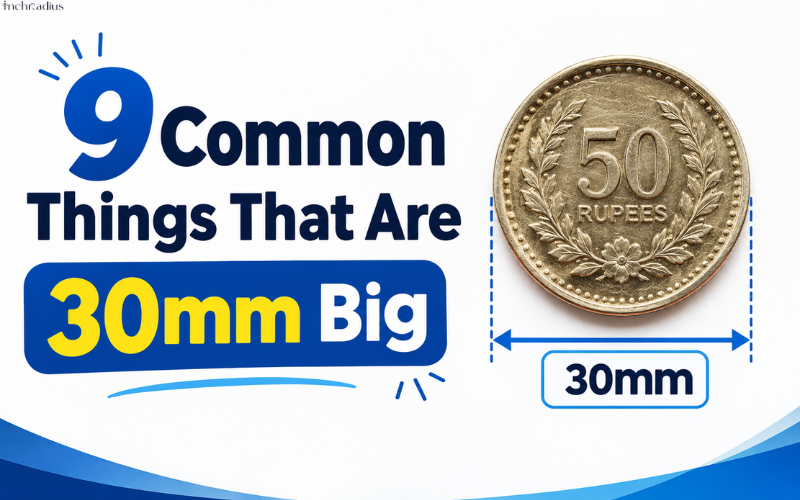
30mm is equal to 3 centimetres, 1.18 inches, or 0.03 metres. It is a small measurement, slightly longer than an inch. To picture it, imagine the width of a large craft button or the side of a small wooden cube. Both can give you a useful idea of how much space 30mm takes up.
This measurement appears in everyday items, craft supplies, hardware and small accessories. It can also help when checking the size of a component, choosing materials for a project or deciding whether a small object will fit into a particular space.
How Long Is 30mm?
30 millimetres is exactly 3 centimetres. It is also approximately 1.18 inches, which means it is a little longer than 1 inch. If you divide a centimetre into ten equal parts, each part represents 1mm. Thirty of these small divisions make up the full measurement.
On a standard ruler, 30mm reaches from the zero mark to the third centimetre line. This makes it fairly easy to check with an ordinary measuring tool.
The measurement is useful for small objects that need to fit into a limited space. For example, a 30mm craft cube has sides measuring 3cm, while a round component with a 30mm diameter measures 3cm from one edge to the opposite edge through its centre.
Related Post: How Long Is 100 Feet? 11 Common Things That Are 100 Feet Long
Here are the main conversions:
- 30mm = 3cm
- 30mm = 1.18 inches
- 30mm = 0.0984 feet
- 30mm = 0.03 metres
How Big Is 30mm?
Imagine placing your finger beside a ruler and looking at the distance between the 0 and 3cm marks. That short stretch is exactly 30mm. It is small enough to fit comfortably between the tips of your thumb and index finger, yet large enough to see clearly without needing to look closely.
A useful comparison is a small wooden craft cube. If each side measures 30mm, it will look roughly as wide as a large button. A round acrylic craft disc with a 30mm diameter offers another helpful reference.
You can also picture 30mm as a little longer than the width of an adult thumb near the nail, although finger sizes differ from person to person.
The easiest way to remember this measurement is to think of 3cm on a ruler. It is a short distance, but it is not as tiny as a few millimetres.
9 Common Things That Are 30mm Big
Several small household, craft and hardware items can help you picture a measurement of 30mm. Some are manufactured to this exact size, while others are available in approximate 30mm dimensions.
The table below provides nine examples. Their descriptions explain which measurements are fixed and which may vary depending on the product.
Related Post: How Long Is 90 Feet? 10 Common Things That Are 90 Feet Long
| Everyday Item | Actual Size |
| Small wooden craft cube | 30mm |
| Round acrylic keyring blank | 30mm |
| Ceramic mosaic tile | 30mm |
| M20 hexagonal nut | 30mm |
| Large craft button | 30mm |
| Round game counter | 30mm |
| Craft pom-pom | 30mm |
| Small round watch case | 30mm |
| Mini decorative candle | 30mm |
1. Small Wooden Craft Cube
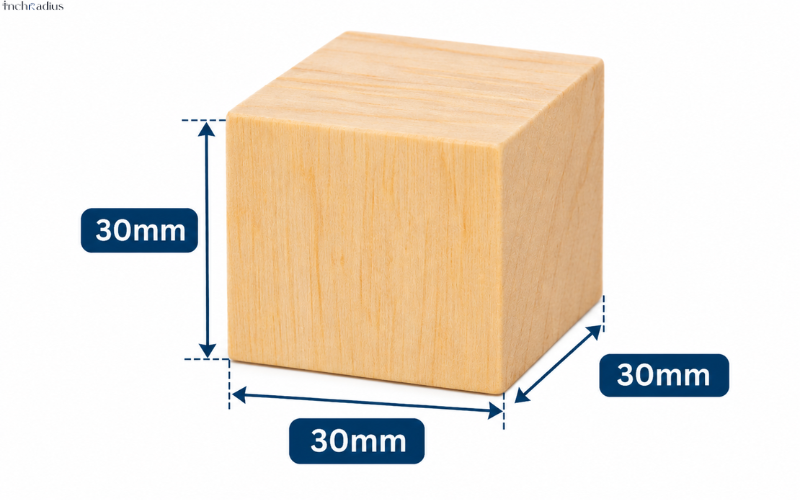
A small wooden craft cube measuring 30mm on each side is an easy way to picture this measurement. Its length, width and height are all 3cm, giving you a solid object that is simple to compare with a ruler.
These cubes are commonly used for school projects, model-making, decorative crafts and small DIY activities. They may be made from unfinished pine, beech or other lightweight wood.
Place one beside a ruler and you will see that its side reaches exactly from the zero mark to 30mm. You can also hold it between your fingers to get a better sense of its size.
Unlike a natural object, a manufactured wooden cube can have a specified dimension. Just check the product description before buying, as craft cubes are sold in several different sizes.
2. Round Acrylic Keyring Blank
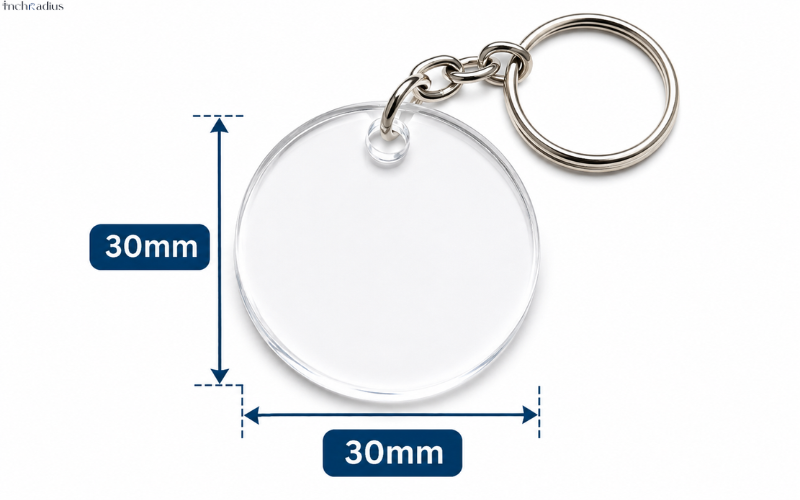
A round acrylic keyring blank with a 30mm diameter is another useful comparison. It looks like a small, flat transparent disc, often supplied with a tiny hole for attaching a metal keyring.
These blanks are used for personalised keychains, handmade gifts, resin decorations and small craft projects. Some have a completely clear finish, while others come in coloured or frosted acrylic.
The important measurement here is the diameter rather than the thickness. If you measure straight across the centre from one outer edge to the other, the distance is 30mm.
This gives you a practical way to picture a 3cm-wide circle. It is also useful when selecting a keyring design because a slightly larger or smaller blank can change how the finished accessory looks.
Related Post: How Long Is 80 Feet? 9 Common Things That Are 80 Feet Long
3. Ceramic Mosaic Tile
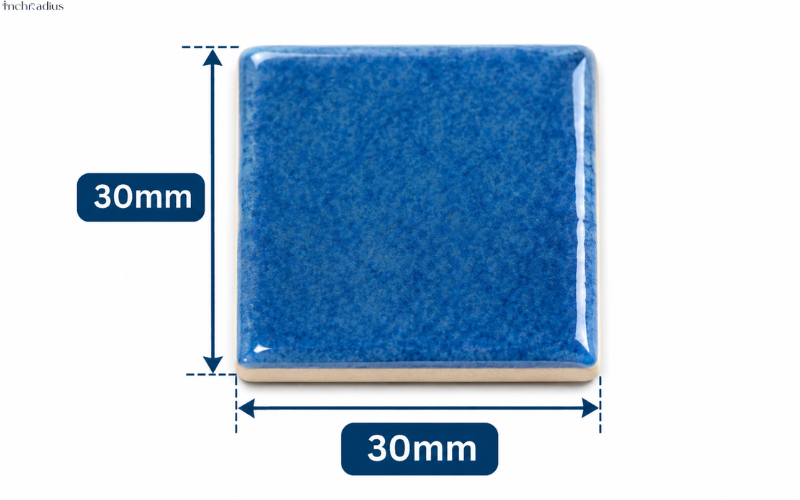
Small ceramic mosaic tiles are used to decorate picture frames, trays, plant pots and other surfaces. Some craft tiles are made with a side length of exactly 30mm, creating a neat square measuring 3cm by 3cm.
A single tile provides a particularly clear visual comparison because its straight edges make the measurement easy to understand. You can place a ruler along one side and check the distance between its corners.
These tiles come in many finishes, including glossy white, blue, green and earthy colours. Their thickness varies, but the width and length can be specified separately by the manufacturer.
A 30mm square tile is also useful when planning a mosaic pattern. For example, three tiles placed side by side would cover 90mm before allowing for grout gaps.
Related Post: How Long Is 70 Feet? 10 Common Things That Are 70 Feet Long
4. M20 Hexagonal Nut
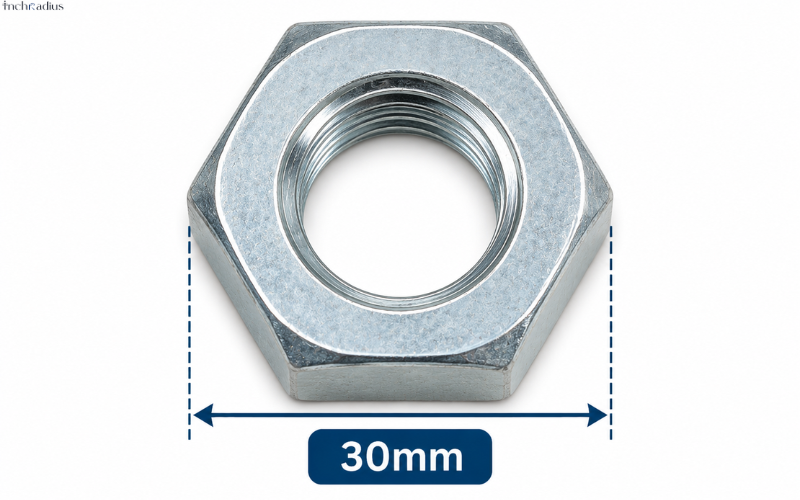
A standard M20 hexagonal nut provides an interesting hardware comparison. Under standard metric dimensions, an M20 hex nut has a width of 30mm across its opposite flat sides.
This is not the diameter of the threaded hole or the total distance between its pointed corners. It is the measurement taken across two parallel flat surfaces.
You can find these nuts in machinery, construction equipment, metal frames and other fastening applications. Their six-sided shape allows a spanner or socket to grip the outside.
A 30mm spanner size is commonly used to tighten or loosen this type of nut. This makes it a useful real-world example of how a 30mm measurement appears in mechanical work.
If you are purchasing one, check the relevant standard and product specifications because different nut sizes have different across-flat dimensions.
5. Large Craft Button
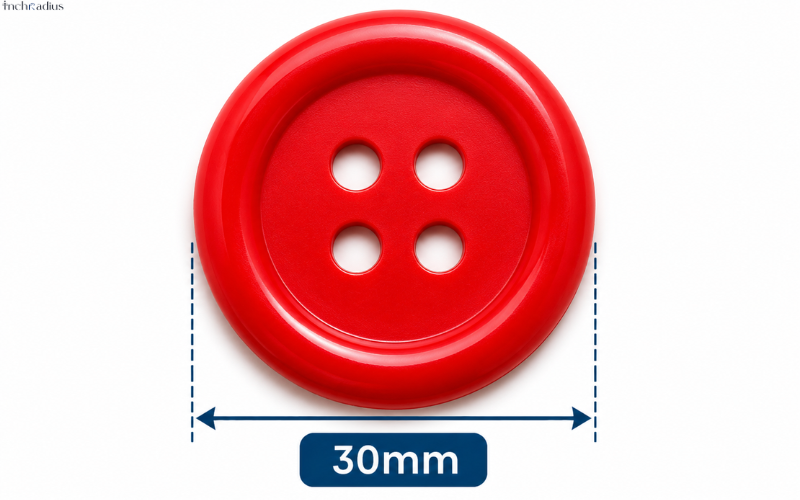
A large craft button measuring approximately 30mm across is a familiar object that can help you visualise this measurement. It is the type of button that might be used on a thick cardigan, a decorative coat or a handmade fabric bag.
Buttons are available in plastic, wood, metal and other materials. Some have two holes, while others have four holes or a raised attachment loop underneath.
The diameter of a 30mm button is the distance from one outside edge to the opposite outside edge through its centre. Its thickness is much smaller.
Buttons are not all manufactured to the same dimensions, so this is an approximate comparison unless the packaging specifies a 30mm diameter.
Related Post: How Long Is 60 Feet? 11 Common Things That Are 60 Feet Long
6. Round Game Counter
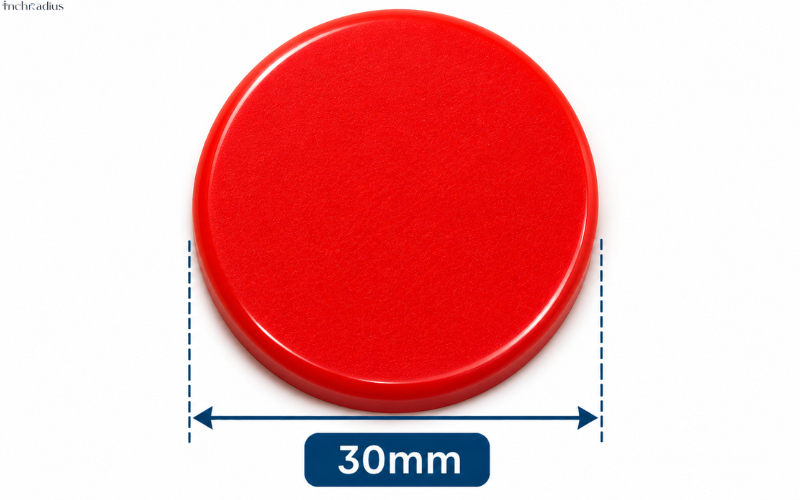
Round game counters are small discs used in board games, educational activities and tabletop games. Some are manufactured with a diameter of 30mm, making them a useful example of this measurement.
They are often made from plastic, cardboard or lightweight wood. Their surfaces may be plain, coloured or printed with numbers and symbols.
A 30mm counter is wide enough to hold between your fingertips but small enough to fit several pieces inside a compact game box. If you place it flat on a ruler, the distance across its centre will measure 3cm.
These counters are especially useful for visualising the measurement because their circular shape makes the outside diameter easy to identify.
Do remember that game counters come in different sizes. A 30mm counter is a specific product size rather than a standard measurement shared by every board game.
Related Post: How Long Is 50 Feet? 12 Common Things That Are 50 Feet Long
7. Craft Pom-Pom
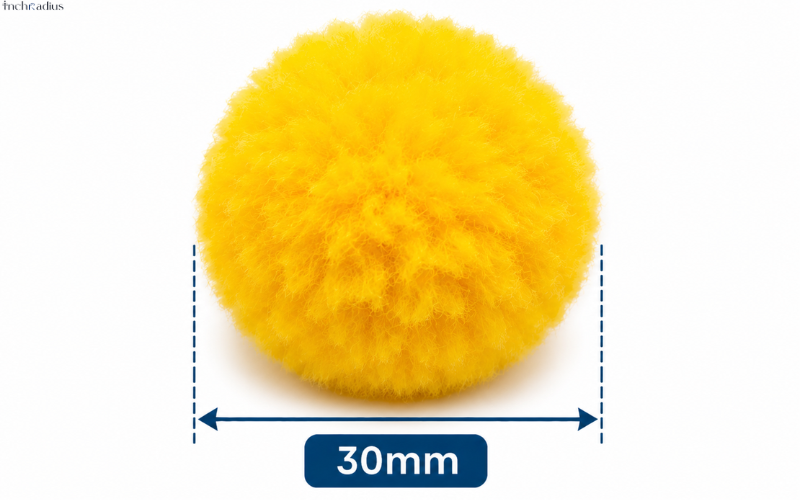
A small craft pom-pom measuring around 30mm across is a softer way to picture this size. These fluffy balls are used in children’s crafts, decorations, handmade toys and creative school projects.
They are commonly made from wool, acrylic fibres or synthetic materials. You can find them in many colours, including red, yellow, pink, green and blue.
Unlike a wooden cube or metal nut, a pom-pom does not have perfectly straight edges. Its fibres can stick out in different directions, so the measurement is generally approximate unless it is carefully specified by the manufacturer.
Imagine a fluffy ball about 3cm wide sitting in the palm of your hand. It gives you a reasonable idea of how much space 30mm occupies.
Related Post: How Long Is 40 Feet? 11 Common Things That Are 40 Feet Long
8. Small Round Watch Case
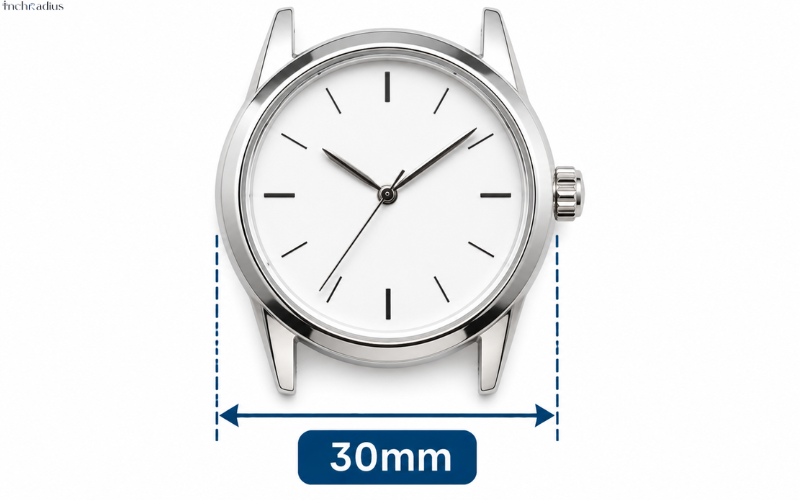
Some compact wristwatches have a case diameter of 30mm. This measurement refers to the width of the round watch body, usually excluding the crown on the side.
A 30mm watch case is relatively small compared with many modern sports watches. It is often found in delicate dress watches, compact everyday designs and smaller wristwatch styles.
The case provides a useful comparison because it is a manufactured component with a clearly defined outside diameter. Looking at one from directly above makes the 3cm width easier to picture.
However, watch measurements vary considerably. Some models have cases measuring 28mm, 32mm or more, so not every small watch will be exactly 30mm wide.
Check the manufacturer’s specifications if you need this measurement for choosing a replacement strap or comparing watch sizes.
Related Post: How Long Is 30 Feet? 10 Common Things That Are 30 Feet Long
9. Mini Decorative Candle
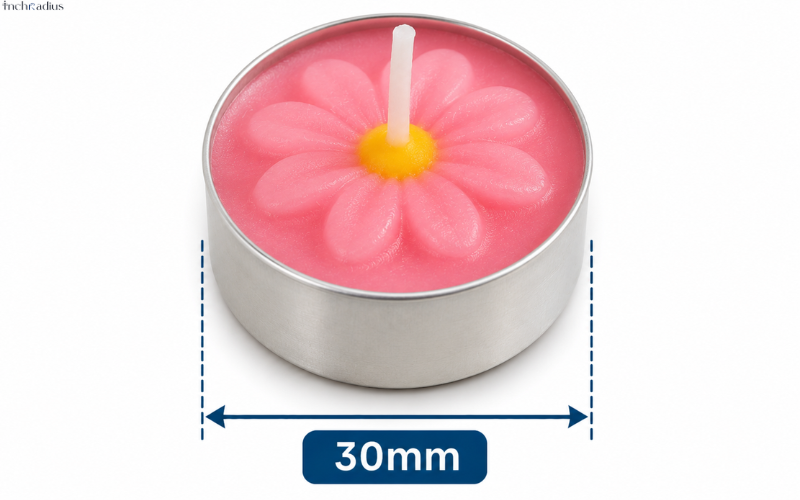
A mini decorative pillar candle with a diameter of approximately 30mm is another household-related comparison. These little candles are often used for table decorations, small displays and decorative arrangements.
They are available in different colours, including ivory, cream, white and pastel shades. Their height can vary, but some compact designs have a base measuring around 3cm across.
The width of the candle is the useful measurement here. Look at it from above and imagine measuring a straight line from one side to the other through the centre. That distance gives you the diameter.
Candles are generally sold in different dimensions, so a 30mm-wide example should be treated as approximate unless its product details confirm the exact size.
It is a useful comparison because most people have seen small decorative candles and can picture their size without much difficulty.
Related Post: 11 Common Things That Are 21 Feet Long
Measurement Without a Ruler
You do not always need a measuring tape or ruler to estimate 30mm. A few familiar objects and simple techniques can help you get close to 3cm.
1. Use Your Thumb as a Reference
Look at the width of your thumb near the nail. For many adults, this area is close to 20–25mm, although hand sizes vary.
A 30mm measurement will usually be a little wider than this reference. You can compare the width of your thumb with a small craft button or another object of known size.
Treat this as a rough estimate rather than an exact measurement. Children and adults can have very different finger proportions.
2. Picture Three Centimetres on a Ruler
If you have access to a ruler occasionally, remember the distance between the 0 and 3cm marks.
This gives you a reliable reference for future estimates. You can also remember that each centimetre contains ten millimetres, so three centimetres contain thirty millimetres.
Once you become familiar with this short distance, you can recognise it more easily when looking at small household objects.
3. Compare It with a 30mm Craft Cube
A manufactured wooden cube with 30mm sides is a useful reference object to keep in a craft box or desk drawer.
Its flat surfaces and straight edges make it easier to compare other objects. If something looks roughly as wide as one side of the cube, it may be close to 30mm.
This method is more reliable than estimating with your fingers, provided the cube has been measured or its dimensions are confirmed.
Related Post: 10 Common Things That Are 20 Feet Long
FAQs
1. Is 30mm the same as 3cm?
Yes. Thirty millimetres is exactly 3 centimetres. One centimetre contains 10 millimetres, so multiplying 3 by 10 gives 30mm. Both measurements describe precisely the same length, just using different metric units.
2. How many inches is 30mm?
30mm is approximately 1.18 inches. It is slightly longer than 1 inch, with an additional 0.18 inches. If you are measuring something for a project, use 1.181 inches when you need a more precise conversion.
3. Is 30mm bigger than 1 inch?
Yes. One inch equals exactly 25.4mm, while 30mm is slightly longer. The difference is 4.6mm. This means an object measuring 30mm will extend a little beyond the 1-inch mark on a ruler.
4. How can I measure 30mm without a ruler?
You can use an object with a confirmed 30mm dimension, such as a small wooden craft cube or a suitable game counter. Your thumb can also provide a rough visual reference, although hand sizes differ. For accurate work, a ruler or calliper is preferable.
5. What does 30mm look like on a ruler?
On a metric ruler, 30mm reaches the 3cm mark. Start at zero and count three centimetre intervals. Each centimetre contains ten small millimetre divisions, making the full distance thirty small divisions.
6. Is 30mm considered a small measurement?
Yes. Thirty millimetres is a relatively small measurement, equal to just 3cm. It is commonly used for small hardware components, craft materials, accessories and compact objects. However, it can still be a noticeable size when measuring tiny parts.
7. How many millimetres are in half a centimetre?
Half a centimetre equals 5mm. Since one centimetre contains 10mm, dividing it in half gives 5mm. This is useful when estimating smaller measurements or reading the short lines between centimetre marks on a ruler.
8. How do I convert 30mm into metres?
To convert millimetres into metres, divide the measurement by 1,000. Therefore, 30 divided by 1,000 equals 0.03 metres. This conversion is useful when working with larger metric measurements or recording dimensions in metres.
- Discover more everyday objects and their measurements in inches
- 12 Common Things That Are 20 Inches Long
- 10 Common Things That Are 19 Inches Long
- 12 Common Things That Are 18 Inches Long
- 10 Common Things That Are 17 Inches Long
- 12 Common Things That Are 16 Inches Long
- 10 Common Things That Are 15 Inches Long
Conclusion
30mm is a short distance equal to 3cm or approximately 1.18 inches. A small wooden craft cube, a round acrylic keyring blank and a 30mm game counter are useful ways to picture its size. You can also remember it by looking at the first three centimetres on an ordinary ruler.
If you need to estimate this measurement without measuring equipment, familiar objects can help, but they should only be treated as references. For accurate DIY, craft or hardware projects, always check the dimensions with a ruler or calliper. The simplest way to remember 30mm is three centimetres, slightly longer than one inch.
