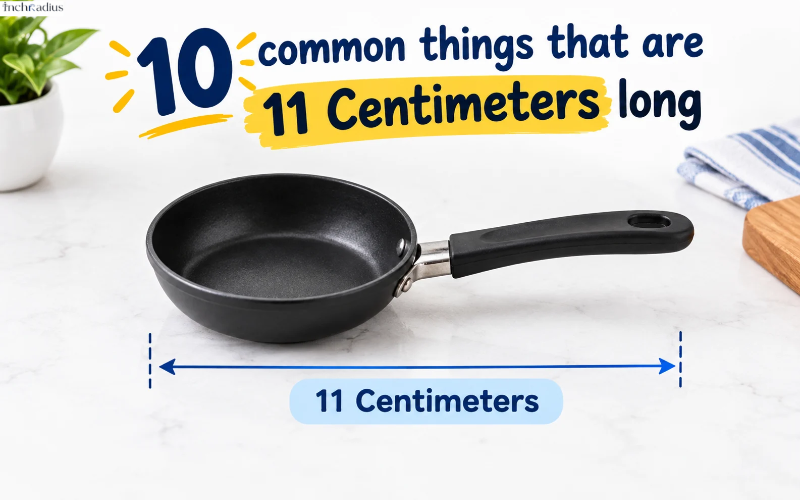
11 centimetres is a short length, measuring approximately 4.33 inches or 110 millimetres. It is a little longer than the width of a standard playing card and close to the length of a small kitchen utensil or a compact stationery item. Although 11 cm may seem difficult to picture without a ruler, familiar objects can make the measurement easier to visualise. You might encounter a similar length when handling craft supplies, small tools, personal accessories or everyday household items.
These comparisons are useful when shopping online, completing a school project or checking whether something will fit into a small space. Remember that real objects vary in size, so these examples are visual references rather than exact measuring tools.
How Long Is 11 Centimeters?
11 centimetres is exactly 110 millimetres, which is approximately 4.33 inches. In metric measurements, it is 0.11 metres. These conversions describe the same length, but each unit can be more convenient in a different situation.
For everyday use, 11 cm is roughly the length of a small pocket-sized object. It is longer than a typical adult thumb and shorter than many standard pencils. A ruler marked in centimetres makes it easy to identify this distance, but familiar objects can help when a measuring tool is unavailable.
You might use this measurement when checking the size of a craft component, comparing small accessories or deciding whether an item will fit inside a drawer. It can also help when reading product dimensions listed in centimetres on an online shop.
Keep in mind that an object described as approximately 11 cm long may be slightly shorter or longer. Its shape and the points used for measurement can affect the final result.
Related Post: How Long Is 9 Centimeters?
How Big Is 11 Centimeters?
Picture a ruler with the zero mark at one end and the 11 cm mark near the middle of its scale. The distance between those two marks is the length you are trying to imagine. It is slightly longer than four inches, so it fits comfortably within the palm-to-finger area of many adult hands.
A small kitchen spatula, a compact craft tool or a short stationery accessory can provide a useful visual reference if its actual dimensions are close to 11 cm. A standard playing card is usually around 8.8 cm wide, making 11 cm noticeably longer than its width.
Paper can help, too. A sheet of A4 paper is 21 cm wide, so 11 cm is just over half that distance. Folding the width in half gives you 10.5 cm, which is only 0.5 cm shorter than the target.
These comparisons make the length easier to picture, but a ruler remains the best choice when an accurate measurement matters.
10 Common Things That Are 11 Centimeters Long
The following objects come from different parts of everyday life, including stationery, kitchen equipment, personal accessories and craft supplies. Their dimensions vary by brand and design, so check the measurements of a particular item if you need an exact 11 cm length.
| Everyday Item | Actual Size |
| Small kitchen spatula | 11 centimetres |
| Mini wooden craft stick | 11 centimetres |
| Compact sewing scissors | 11 centimetres |
| Short artist’s paintbrush | 11 centimetres |
| Small crochet hook case | 11 centimetres |
| Miniature wooden rolling pin | 11 centimetres |
| Pocket comb | 11 centimetres |
| Small reusable travel cutlery handle | 11 centimetres |
| Miniature model paintbrush | 11 centimetres |
| Short plant label | 11 centimetres |
1. Small Kitchen Spatula

A small kitchen spatula can be close to 11 cm long, particularly when it is designed for narrow jars, small bowls or miniature baking projects. Compact spatulas have short handles and flexible heads that help scrape food from the sides of containers.
The exact length depends on the design. Some jar spatulas are shorter than 11 cm, while others are longer. Measure from the tip of the silicone head to the end of the handle to find its full length.
As a visual reference, imagine placing the spatula beside a ruler. If its tip reaches the 11 cm mark when the handle starts at zero, it matches the target. This comparison is handy when choosing a utensil for a small kitchen drawer or a travel cooking kit.
2. Mini Wooden Craft Stick

Wooden craft sticks are used in school projects, model-making, decorations and small DIY tasks. Many familiar full-sized lolly sticks are longer than 11 cm, but shorter craft sticks are available in different lengths.
An 11 cm stick is useful for visualising the measurement because it has a straight shape and clearly defined ends. You can lay it flat against a ruler to see how closely it matches the target. Its rigid edges also make the comparison easier than using a curved object.
If you are buying craft supplies, check the stated length rather than relying on a photograph. Online product pictures can make a stick appear longer or shorter depending on the camera angle.
Short wooden sticks are particularly useful in miniature house projects, plant decorations and small art activities where a long stick would be difficult to handle.
3. Compact Sewing Scissors
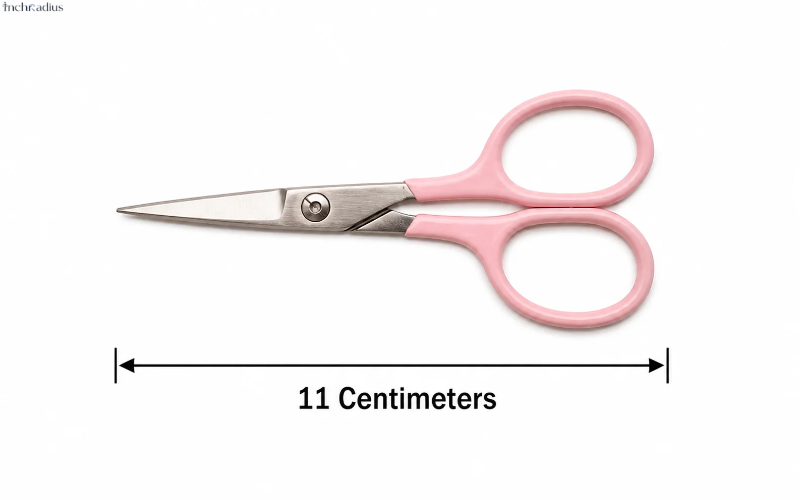
Compact sewing scissors are designed for trimming thread, cutting small fabric pieces and carrying in a sewing kit. Some embroidery scissors measure close to 11 cm from the tips of their blades to the outer ends of their handles.
This makes them a useful example of a small everyday tool with a clearly defined overall length. However, not all compact scissors share the same dimensions. Certain models are shorter, while larger dressmaking scissors can be much longer.
To compare a pair with 11 cm, place the closed scissors on a ruler and align the blade tip with the zero mark. Measure to the furthest point of the handle, rather than measuring the blades alone.
Their compact size also explains why they are useful for detailed sewing work. They take up little room in a craft box and are easier to manoeuvre around loose threads than larger scissors.
4. Short Artist’s Paintbrush
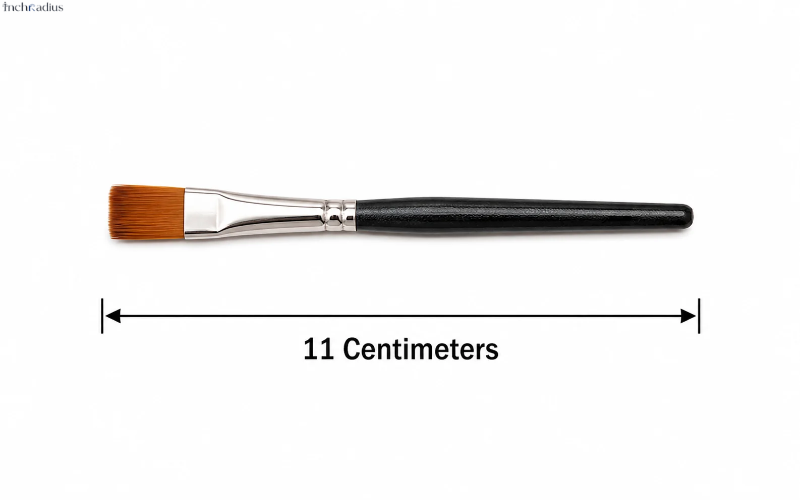
A short artist’s paintbrush can provide a helpful comparison for an 11 cm measurement. Some miniature brushes and compact detail brushes are made with short handles for painting models, decorating small objects and working on fine details.
The length depends on the brush style. Many standard art brushes are considerably longer than 11 cm, so choose a compact model and check its stated dimensions before using it as a reference.
A paintbrush is easy to measure because it has a narrow, straight body. Start at the end of the handle and measure to the tip of the bristles, taking care not to bend them. If you need a precise result, measure the brush gently without pressing down on the bristles.
An 11 cm brush is also small enough to fit easily into many compact art kits. It gives you a practical example of how a short length can still be useful for detailed work.
5. Small Crochet Hook Case

A compact crochet hook case is another object that may measure around 11 cm long. These small holders are designed to keep crochet hooks, needles and other narrow tools together, making them useful for people who enjoy knitting or crochet while travelling.
Cases come in many shapes. A slim holder for just a few hooks may be close to 11 cm, while a larger roll-up organiser can measure several times that length when opened. Always check whether the listed measurement refers to the closed case or its expanded size.
For a quick comparison, place the closed case next to a ruler and measure along its longest side. A length close to 11 cm gives you a useful reference for the target measurement.
This example also shows how centimetres can help when choosing storage products. A case that is too long may not fit comfortably into a small handbag or craft pouch.
6. Miniature Wooden Rolling Pin
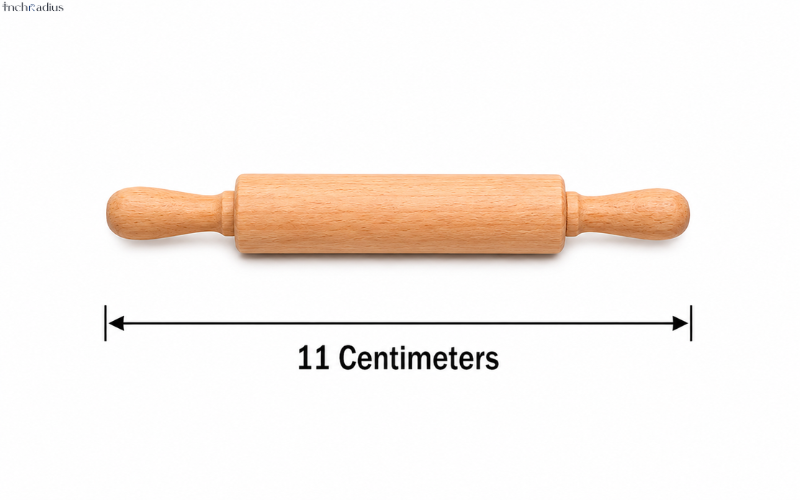
A miniature wooden rolling pin can be around 11 cm long. These small tools are often used for children’s play kitchens, modelling clay, miniature baking displays and craft projects. Some compact pastry tools are also made for working with small amounts of dough.
Unlike a full-sized rolling pin, a miniature version is short enough to hold comfortably in one hand. Its simple shape makes it easy to compare with a ruler because both ends are clearly visible.
The length will depend on whether the handles are included in the measurement. For consistency, measure from the outer edge of one handle to the outer edge of the other. Measuring only the central rolling section will produce a shorter result.
If you are making miniature furniture or accessories, an 11 cm rolling pin can help you picture the scale of other small objects used in the same project.
7. Pocket Comb
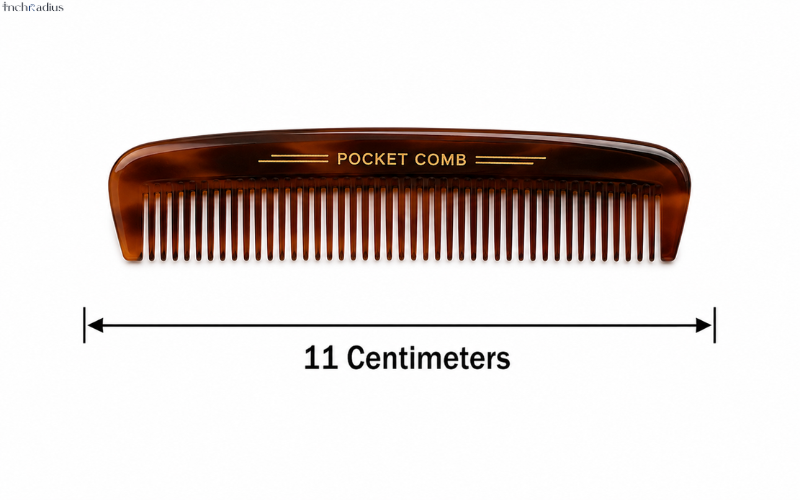
A pocket comb can be close to 11 cm long, although many travel combs are shorter or longer. These compact accessories are designed to fit inside a handbag, wash bag or jacket pocket without taking up much room.
The comb’s straight body makes it easy to use as a visual reference. Place one end against the zero mark of a ruler and measure along its length to the opposite end. Avoid including a separate case unless you want to measure the complete product.
An 11 cm comb is roughly the length of a small personal accessory that can be carried easily throughout the day. This makes it a useful way to picture the measurement without needing to imagine a much larger object.
If you are buying a comb online, check the dimensions carefully. A product photograph may show the comb beside a hand, but hand sizes and camera angles can make the actual length difficult to judge.
8. Small Reusable Travel Cutlery Handle
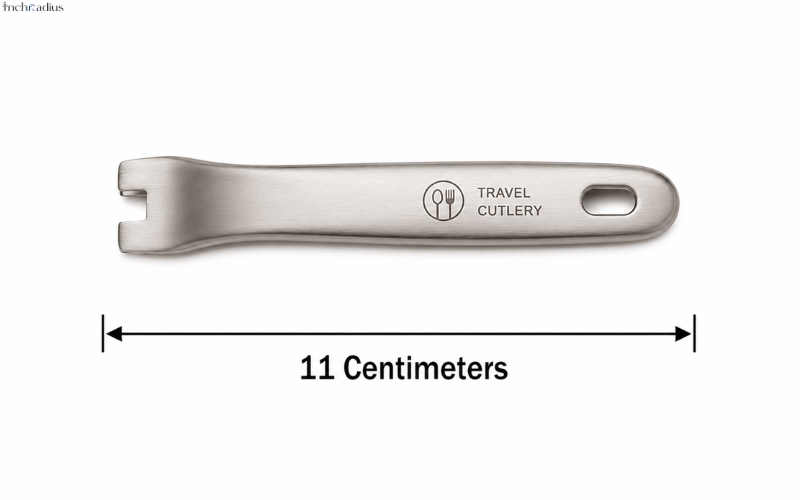
Some compact reusable travel cutlery pieces have handles that measure close to 11 cm. Small spoons, forks and folding utensils are designed for lunch boxes, camping kits and portable dining sets.
The handle itself may be around 11 cm even when the entire utensil is longer. This distinction matters because measuring the handle alone is different from measuring the item from end to end. Check the product dimensions or use a ruler to confirm which part matches the target.
A compact utensil is useful for visualising a short measurement because its shape is narrow and easy to compare with a straight ruler. You can also place it beside a lunch container to get a sense of how much space a similar-sized object occupies.
Travel cutlery varies widely, so treat this as an approximate example rather than a fixed standard. A folding design may have a different length when opened and closed.
9. Miniature Model Paintbrush
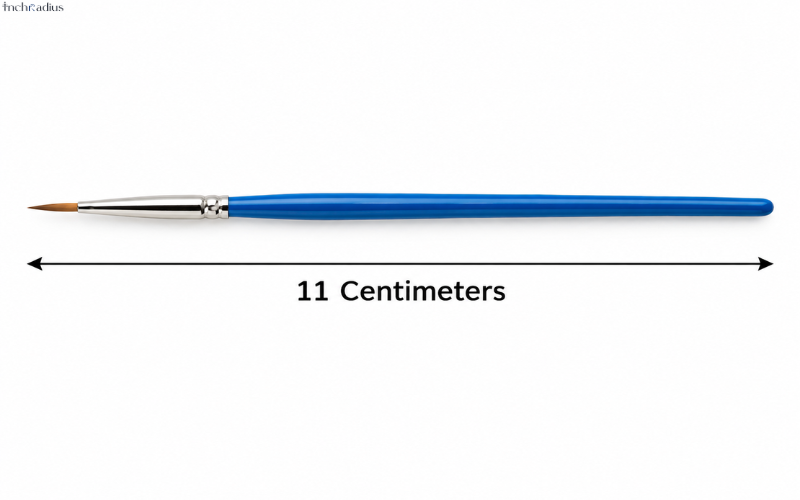
Miniature model paintbrushes are used for painting small figures, model vehicles, tabletop scenery and other detailed craft projects. Certain compact brushes measure approximately 11 cm overall, although the length varies with the handle and bristle design.
Their small size makes them a useful reference for 11 cm, especially when comparing several craft tools laid out on a table. The brush can be placed directly beside a ruler, with the handle and bristles aligned along the same line.
When measuring, include the complete brush from the end of its handle to the tip of the bristles. Avoid squeezing the bristles against the surface, as this can change their shape and make the result less reliable.
A short model brush is also practical for fine work because it gives the painter control over small areas. If you are assembling a hobby kit, knowing the brush length can help you choose a suitable storage box.
10. Short Plant Label

Short plant labels are used to identify seedlings, herbs and small plants in pots or garden trays. Some compact labels measure around 11 cm from the top to the pointed end that goes into the soil.
Their length is useful for visualising 11 cm because the label is straight and relatively flat. You can lay it against a ruler and compare the total length with the target measurement. If you measure only the section that remains above the soil, the visible portion will be shorter.
Plant labels are available in plastic, wood and metal. Their sizes depend on the type of plant, the depth needed for planting and the amount of writing space required.
An 11 cm label may suit small pots and seed trays where a tall marker would look out of place. It also offers a practical example of how a short length can be divided between a visible section and a section hidden from view.
Measurement Without a Ruler
You can estimate 11 cm without a ruler by using familiar objects, but these methods provide approximations rather than guaranteed measurements.
Use a Sheet of A4 Paper
An A4 sheet is 21 cm wide. Fold it in half across its width and you will get a section measuring 10.5 cm. That is just 0.5 cm shorter than 11 cm, making it a useful starting point for a quick estimate.
Compare Four Inches
11 cm is approximately 4.33 inches. If you are familiar with an inch-based ruler, four inches gives you a length of 10.16 cm. Add roughly another 0.84 cm to reach 11 cm.
This is easier if you have a ruler with both inches and centimetres marked on it.
Use Your Hand Carefully
The width of a few fingers placed together or the length of part of your palm can help you picture a short distance. However, hand sizes vary considerably between people. Do not assume that a particular number of fingers always equals 11 cm.
For anything that must fit precisely, use a ruler, measuring tape or another reliable measuring tool.
Related Post: How Long Is 10 Centimeters?
FAQs
1. Is 11 cm the same as 4 inches?
No. Four inches equals 10.16 cm, so 11 cm is slightly longer. The difference is 0.84 cm, or 8.4 mm. The two measurements may look similar in everyday situations, but the difference can matter when cutting materials, fitting parts together or choosing an item that must fit within a specific space.
2. How many millimetres are in 11 cm?
There are exactly 110 millimetres in 11 centimetres. Each centimetre contains 10 millimetres, so multiplying 11 by 10 gives 110 mm. Millimetres are useful for smaller objects and detailed work because they allow you to describe short distances without using decimal centimetres.
3. How many inches is 11 centimetres?
11 centimetres is approximately 4.33 inches. To convert centimetres to inches, divide the centimetre measurement by 2.54. The result is useful when comparing products that use imperial measurements, especially when shopping on websites that list dimensions in inches rather than centimetres.
4. Is 11 cm considered a small length?
Yes, 11 cm is a relatively short length for most everyday objects. It is suitable for visualising compact accessories, small craft tools and pocket-sized items. However, whether it is small depends on the object. An 11 cm plant label is quite ordinary, while an 11 cm kitchen knife blade would be considered relatively short.
5. How can I measure 11 cm without a ruler?
Fold the width of an A4 sheet in half to get approximately 10.5 cm. This gives you a close estimate, although it is not exactly 11 cm. You could also compare the length with a verified object measuring 11 cm. Avoid relying entirely on fingers or hand spans because their sizes differ.
6. Is 11 cm longer than a standard playing card?
Yes. A standard playing card is usually about 8.8 cm wide and 6.3 cm tall. An 11 cm length is about 2.2 cm longer than its width. This comparison can help you picture the measurement, but playing card dimensions can vary slightly between manufacturers and card styles.
7. What household object is closest to 11 cm long?
A compact pocket comb, small utensil or short craft tool may measure close to 11 cm. There is no single household object with a universal 11 cm length, as products vary by design and manufacturer. If you need a reliable reference, measure an object first instead of assuming its dimensions.
8. Is 11 cm enough space for a small accessory?
That depends on the accessory’s shape and thickness as well as its length. An item measuring exactly 11 cm may not fit into a space that is also 11 cm long if there is a tight corner, a bulky end or a protective case. Allow a little extra room when planning storage or choosing a container.
Conclusion
11 centimetres is a useful short measurement to picture because it is approximately 4.33 inches or 110 millimetres. A compact pocket comb, a small kitchen utensil or a short plant label can help you imagine a length close to this size, provided you check the object’s actual dimensions. An A4 sheet folded across its width also gives a handy estimate of 10.5 cm, which is close to the target.
For a quick visual comparison, think of a straight object stretching a little beyond four inches. When accuracy matters, use a ruler and measure from one end to the other. This simple approach helps you judge sizes more confidently when shopping, crafting or organising small household items.