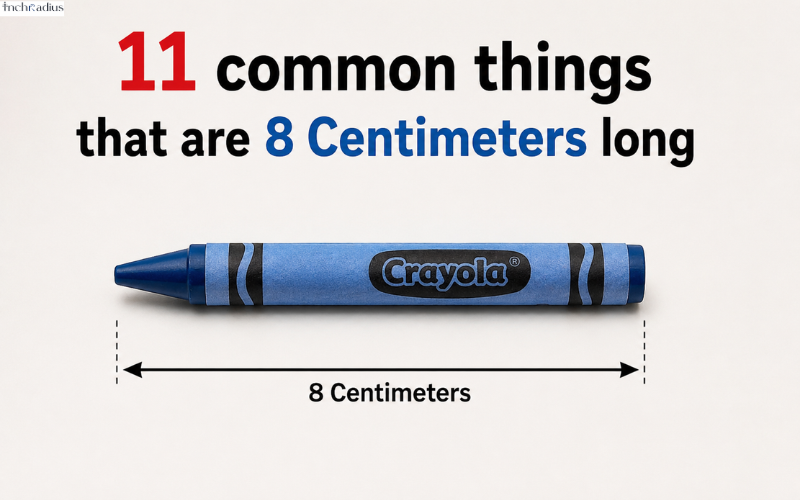
8 centimetres is equal to 3.15 inches or 80 millimetres. It is a short length, roughly the width of a small hand or the length of a standard sticky note’s shorter side, depending on its dimensions. Although the measurement is easy to read on a ruler, it can be harder to picture when you do not have one nearby.
Everyday objects provide useful reference points for estimating this length at home, in a classroom or while shopping. Items such as paper clips, small stationery products and household accessories can help you visualise 8 centimetres. The comparisons below distinguish between objects with standard dimensions and those whose sizes vary by design or manufacturer.
How Long Is 8 Centimeters?
Eight centimetres measures exactly 80 millimetres. In imperial units, this is approximately 3.15 inches, or just over 3 inches. A centimetre contains 10 millimetres, so eight centimetres can be marked as eight consecutive centimetre intervals on a metric ruler.
The measurement is small enough to fit comfortably in your palm, yet long enough to be noticeable on many everyday objects. It can be useful when checking the size of a craft project, estimating the dimensions of a small accessory or comparing the length of a stationery item.
For a quick visual reference, imagine the distance from the zero mark to the 8 cm mark on a ruler. The same distance is slightly longer than three 1-inch sections placed end to end. This makes an inch-based ruler useful for estimating the measurement, although a metric ruler provides a more direct and accurate reading.
Related Post: How Long Is 7 Centimeters?
How Big Is 8 Centimeters?
An 8 cm length is a little longer than 3 inches, making it comparable to several small objects used around the home and office. Picture a small paper clip, a compact stationery accessory or a short household component. These objects can help you form a mental image of the distance without needing to memorise a conversion formula.
Your fingers can also provide a rough reference. The width of several fingers placed side by side may approach 8 cm, but this varies considerably with hand size. A small notebook or a piece of folded paper can provide another visual comparison if you know its dimensions.
Remember that length and width are different measurements. An object may be 8 cm long but much narrower, or it may have a width of 8 cm while being considerably longer in the other direction. Always compare the same dimension when estimating an object’s size.
11 Common Things That Are 8 Centimeters Long
Several familiar objects can help you picture a length of 8 cm. The examples below include stationery, household items, craft supplies and small accessories. Some are available in standard sizes, while others vary between brands and models, so their descriptions explain how closely they match the target measurement.
| Everyday Item | Actual Size |
| Large paper clip | 8 centimetres |
| Small sticky note | 8 centimetres |
| Mini glue stick | 8 centimetres |
| Short pencil sharpener | 8 centimetres |
| Small sewing scissors | 8 centimetres |
| Craft paintbrush | 8 centimetres |
| Keychain torch | 8 centimetres |
| Small hair clip | 8 centimetres |
| Miniature ruler | 8 centimetres |
| Tea light candle | 8 centimetres |
| Small toy building block | 8 centimetres |
The table uses 8 centimetres as the reference measurement. The objects listed are examples of items that may be available in this length, rather than a claim that every product of that type measures exactly 8 cm. Check the individual product dimensions when exact sizing matters.
Large Paper Clip

A large paper clip is a familiar stationery item used to hold sheets of paper together without staples or adhesive. Depending on its design, a large paper clip may measure close to 8 cm from end to end. Smaller standard paper clips are considerably shorter, so it is important to distinguish a large or oversized clip from an ordinary one.
To use a paper clip as a visual reference, place it on a flat surface and compare its longest dimension with the distance you want to estimate. Its narrow shape makes its length easy to see, even though the metal wire itself occupies very little space.
Paper clips are particularly useful in classrooms and offices because they are easy to find. If you need an accurate comparison, measure the clip first rather than assuming every large paper clip has identical dimensions.
Small Sticky Note
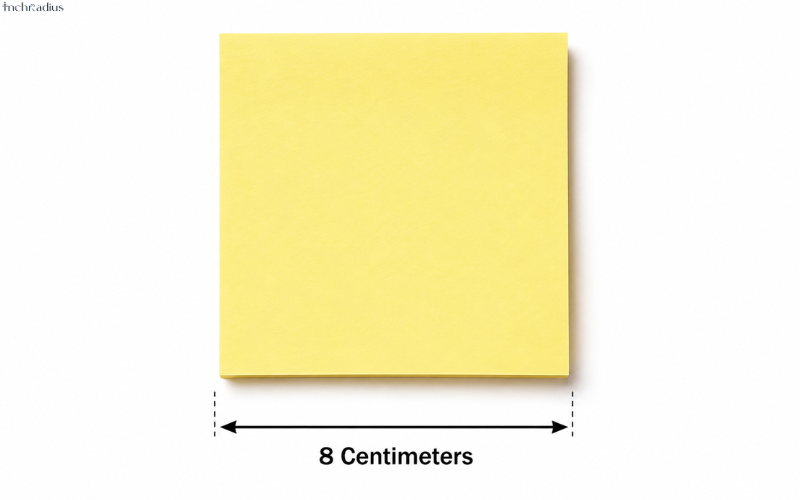
Small sticky notes come in several shapes and sizes. Some square versions have a side measuring 8 cm, making them a convenient reference for this length. Larger notes and narrow rectangular varieties have different dimensions, so the product’s stated size matters.
A sticky note is useful because its straight edges make measurement comparisons simple. Lay it flat and compare one side with the length you want to estimate. Unlike a curved object, it gives you a clear, uninterrupted edge that is easy to follow with your eyes.
These notes are commonly used for reminders, revision notes and labels. If a particular sticky note measures 8 cm along one side, that edge provides a direct reference for the target measurement. Do not assume all sticky notes share this size, especially when buying different brands.
Mini Glue Stick

A mini glue stick is a compact adhesive product used for school projects, paper crafts and small office tasks. Certain travel-sized or children’s craft versions have an overall length close to 8 cm. Full-sized glue sticks are usually longer, so the miniature format is the relevant comparison.
The length is normally measured from the bottom of the container to the top of the cap. The twist mechanism and cap may affect the total size, depending on the design. This is why two glue sticks that hold similar amounts of adhesive can have different external dimensions.
If you have a mini glue stick at home, place it beside a ruler to check whether it matches 8 cm. Once measured, it can serve as a handy visual reference for small craft materials, stationery purchases and other compact items.
Short Pencil Sharpener
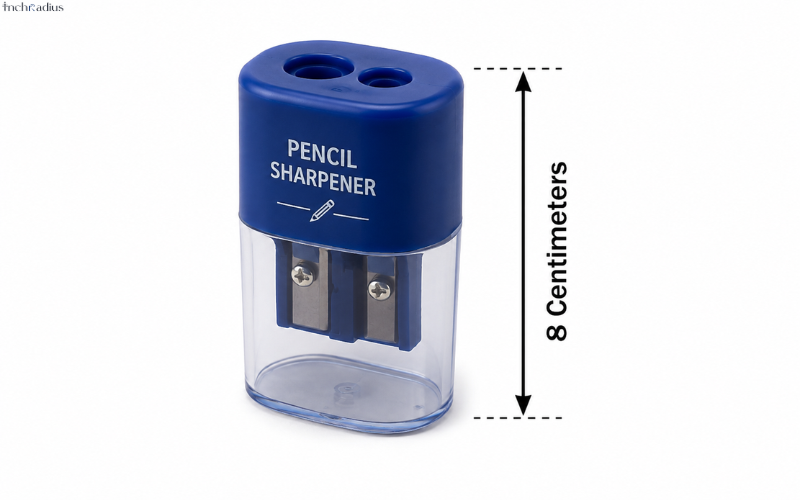
A short pencil sharpener with a built-in shavings container can have an overall length of approximately 8 cm. These sharpeners are larger than simple metal blade sharpeners but remain compact enough to fit inside a pencil case or school bag.
The length depends on the container’s shape and the position of the cap. Some models are square, while others have a rounded or elongated body. Measure from one end to the other along the longest side if you want to compare it with an 8 cm distance.
This type of sharpener is useful as a reference because it has a solid, clearly defined body. It can also help children picture the measurement while organising stationery or completing a school measurement activity. Check its dimensions before treating it as an exact match.
Small Sewing Scissors
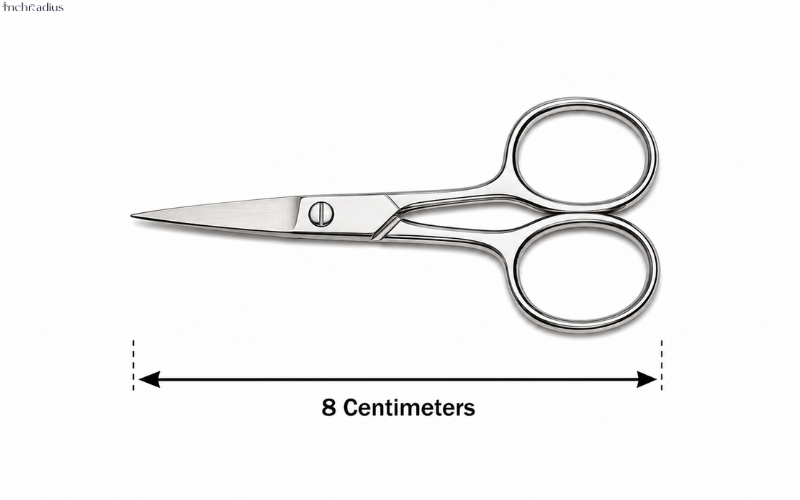
Small sewing scissors are designed for trimming loose threads, cutting embroidery floss and handling delicate fabric details. Some compact models have an overall closed length of around 8 cm, although many embroidery scissors are longer.
Their measurement should be taken from the tip of the blades to the farthest point of the handles. Measuring only the metal blades would give a different result because the handles form part of the full length.
These scissors provide a useful comparison for people who sew, knit or complete craft projects. Their pointed tips and compact handles make them easy to recognise, but they should always be handled carefully and kept away from young children. If exact dimensions matter, use the manufacturer’s specifications rather than relying on the general category.
Craft Paintbrush
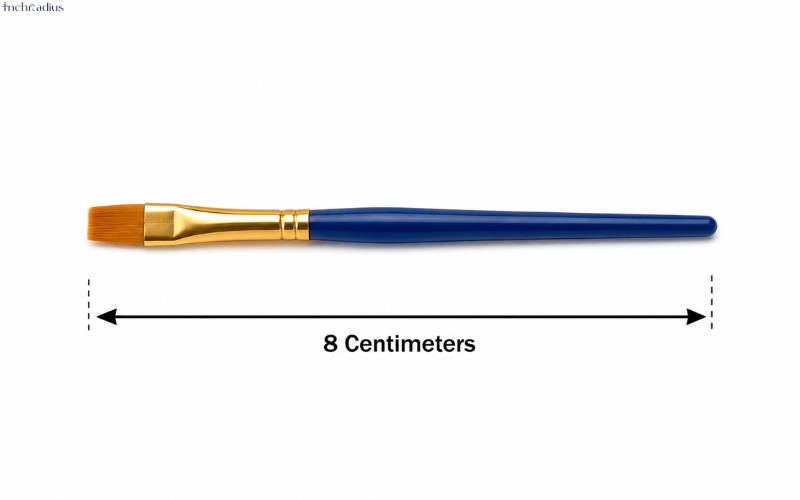
A compact craft paintbrush can measure close to 8 cm from the end of its handle to the tip of its bristles. These short brushes are sometimes sold for children’s painting sets, miniature artwork and detailed craft projects. Full-sized artist brushes are generally longer.
When comparing a brush with an 8 cm measurement, include the entire brush rather than the handle alone. The bristles may extend beyond the handle and can change the overall length. A brush with a short handle may still have a longer total measurement if it has a large head.
This object is particularly useful for visualising the length of a small tool. It also shows why measuring the entire object is important. A handle, cap or attachment can add to the final dimension, even when the main body appears short.
Keychain Torch
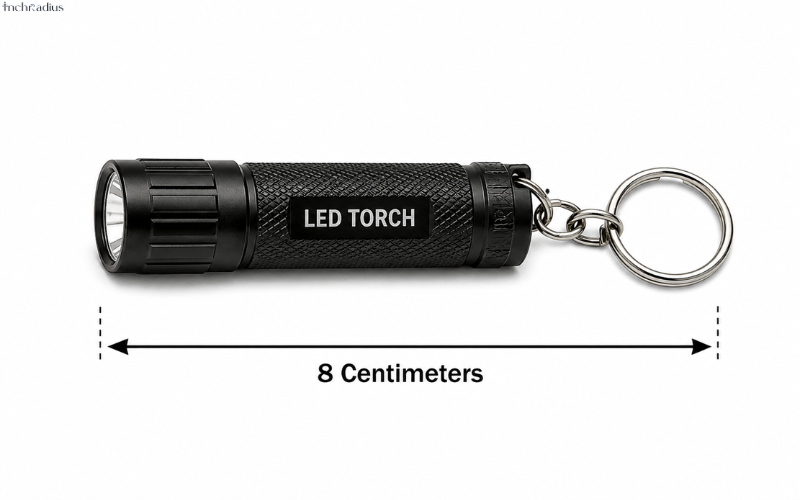
A compact keychain torch is a small battery-powered light designed to attach to keys, bags or a camping accessory. Some models have a body length near 8 cm, although miniature torches range from very short capsule shapes to longer cylindrical designs.
The most useful measurement is usually the length of the torch body, excluding a separate key ring. If the ring is included, the overall length may change depending on how it hangs. This distinction matters when checking whether the torch will fit into a small storage compartment.
Keychain torches are handy for finding a keyhole, checking a dark cupboard or illuminating a small area during a power cut. Their compact size makes them a relatable comparison, but their dimensions should be checked individually because designs vary widely.
Small Hair Clip
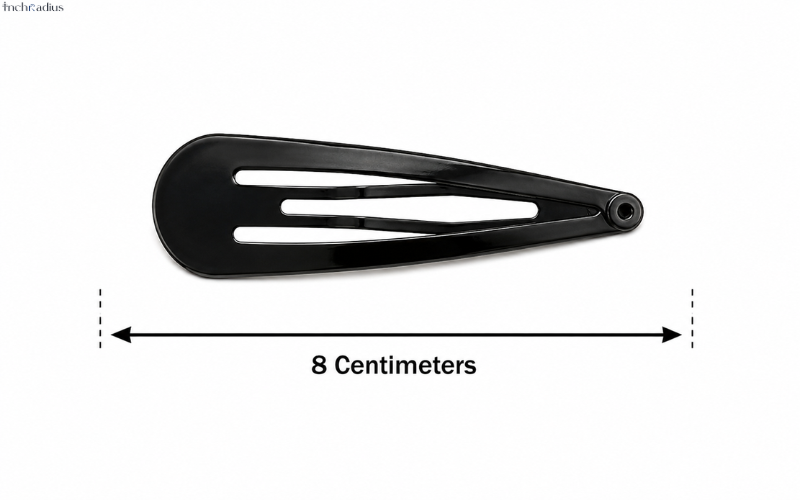
A small hair clip or barrette can be approximately 8 cm long, depending on its style. Some are designed to hold a narrow section of hair, while others have larger bodies intended to secure thicker hair. Their decorative ends and curved shapes can also affect the measurement.
To compare a clip with 8 cm, measure along its longest direction while it is closed. Measuring the curved surface with a flexible tape may produce a slightly different reading from measuring the straight distance between its ends.
Hair accessories can be useful visual references because they are common in dressing tables, handbags and bathroom drawers. However, small clips are not all the same size. A tiny snap clip may be much shorter, whereas a long barrette may exceed the target length.
Miniature Ruler
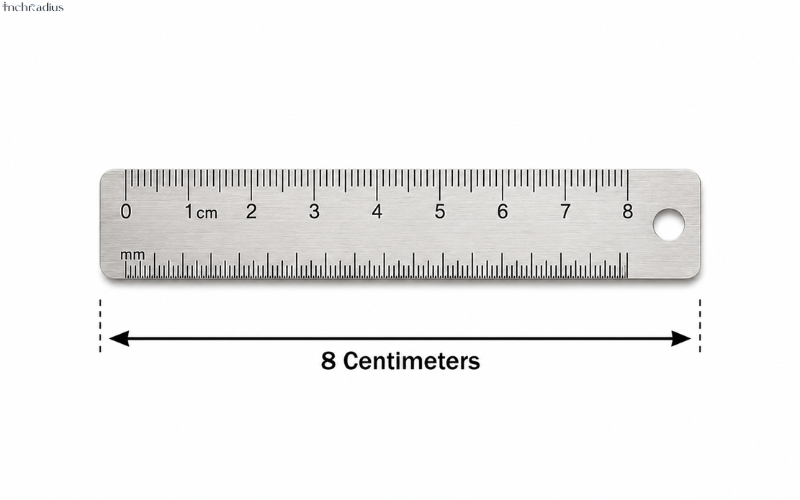
A miniature ruler made with an 8 cm marked measuring section is one of the clearest ways to represent this distance. Small rulers are sold for pencil cases, craft kits and compact stationery sets. Some have a total length of 8 cm, while others are longer and include additional markings.
A ruler is especially useful because it provides a direct reference instead of relying on an object’s typical dimensions. Line up its zero mark with the starting point and identify the 8 cm mark to see the exact distance.
Check whether the ruler’s total length is 8 cm or whether its measurement scale simply includes the 8 cm mark. These are not necessarily the same thing. A longer ruler can still show the target measurement clearly, making it more dependable than an unrelated object when accuracy is important.
Tea Light Candle
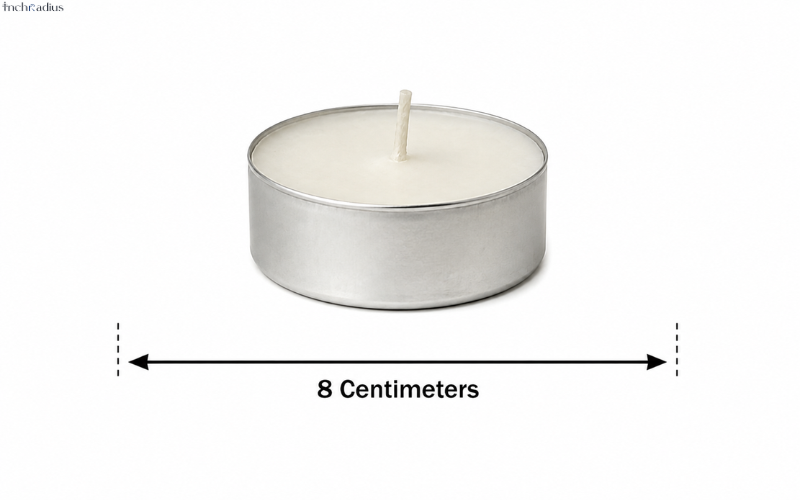
A tea light candle is a small candle usually held in a shallow metal or plastic cup. Its diameter is often only a few centimetres, so a single tea light is not generally 8 cm long. However, a small tea light holder or a wider decorative tea light assembly may approach this measurement.
This example highlights the importance of checking which dimension is being compared. For a round object, diameter measures the straight distance across its widest part, while height measures the distance from its base to its top. Neither should be confused with the length of an elongated object.
If you use a candle-related item as a visual reference, choose one whose actual dimension is close to 8 cm. Never assume a standard tea light has an 8 cm diameter, and keep lit candles away from flammable materials.
Small Toy Building Block
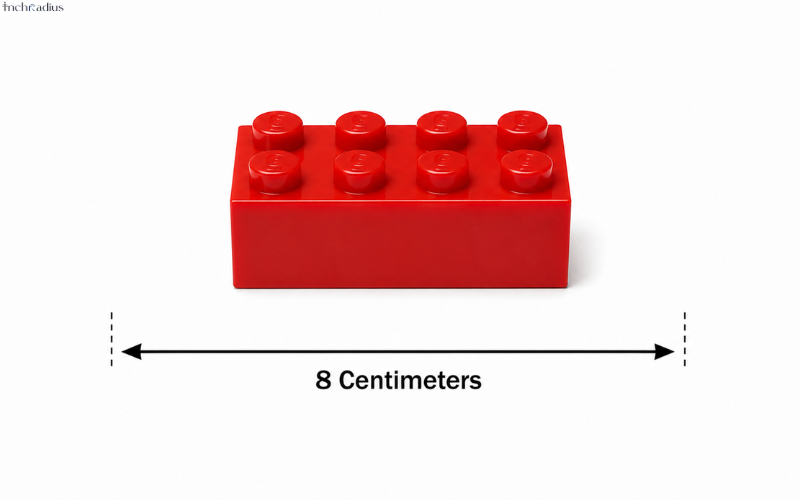
Small toy building blocks are useful for understanding measurements because their straight edges and flat surfaces are easy to compare. A single block is often shorter than 8 cm, but a longer block or a carefully arranged row of smaller blocks can create a combined length near the target.
For example, place several blocks in a straight line, making sure their ends touch without overlapping. Measure the complete row to see whether it reaches 8 cm. The result depends on the dimensions of the individual blocks, so count alone is not a reliable way to determine the total.
This method is practical for children’s activities involving construction toys, counting and measurement. It demonstrates how smaller lengths combine to make a larger one. For an exact result, measure the finished row rather than assuming every block is manufactured to the same size.
Measuring 8 Centimeters Without a Ruler
You can estimate 8 cm without a ruler by using familiar objects, although the result will not be as precise as a proper measurement.
Use the width of your hand as a guide. Place several fingers together and compare their combined width with the distance you need. Finger widths differ between people, so this should only be a rough estimate. If you have access to a ruler later, measure your hand to learn how close your estimate was.
Compare the distance with a known stationery item. A sticky note or a compact craft tool can help if you already know its dimensions. Place the object beside the distance you want to estimate and compare their edges. Make sure you are comparing length with length, rather than the width of one object with the length of another.
Use an inch ruler. Eight centimetres is approximately 3.15 inches. On an imperial ruler, this is a little more than 3 inches. Three inches equals 7.62 cm, so you need to add another 0.38 cm to reach 8 cm. This is a useful estimate, although a metric ruler is better for an exact result.
Related Post: How Long Is 6 Centimeters?
FAQs
Is 8 centimetres bigger than 3 inches?
Yes. Three inches equals 7.62 cm, so 8 cm is 0.38 cm longer than 3 inches. The difference is small, but it matters when measuring items that need to fit a specific space. For everyday visual comparisons, 3 inches is a useful starting point, while a ruler gives a more accurate result.
How many millimetres are in 8 centimetres?
There are exactly 80 millimetres in 8 centimetres. Each centimetre contains 10 millimetres, so multiplying 8 by 10 gives 80. Millimetres are useful when measuring small components, craft materials and other items where a difference of just a few millimetres can affect the fit.
How many inches is 8 cm?
Eight centimetres is approximately 3.15 inches. To convert centimetres to inches, divide the centimetre measurement by 2.54. The calculation is 8 ÷ 2.54, which gives approximately 3.1496 inches. Rounding to two decimal places gives 3.15 inches.
Is 8 cm considered a long length?
No, 8 cm is generally considered a short length. It is just over 3 inches, making it suitable for describing small stationery products, compact accessories and short household components. Whether it seems long or short depends on the object being measured and the purpose of the measurement.
Can I measure 8 cm with my fingers?
You can estimate 8 cm using your fingers, but the result will vary with your hand size. Placing several fingers together may give you a rough visual reference. For more dependable results, measure your finger widths with a ruler first or use a marked measuring tool when accuracy is important.
What household object can help me picture 8 cm?
A small stationery item with known dimensions is a practical reference. A sticky note with an 8 cm side, for example, gives you a clear straight edge. Compact craft tools may also help, provided their actual dimensions are checked rather than assumed from their general appearance.
Is 8 cm the same as 80 mm?
Yes, 8 cm and 80 mm represent exactly the same length. The difference is simply the unit used to express it. Centimetres are often convenient for everyday objects, while millimetres are useful for detailed measurements, product specifications and tasks requiring greater precision.
How can I measure 8 cm accurately at home?
Use a metric ruler or tape measure with clearly marked centimetre divisions. Place the zero mark at one end of the object and read the scale at the other end. Keep the ruler straight and avoid starting from its physical edge unless that edge aligns with zero. For curved objects, a flexible tape may be more suitable.
Conclusion
Eight centimetres is a manageable length to picture once you relate it to familiar objects. It equals 80 millimetres or approximately 3.15 inches, placing it just beyond the 3-inch mark on an imperial ruler. Small stationery items, compact craft tools and accessories can help you visualise the distance, provided their actual dimensions are checked. A miniature ruler offers a more dependable reference than an object whose size varies between manufacturers.
If you do not have measuring equipment, use a familiar item or the width of your fingers for a rough estimate. For projects that require a precise fit, always confirm the measurement with a metric ruler or tape measure.