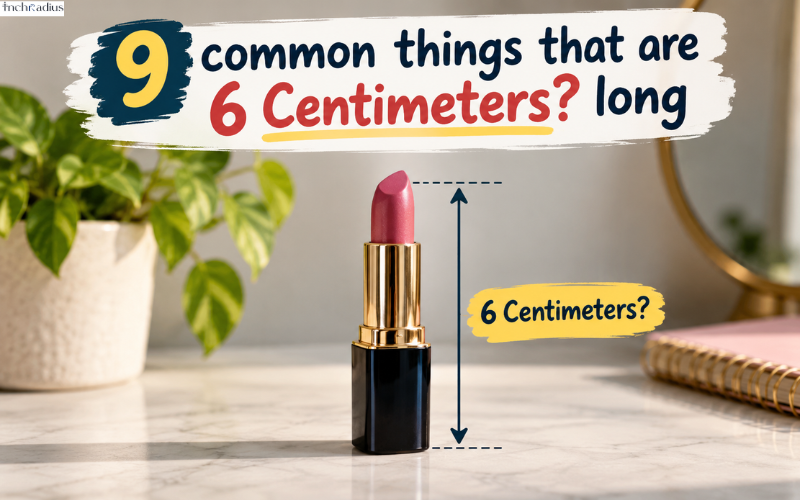
Six centimetres is a small measurement, equal to 2.36 inches or 60 millimetres. It is roughly the length of a standard house key, although key sizes vary. This measurement is useful when checking the size of small household objects, craft materials, stationery, accessories or items that need to fit into a limited space.
A six-centimetre length can be difficult to picture if you do not have a ruler nearby, but familiar objects make it easier to estimate. By comparing this distance with everyday items, you can develop a clearer sense of how long 6 centimetres really is and recognise the measurement in practical situations.
How Long Is 6 Centimeters?
Six centimetres is exactly 60 millimetres. Converted into inches, it is approximately 2.36 inches, which is a little less than 2½ inches. In metres, the same distance is 0.06 metres.
The measurement is short enough to fit comfortably across part of your palm, yet long enough to be noticeable on a small object. For example, a house key may measure close to 6 centimetres from end to end, depending on its design. A small craft stick or a short stationery item may offer a similar comparison.
You might encounter this length when measuring a small package, checking the dimensions of a handmade decoration or choosing a component for a repair. It is also useful when reading product dimensions online, where sizes may be given in centimetres rather than inches. Remember that 6 centimetres is an exact unit of length, while comparisons with everyday objects are estimates unless the object has been measured.
Related Post: How Long Is 30 Feet? 10 Common Things That Are 30 Feet Long
How Big Is 6 Centimeters?
Imagine the distance between the tip of your thumb and a point a little beyond its first joint. Depending on your hand size, that distance may come close to 6 centimetres. Another way to picture it is to look at a standard ruler: the six-centimetre mark sits just past the 2-inch mark.
A measurement of this size is easy to overlook when looking at a larger object, but it can make a noticeable difference when working with small items. A gap of 6 centimetres between two hooks, for instance, may be enough for a small accessory but too narrow for a larger one.
You can also visualise this length by placing two small objects end to end, provided you know their individual sizes. The key is to focus on the full distance from one end to the other, rather than the object’s height or width. Familiar comparisons can help you estimate the size, but use a ruler when accuracy matters.
9 Common Things That Are 6 Centimeters Long
Many small everyday objects are close to 6 centimetres long. Their dimensions depend on the brand, style and purpose, so treat the following examples as visual references rather than exact standards. Each item can help you picture a distance of about 60 millimetres.
| Everyday Item | Actual Size |
| Standard house key | 6 centimetres |
| Small toy car | 6 centimetres |
| Compact USB flash drive | 6 centimetres |
| Lipstick tube | 6 centimetres |
| Small hair clip | 6 centimetres |
| Short chalk stick | 6 centimetres |
| Small rectangular eraser | 6 centimetres |
| Mini glue stick | 6 centimetres |
| Small hotel soap bar | 6 centimetres |
1. Standard House Key

A standard house key is a handy object to picture when estimating 6 centimetres. Many traditional house keys measure around 5–6 centimetres from the tip of the blade to the end of the bow, although some are shorter or longer. The shape and size depend on the lock and key design.
To use a key as a comparison, place it flat on a surface and look at its full length. Imagine a straight line running from one end to the other. If your key measures close to 6 centimetres, it gives you a useful reference for other small objects.
For example, you could compare the key with a small screw, a craft component or a narrow gap in a drawer organiser. Do not assume every key is exactly 6 centimetres long, especially if you need a precise measurement for a repair.
2. Small Toy Car
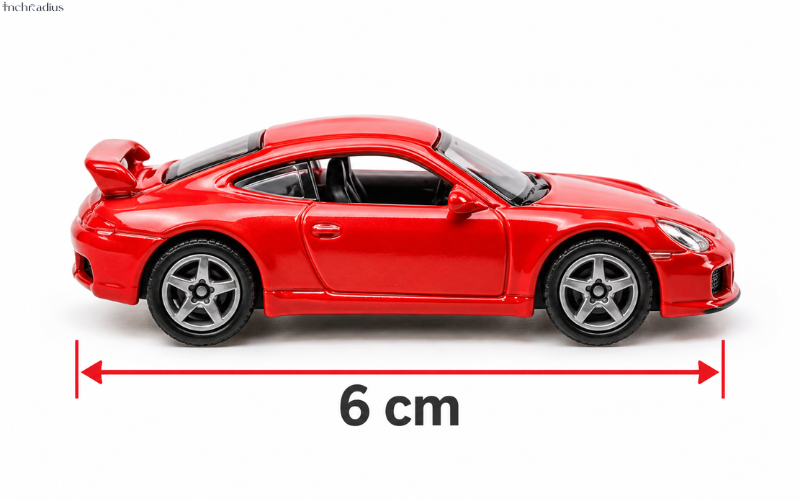
Small die-cast toy cars are often close to 6 centimetres long, particularly compact models designed for children’s play or miniature collections. However, toy sizes vary considerably. Some are shorter, while larger models can measure well over 10 centimetres.
A toy car is a useful comparison because its length is easy to see. Place it on a table and look from the front bumper to the rear bumper. That distance gives you a simple visual reference for 6 centimetres if your particular model is close to the target size.
This comparison can be useful when choosing a small storage box, arranging miniature vehicles on a shelf or planning a craft project. Bear in mind that the wheels and body shape can make a toy appear longer or shorter from certain angles. Measuring the car itself will tell you whether it is a suitable reference.
3. Compact USB Flash Drive
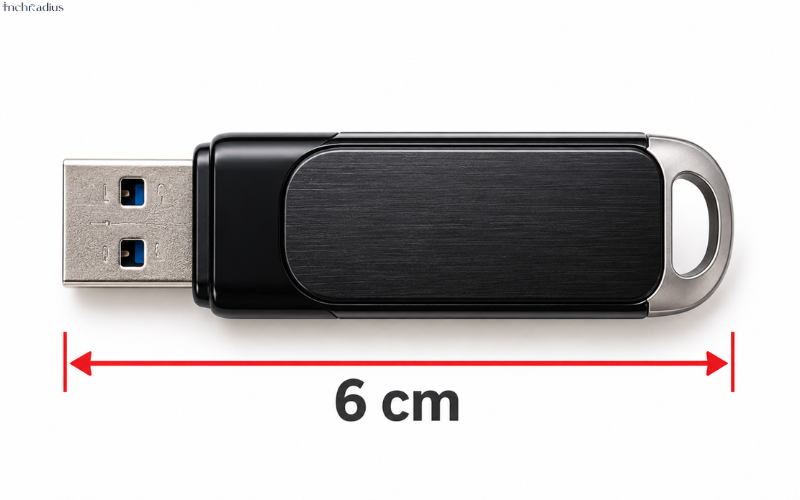
A compact USB flash drive can be around 6 centimetres long, including its casing and connector. Some models are much smaller, especially those designed to stay plugged into a laptop, while others have longer housings or protective caps.
The useful feature of a flash drive is its simple shape. Most have a fairly straight body, making it easy to compare their end-to-end length with a six-centimetre line. If yours is close to this size, it can help you estimate the dimensions of a small gadget or accessory.
For example, you might use the comparison when deciding whether a flash drive will fit inside a pencil case, organiser or small pocket. Remember to measure the entire drive, including any cap that extends beyond the main body. Connector size alone does not determine the total length.
4. Lipstick Tub
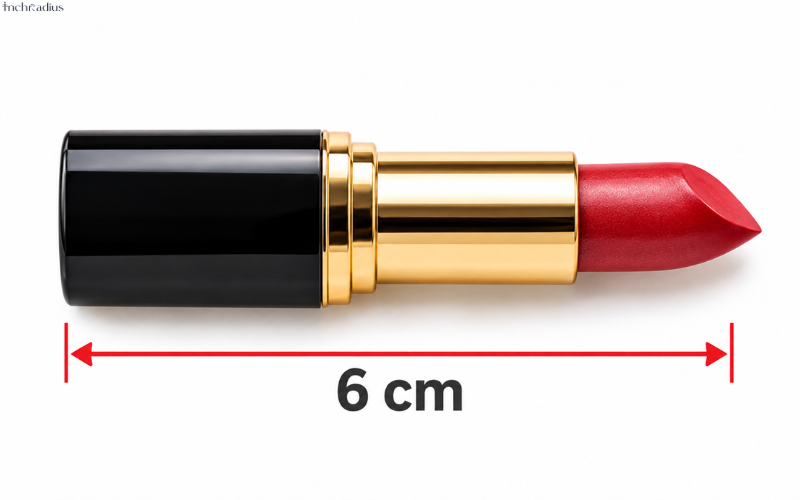
Some lipstick tubes measure around 6 centimetres in height when closed, making them a familiar reference for this measurement. The exact size depends on the packaging. Slim travel lipsticks may be shorter, while larger cosmetic products can be considerably taller.
To picture the measurement, place the closed lipstick on a flat surface and imagine measuring from its base to the top of the cap. If the tube is close to 6 centimetres, its height offers a practical comparison for other compact objects.
This can be helpful when arranging makeup in a small pouch or checking whether a cosmetic item will fit into a narrow compartment. Be careful not to confuse the tube’s height with its width. Most lipstick containers are much narrower than they are tall, and their dimensions vary between brands.
5. Small Hair Clip
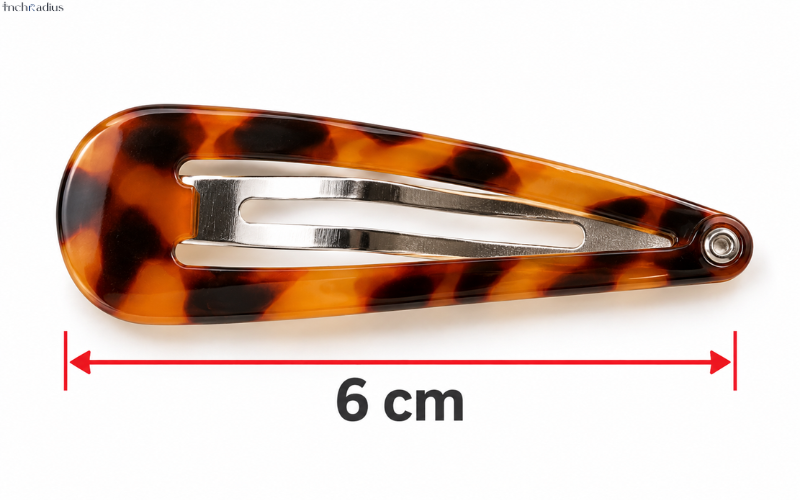
A small hair clip can measure close to 6 centimetres from one end to the other. This is particularly true of some slim snap clips and small decorative clips. Larger claw clips and long barrettes may measure much more, so the type of clip matters.
Lay the clip flat and look along its longest side. This is the dimension to compare with 6 centimetres, rather than the height of the clip when it is closed. Its curved shape may make it look shorter than a straight object of the same length.
A clip of this size can be useful as a reference when choosing a small accessories case or planning a handmade hair decoration. If you are making several matching pieces, measure the clip first instead of relying on its appearance. Even clips sold under the same general description can differ in size.
6. Short Chalk Stick

A short piece of chalk measuring about 6 centimetres is another way to visualise this distance. Full-length chalk sticks are often longer, but a worn piece may reach this size after regular use. Short chalk can also be found in craft sets and classroom supplies.
The straight shape makes it easy to compare with a ruler or a line drawn on paper. Place the chalk beside a marked six-centimetre section and check whether the ends line up. This helps you see the difference between an estimate and an exact measurement.
A chalk piece of this length may be useful for marking a small area on a chalkboard, labelling a temporary surface or working on a simple art project. Since chalk breaks and wears down, its size is not fixed. Use it as a visual example only when its current length is close to 6 centimetres.
7. Small Rectangular Eraser
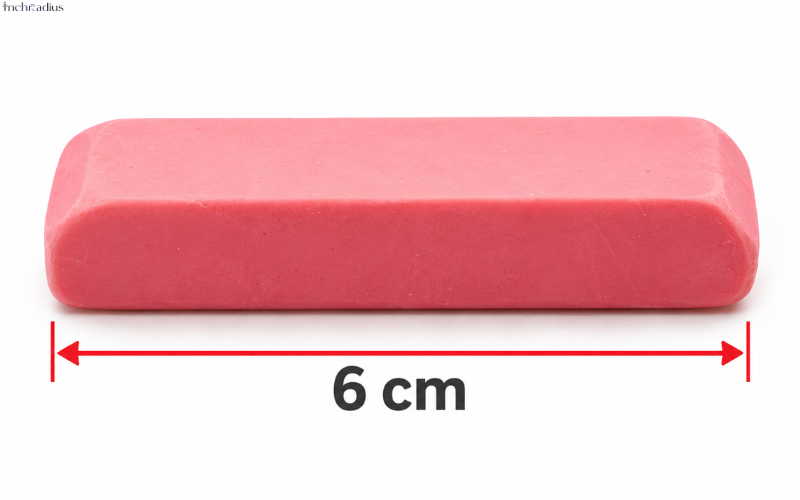
Some rectangular stationery erasers are around 6 centimetres long, although many standard erasers are shorter. Larger block erasers and specialist art erasers may also be longer or wider. The easiest reference is a simple, straight-sided eraser with a clearly visible long edge.
Place the eraser flat on a desk and look along its longest side. If that side measures close to 6 centimetres, you can use it to estimate a similar distance on a sheet of paper or a small craft project. Its rectangular shape makes the comparison easier than it would be with a rounded object.
An eraser can be especially useful for schoolwork, drawing and stationery organisation. For instance, you might check whether it fits into a small pencil tin alongside a pencil and sharpener. Do not assume all erasers have the same dimensions; measure yours before using it as a reliable reference.
8. Mini Glue Stick
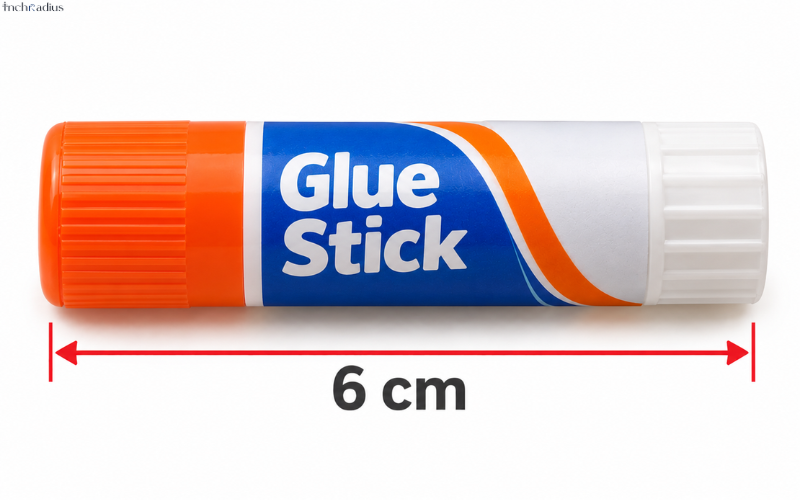
A mini glue stick may be close to 6 centimetres long, depending on the brand and whether its cap is included. Small craft and school versions are often shorter than full-size glue sticks, which can be considerably longer.
Its narrow, cylindrical shape gives you a straightforward way to picture the measurement. Stand the closed glue stick upright or lay it on a table, then consider its full length from the bottom to the top of the cap. If that distance is close to 6 centimetres, it works as a useful comparison.
This example is practical for anyone who enjoys paper crafts, scrapbooking or making greeting cards. You might use the length to estimate the space needed in a compact stationery pouch. Some glue sticks have twist-up bases or long caps, so check the complete item rather than measuring only the adhesive section.
9. Small Hotel Soap Bar

A small hotel soap bar can measure approximately 6 centimetres across its longest side. Guest soaps come in different shapes and sizes, so some are noticeably shorter, while others are wider or thicker. A compact rectangular bar is the most useful version for this comparison.
Look at the soap from above and focus on the longest edge. That distance is what matters when comparing it with a six-centimetre line. The thickness of the bar is a separate measurement and may be only a small part of its length.
This comparison can help when organising toiletries in a travel bag or deciding how much room a small soap bar will take up in a container. Soap also changes shape with use, so an opened bar may no longer match its original dimensions. Treat it as an approximate visual reference rather than a standard-sized object.
How to Measure 6 Centimeters Without a Ruler
You can estimate 6 centimetres using familiar objects and your own hands. These methods are useful for quick checks, although none should replace a proper measuring tool when accuracy is essential.
1. Use the Width of Your Fingers
Look at the width of your index and middle fingers placed side by side. Depending on your hand size, their combined width may provide a rough reference for a few centimetres. You may need to adjust the spacing or use additional fingers to estimate 6 centimetres.
Finger sizes vary, so this method is best for a quick visual estimate rather than an exact measurement.
2. Compare It with a Two-Inch Length
Two inches equals 5.08 centimetres, which is slightly shorter than 6 centimetres. If you can picture a 2-inch length, imagine extending it by just under one centimetre. That gives you a useful sense of the difference.
This method works well if you are familiar with imperial measurements but need to estimate a metric distance.
3. Use a Familiar Small Object
Find a house key, compact USB drive or small rectangular eraser that you have measured before. If it is close to 6 centimetres long, keep it in mind as a reference.
You can compare other items against it to judge whether they are shorter or longer. Remember that this works best when you know the reference object’s actual size. Two objects that look similar may still differ by several millimetres.
Related Post: How Long Is 40 Feet? 11 Common Things That Are 40 Feet Long
FAQs
1. Is 6 centimetres bigger than 2 inches?
Yes. Two inches equals 5.08 centimetres, so 6 centimetres is 0.92 centimetres longer. The difference is just under one centimetre, or about 9.2 millimetres. Although the two measurements are fairly close, they are not interchangeable when a project requires an accurate fit.
2. How many millimetres are in 6 centimetres?
There are exactly 60 millimetres in 6 centimetres. Each centimetre contains 10 millimetres, so you multiply 6 by 10 to get 60. This conversion is useful when measuring small parts, craft materials and other objects where a difference of a few millimetres can matter.
3. What does 6 centimetres look like on a ruler?
On a standard metric ruler, 6 centimetres is the distance from the zero mark to the 6 cm mark. It is equivalent to 60 small millimetre divisions. On a ruler marked in inches, it reaches approximately 2.36 inches, slightly less than the 2½-inch mark.
4. Is 6 centimetres considered a short length?
Yes, 6 centimetres is a relatively short length. It is suitable for describing small objects such as compact accessories, stationery and miniature toys. However, whether it seems short depends on what you are measuring. Six centimetres is substantial for a small component but tiny compared with a book, table or door.
5. Can I use my fingers to measure 6 centimetres?
You can use your fingers to estimate this distance, but the result will vary according to your hand size. Try comparing the combined width of several fingers or using a familiar part of your hand as a reference. For accurate work, use a ruler marked in centimetres or millimetres.
6. How many inches is 6 centimetres?
Six centimetres equals approximately 2.36 inches. To convert centimetres into inches, divide the centimetre measurement by 2.54. The result is slightly longer than 2 inches but shorter than 2½ inches, making those familiar ruler markings useful for a quick estimate.
7. What everyday object is closest to 6 centimetres long?
A traditional house key or a compact USB flash drive may be close to 6 centimetres long. However, neither has a universal size. The best comparison is an object you can measure yourself and then use as a reference for estimating similar lengths.
8. Why is measuring 6 centimetres accurately important?
Accurate measurement matters when an item must fit into a small space or line up with another component. A difference of a few millimetres can affect craft projects, repairs, packaging and product selection. For casual comparisons, an everyday object may be enough, but precise work calls for a ruler or measuring tape.
Conclusion
Six centimetres is a little less than 2½ inches and equals exactly 60 millimetres. A compact house key, small toy car or short USB flash drive can help you picture this length, provided the particular item is close to the target measurement. Your fingers can also offer a rough estimate when you do not have a ruler nearby.
For a quick mental reference, remember that 6 centimetres is slightly longer than 2 inches. If you need to cut a material, check a product’s dimensions or make something fit neatly, measure the distance directly rather than relying on an estimate. A small difference can matter when space is limited.