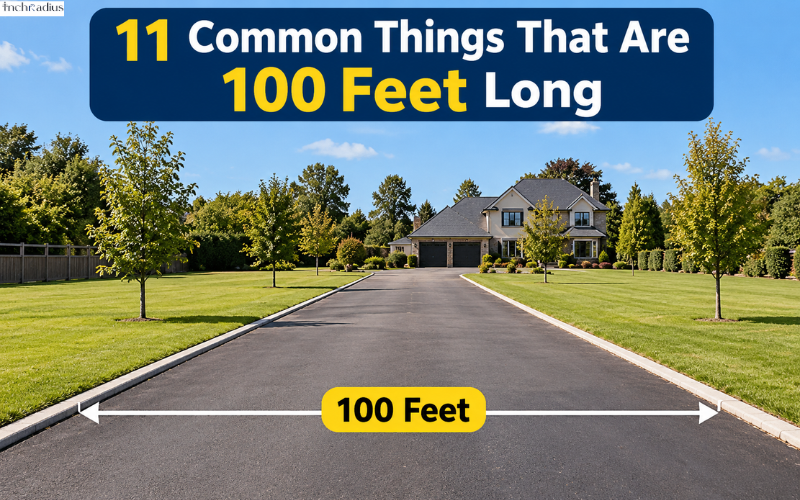
100 feet is exactly 1,200 inches, 30.48 metres, or 3,048 millimetres. It is a substantial distance, roughly the length of a 10-storey building standing upright or a large section of a commercial aircraft’s wingspan. To picture it, imagine walking along a long garden, looking across a sports field, or standing beside a tall radio tower.
These familiar settings make the measurement easier to visualise without carrying a tape measure. Although few everyday household objects measure exactly 100 feet, several structures, vehicles, and outdoor features come close. Their dimensions vary, so they work best as practical comparisons rather than exact measuring tools.
How Long Is 100 Feet?
100 feet is a length equal to 30.48 metres. It contains 1,200 inches and 3,048 millimetres, making it a useful measurement for describing large spaces, long structures, and outdoor distances. In everyday situations, it is much longer than a typical room or garden shed, but shorter than many large ships and commercial aircraft.
A distance of 100 feet can cover a sizeable part of a school playground or the length of a small outdoor swimming pool. It is also a practical figure when planning a garden fence, measuring a building’s frontage, or estimating the space needed for an outdoor activity.
The precise conversion never changes, but real-world comparisons do. A tower described as 100 feet tall may be slightly shorter or taller, while a 100-foot stretch of cable can be measured exactly. For accurate work, use a suitable measuring tool rather than relying on visual comparisons.
How Big Is 100 Feet?
Imagine standing at one end of a straight 100-foot path and looking towards the other. The far end would be about 30 metres away, so a person standing there would be clearly visible but would not be close enough for an ordinary conversation at a quiet volume.
An easy comparison is a large tree or a tall communication tower. A 100-foot tower rises far above most houses, while a mature tree of similar height can dominate a garden or park. The height of a structure and the length of a distance are different things, though: a tower stands vertically, whereas a path extends horizontally.
You can also picture the length as a row of ten 10-foot sections placed end to end. This mental image works well when planning a fence, laying out an event space, or estimating the length of a driveway. The key is to picture the full distance, not just the height of a tall object.
Related Post: How Long Is 80 Feet? 9 Common Things That Are 80 Feet Long
11 Common Things That Are 100 Feet Long
The following examples help put 100 feet into perspective. Some are long objects, such as hoses and cables, while others are tall structures or outdoor features measuring approximately 100 feet in one dimension. Their actual sizes depend on the design and location, so treat these as visual references rather than standard dimensions.
| Everyday Item | Actual Size |
| Radio Communication Tower | 100 feet |
| Large Mature Tree | 100 feet |
| Water Tower | 100 feet |
| Long Water Slide | 100 feet |
| Garden Fence Run | 100 feet |
| Large Grain Silo | 100 feet |
| Ferris Wheel | 100 feet |
| Long Garden Hose | 100 feet |
| Zip-Line Cable Section | 100 feet |
| Large Driveway | 100 feet |
| Small Recreational Boat | 100 feet |
1. Radio Communication Tower
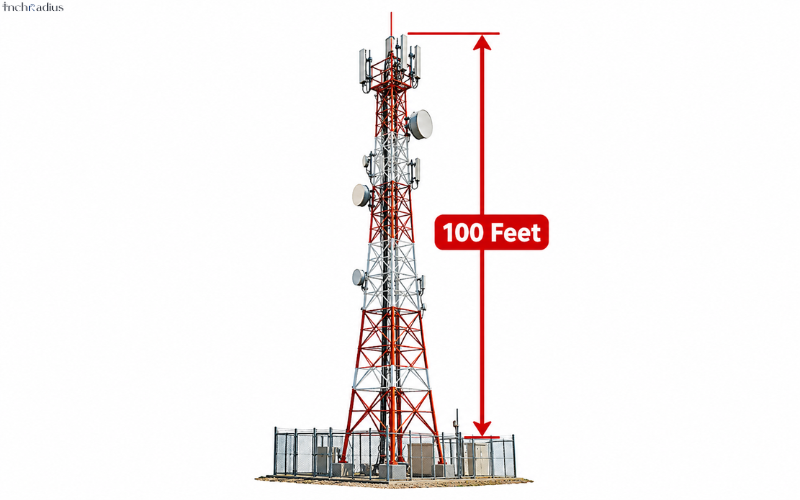
A radio communication tower standing 100 feet tall provides a clear example of this measurement. Such towers support antennas used for radio signals, mobile communications, and other wireless services. Some smaller installations reach around this height, although many communication towers are considerably taller or shorter.
Looking at a tower from the ground helps you appreciate how much space 100 feet represents vertically. The structure may appear narrow at its base, but its height can make it visible from a considerable distance across open land.
To visualise the same measurement horizontally, imagine laying a line along the ground equal to the tower’s full height. This is a useful mental comparison when estimating the length of a field or outdoor area. Remember that the tower’s height is an approximate example, not a standard size for all communication towers.
2. Large Mature Tree

Some mature trees can grow to around 100 feet tall, depending on their species, age, growing conditions, and access to sunlight. Tall oaks, beeches, and certain other woodland trees can reach impressive heights, while many trees in residential gardens remain much smaller.
Standing near a tree of this size gives you a sense of the distance from the ground to its highest branches. Its crown may spread widely, too, although the width of the branches is not the same as the tree’s height.
For a horizontal comparison, picture the tree lying carefully along a straight line on the ground. The resulting length would be close to 100 feet if the tree were exactly that tall. This is only a visual exercise; real trees vary considerably, and their curved trunks and branches make them unsuitable for accurate measuring.
3. Water Tower

A water tower is another useful reference for picturing 100 feet. Some elevated water towers rise to approximately this height, including the supporting legs and the tank above them. Their purpose is to store water and help maintain pressure in a distribution system.
The elevated tank can be seen from far away, particularly in flat areas where there are few tall buildings or trees. Its height makes it easier to imagine a vertical distance of 100 feet than a line drawn along an empty road.
Water towers come in many designs, so not every example reaches this measurement. Some are much taller, while others have shorter supports. If you are estimating a horizontal distance, imagine the tower’s full height laid out along the ground. This gives you a rough sense of scale without confusing the tower’s height with its width.
4. Long Water Slide
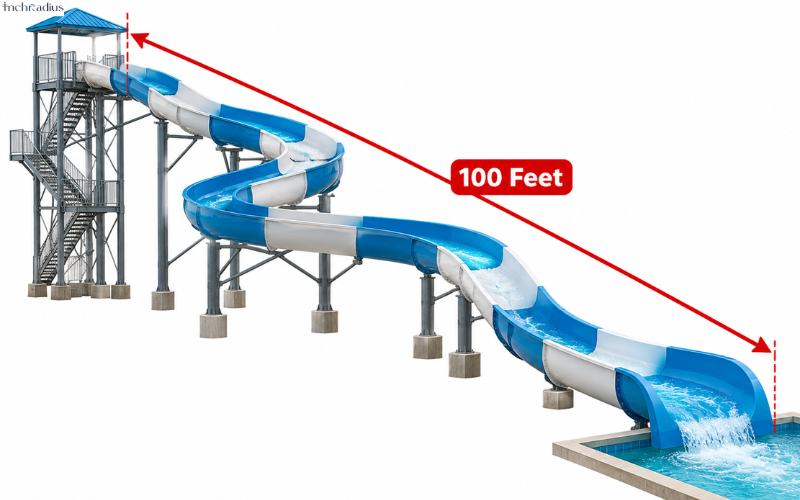
A long water slide at a water park can have a riding path of approximately 100 feet or more. Its actual length depends on the number of bends, the slope, and whether the measurement follows the curved surface or the straight-line distance between its ends.
This distinction matters because a slide that looks relatively short from the ground can have a much longer riding path when it curves around a support structure. A 100-foot slide gives riders a substantial stretch to travel before reaching the splash pool.
To visualise the distance, imagine a straight 100-foot line running alongside the slide. The slide may cover a smaller area on the ground because its path bends and rises. This comparison is useful for understanding length, but the slide’s full riding distance should be checked against the manufacturer’s specifications.
5. Garden Fence Run
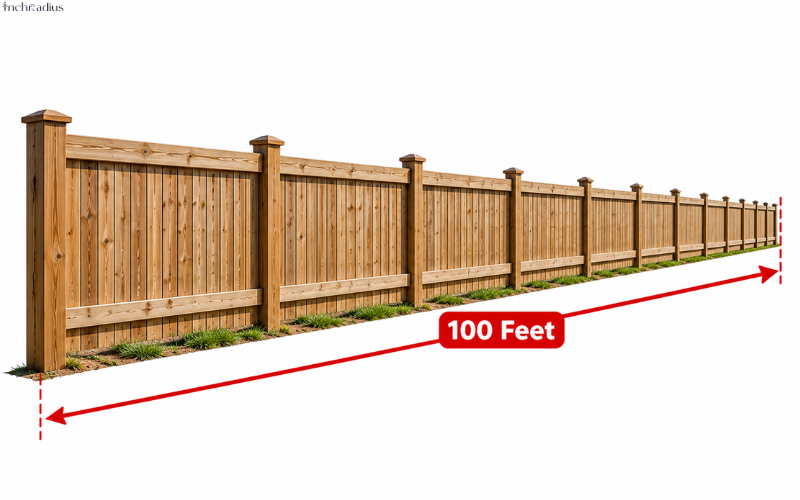
A 100-foot garden fence run is a practical example because fences are often measured in feet when planning a property boundary. A straight section extending for 100 feet covers 30.48 metres, which can be a substantial distance along the side or back of a garden.
You might use this measurement when estimating how many fence panels, posts, or lengths of timber are needed for a project. The final quantity depends on panel width, post spacing, gates, and the shape of the boundary.
For example, ten fence sections that each cover 10 feet would span 100 feet in total, provided their dimensions and joins allow that exact coverage. A real garden boundary may bend or change direction, so measure each straight section separately. This example is especially helpful because the distance can be laid out directly on the ground rather than estimated from an object’s height.
6. Large Grain Silo

Large grain silos are used on farms and at agricultural storage sites to hold crops such as wheat, maize, and barley. Some industrial silos approach 100 feet in height, although the size varies with their capacity, construction, and intended use.
A silo of this scale looks imposing because its cylindrical body rises well above farm buildings and machinery. Its height is a useful reference for understanding a measurement of 100 feet, especially when viewed from a distance.
The cylinder’s height should not be confused with its circumference, which is the distance around the silo. These are different measurements. To picture 100 feet as a horizontal length, imagine measuring a straight line from one end of the silo’s height to the other if it were laid down. Actual grain silos are fixed structures, so this is a comparison rather than a practical measuring method.
7. Ferris Wheel

A Ferris wheel with a diameter of approximately 100 feet is a useful way to picture a large measurement. The diameter is the straight-line distance across the wheel through its centre, from one outer edge to the opposite edge.
At an amusement park, a wheel of this size rises above nearby stalls and smaller rides. Its circular shape also helps explain why measurements need to be described carefully: the diameter is not the same as the distance travelled by a passenger around the full wheel.
A wheel with a diameter of exactly 100 feet would have a circumference of roughly 314 feet. That means the outer rim travels more than 100 feet during one complete rotation. Actual Ferris wheels come in many sizes, so check the stated diameter if precision matters. As a visual comparison, though, a wheel around this size gives a strong impression of the scale of 100 feet.
8. Long Garden Hose

A 100-foot garden hose is a realistic example of an object that can be purchased in a standard stated length. Long hoses are useful for watering lawns, reaching distant flower beds, or cleaning areas away from an outdoor tap. They are sold in different lengths, so check the packaging rather than assuming every hose measures 100 feet.
When fully extended in a straight line, a 100-foot hose covers 30.48 metres. If it is coiled or routed around garden beds, it occupies less straight-line distance because its path bends.
A hose is particularly useful for estimating a distance around a property. You can lay it out along the route you intend to measure, keeping in mind that the hose’s curved path measures the route travelled rather than the shortest distance between two points. Avoid stretching it tightly enough to damage the hose or its fittings.
9. Zip-Line Cable Section

A zip-line course may include a cable section measuring 100 feet or longer. Riders travel along the cable using a pulley and suitable safety equipment. Short recreational zip lines can be found in adventure parks, gardens, and activity centres, while larger courses may span hundreds or thousands of feet.
A straight 100-foot cable section gives you a useful reference for the distance between two fixed points. However, the actual cable may sag slightly under its own weight, and its length can be greater than the horizontal distance between the anchor points.
This distinction is important when comparing cable length with a measured path across the ground. A 100-foot cable does not automatically mean the landing point is 100 feet away horizontally. For a simple visual estimate, picture ten 10-foot lengths joined together. Never enter or handle a zip-line installation to measure it; use the course’s published specifications or a safe ground-based measurement instead.
10. Large Driveway
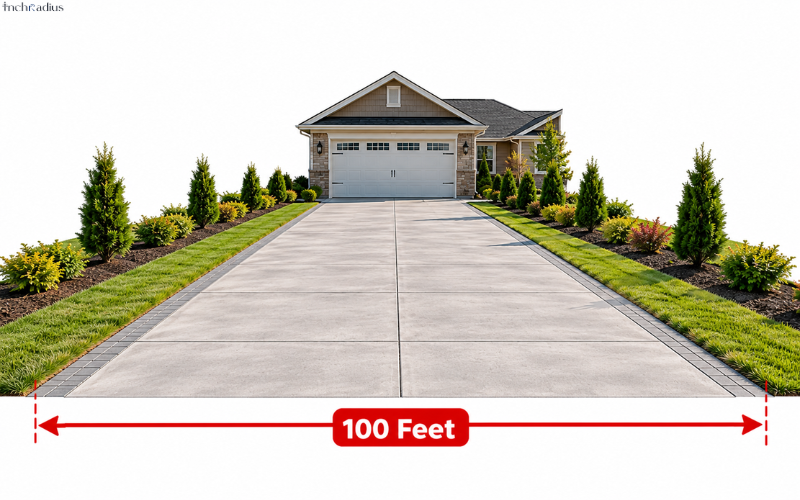
A driveway measuring 100 feet from the entrance to the garage or house is possible on larger residential properties. It is particularly common to encounter long driveways where a house sits well back from the road or where the property includes a large garden.
Unlike a tall tower, a driveway gives you a horizontal reference that closely matches the way many people use the measurement. Walking from one end to the other can help you picture the distance, although your steps will not give an exact result unless you know their length.
A 100-foot driveway may provide space for several parked vehicles, depending on their sizes and how they are arranged. The usable parking area also depends on the driveway’s width, turning space, and any slopes. Driveways vary widely, so 100 feet is an example of a possible length, not a typical measurement for every home.
11. Small Recreational Boat
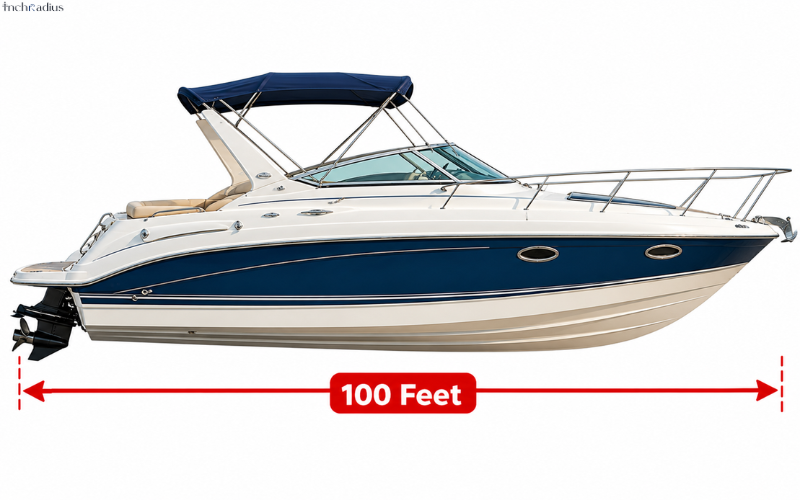
A recreational boat measuring 100 feet from bow to stern is a sizeable vessel, generally closer to a large motor yacht than a small personal boat. It can provide a helpful comparison for anyone who has seen a long vessel at a marina or in a harbour.
Boat length is usually measured along the vessel’s overall length or between defined points, depending on the specification being used. The hull’s shape, bow, stern, and any extensions can affect the reported figure.
Although a 100-foot yacht is not a small boat in everyday terms, it illustrates the measurement clearly. Imagine the vessel alongside a dock, then picture its full length laid out on a straight road. The comparison is useful because it relates the measurement to a recognisable object, but do not assume that ordinary recreational boats are anywhere near this size. Many are considerably shorter.
How to Measure 100 Feet Without a Ruler
You do not always need a long tape measure to estimate 100 feet. A few familiar methods can help you judge the distance, although they are not substitutes for accurate measurements when precision matters.
1. Count Your Walking Steps
Walking is one of the simplest ways to estimate a long distance. An adult’s ordinary walking step might cover around 2 to 2.5 feet, depending on height, pace, and walking style. At that rate, 100 feet would take roughly 40–50 steps.
For a better estimate, measure a short distance first, such as 10 feet, and count how many steps you take. Repeat this several times to calculate your average. You can then use that figure to estimate a longer distance.
This method is useful for open spaces, garden boundaries, and playgrounds. Keep your pace consistent and walk in a straight line. Uneven ground and changes in stride can affect the result.
2. Use a 100-Foot Garden Hose
If you have a hose marked as 100 feet long, it can provide a ready-made reference. Extend it along a reasonably straight path and use its full length to visualise the distance.
A hose may curve around plants or obstacles, so remember that its total length can exceed the straight-line distance between its ends. Keep the hose clear of sharp edges and avoid pulling it hard enough to damage the fittings.
This method is particularly useful when planning a garden project, estimating a fence run, or checking whether an outdoor tap is far enough away from a planting area. Check the manufacturer’s stated length before using the hose as a reference.
3. Divide the Distance into Smaller Sections
If you can estimate 10 feet reasonably well, repeat that distance ten times to create a rough 100-foot measurement. You could use marked sections of a path, measured rope, or a familiar space whose dimensions are already known.
For example, if you have a straight area measuring 20 feet, five sections of that length will total 100 feet. This approach reduces the difficulty of judging one long distance at once.
Smaller sections are easier to compare against familiar measurements, but small errors can accumulate. For building work, fencing, or other tasks that require accuracy, use a suitable tape measure, measuring wheel, or laser distance meter.
Related Post: How Long Is 90 Feet? 10 Common Things That Are 90 Feet Long
FAQs
1. How many metres are there in 100 feet?
100 feet equals exactly 30.48 metres. To convert feet to metres, multiply the number of feet by 0.3048. This conversion is useful when measuring outdoor spaces, planning construction projects, or comparing dimensions given in different measurement systems.
2. How many inches are in 100 feet?
There are exactly 1,200 inches in 100 feet because each foot contains 12 inches. Multiply 100 by 12 to get the answer. For smaller measurements, such as a few inches of material, the same conversion makes it easy to switch between feet and inches.
3. Is 100 feet longer than a standard swimming pool?
It depends on the pool. A 100-foot distance is approximately 30.48 metres, while an Olympic-size swimming pool is 50 metres long. Therefore, 100 feet is considerably shorter than an Olympic pool. Some smaller recreational pools may be shorter than 100 feet.
4. How long does it take to walk 100 feet?
Most adults can walk 100 feet in roughly 20–30 seconds at a comfortable pace. The exact time depends on walking speed, terrain, obstacles, and whether the person stops along the way. It is a useful rough estimate, but walking time should not be treated as an exact measurement.
5. How many steps does it take to walk 100 feet?
For an adult taking steps that cover around 2–2.5 feet, walking 100 feet may take approximately 40–50 steps. Individual stride lengths vary, so your result may differ. Counting steps can help estimate a distance, particularly after checking your average step length over a known distance.
6. What does a 100-foot distance look like?
Picture a straight garden boundary, a long driveway, or a cable extending across an outdoor space. A 100-foot distance is 30.48 metres, which is considerably longer than most rooms in a house. A tall structure of roughly the same height can also help you picture the scale.
7. Can a garden hose measure 100 feet?
Yes. Garden hoses are available in 100-foot lengths, although other lengths are also common. Check the label to confirm the stated size. When fully extended, the hose can help you estimate a long outdoor route, but bends in the hose mean the distance between its ends may be shorter than its total length.
8. How can I measure 100 feet accurately without a tape measure?
A measuring wheel is a practical option for long distances on reasonably flat ground. A laser distance meter may also work if the device supports the required range and the target is suitable. Walking steps or dividing the distance into smaller sections can provide rough estimates, but they are less reliable for precise work.
Conclusion
100 feet is a substantial distance, equal to 30.48 metres or 1,200 inches. A long garden hose, a driveway, or a fence run can help you picture the measurement horizontally, while a tall communication tower or mature tree provides a useful vertical comparison.
The easiest mental shortcut is to divide the distance into ten sections of 10 feet each. This makes it simpler to estimate the size of an outdoor area without trying to visualise the whole length at once. Remember that the objects discussed here vary in size, and some examples describe height rather than horizontal length. Use them to develop a sense of scale, and choose a proper measuring tool whenever an exact 100-foot distance is required.